

Two-thirds of us support banning pet cats from roaming. A ban would save millions of native animals – and billions of dollars
- Written by Jaana Dielenberg, University Fellow, Charles Darwin University
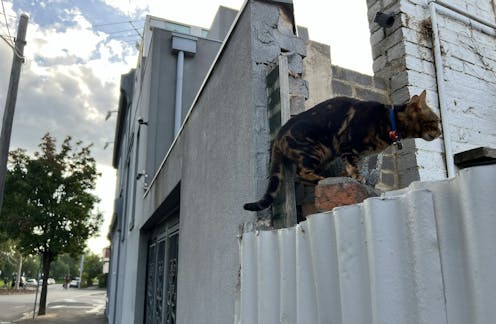
Australians have more pet cats than ever before – more than 5 million in total. With the growing number, expectations on pet owners are shifting.
Many cat owners are now voluntarily keeping their cats indoors or in secure runs, and local governments mandate it in some areas. But most pet cats in Australia still roam local streets and gardens.
Broader adoption of keeping cats safe at home would have large benefits for cat welfare, human health, local wildlife and even the economy. So, should pet owners be required to keep their pets contained to their property, as dogs are?
We put that question to thousands of people in a national survey in late 2023, and recently published the results.
We found most people support requiring owners to contain cats. Just one in 12 people (8%) are opposed. The time might be right for nationwide change in how we manage our pet cats.
Local councils are embracing cat containment
From November 1, Geelong City Council will join a fast-growing group of local governments in urban and regional areas that require pet cats to be securely contained 24 hours a day.
More than a third of local councils in Australia now require cats to be contained overnight or 24 hours a day. Most are in the ACT and Victoria.
Given how good cats are at climbing and jumping, containing cats usually requires keeping them indoors or in secure runs.
The main reasons cited by local govenments for these regulations are:
improving pet welfare: contained cats live longer and healthier lives with fewer vet bills because they are protected from traumatic injuries from car accidents, dog attacks and cat fights, infections, diseases and other misadventures.
saving wildlife: four out of five cats allowed outside will hunt and kill an average of two to three animals per week. With millions of pet cats in Australia, each year this adds up to 6,000–11,000 animals killed in our suburbs per square kilometre and 323 million native animals killed nationally. Night curfews only protect nocturnal species such as possums.
reducing nuisance to neighbours: containment results in less disturbance from cat fights and prevents the neighbour’s cat killing the birds and lizards living in your backyard or nearby park, which many community members value.
The public health toll of roaming cats
Another major benefit is less talked about. Stopping pet cats from roaming would greatly reduce rates of cat-borne diseases.
Several diseases which could not exist without cats can be passed to humans. These cost Australia more than $6 billion a year based on costs of medical care, lost income and other related expenses.
The most widespread of these diseases is toxoplasmosis, a parasitic infection that can be passed to humans but must complete its life cycle in cats. Australian studies have reported human infection rates between 22% and 66% of the community.
Cat-borne diseases cause considerable community harm, with an estimated 8,500 hospitalisations and 550 deaths from acute infections and also from increased rates of car accidents, suicides and mental health issues in infected people.
Pet cats are crucial to the rates of these diseases in the community. In suburbs that do not require containment, you’ll find up to 100 roaming pet cats per square kilometre.
Eliminating stray cats from our suburbs is also important to reduce disease rates – just one of the reasons why people should not feed stray cats.
Read more: Cats carry diseases that can be deadly to humans, and it's costing Australia $6 billion every year
Most of us support containment
A policy requiring all cats to be contained has clear benefits. But would it have support? Rules only produce benefits if people follow them.
This is why colleagues at Monash University and I surveyed more than 3,400 people on whether they would support policies that “require cat owners to keep their cat contained to their property”.
We found a clear majority (66%) of people support cat containment. A strikingly small proportion of people, about one in 12 people (8%), are opposed. The remaining 26% were ambivalent, selecting “neither support nor oppose”.
Other surveys have found almost half (42% or 2.2 million) of Australia’s pet cats are already kept contained by their owners.
Some councils can’t legally require cat containment
Our findings suggest communities would broadly support their local councils if they moved to require cats to be contained.
While councils are responsible for pet issues, state and territory laws greatly influence what councils can and can’t do.
In New South Wales and Western Australia, state laws actually prevent local councils from requiring cat containment (except for in specific circumstances, such as in declared food preparation areas in NSW).
Rules are just the start
To boost compliance, councils need to invest in communicating new rules and the reasons for them. After a grace period, council officers will also need to monitor and enforce the rules.
Communities may need support too, especially if there are costs involved. Councils could, for example, offer rebates for flyscreens to stop cats slipping out of open windows.
Working with other colleagues in 2020, we surveyed Australia’s local governments about their approaches to cat management. Most reported tiny budgets for cat management.
Local governments should not be left to shoulder the cost alone. Federal, state and territory governments are also responsible for Australia’s wildlife (and human health). These governments have a range of projects covering both feral and pet cats.
The Australian government collects A$3 billion a year in GST from spending on pets. Diverting a small proportion into responsible pet ownership programs would make an enormous difference.

Containment has wide backing
Our research shows the community is ready for widespread reform of how we manage all these cats.
Requiring pet cats to be contained is a sound policy choice. But to realise the full benefits, we also need to invest in effective communication for communities, provide rebates to help contain cats, and make sure the rules are followed.
Kim Borg, Melissa Hatty and Emily Gregg contributed to the national survey, and Sarah Legge, John Woinarski and Tida Nou contributed to research on cat impacts and management.
Authors: Jaana Dielenberg, University Fellow, Charles Darwin University

















