

Australia is set to ban live sheep exports. What will this mean for the industry?
- Written by Alan Renwick, Professor of Agricultural Economics, Lincoln University, New Zealand
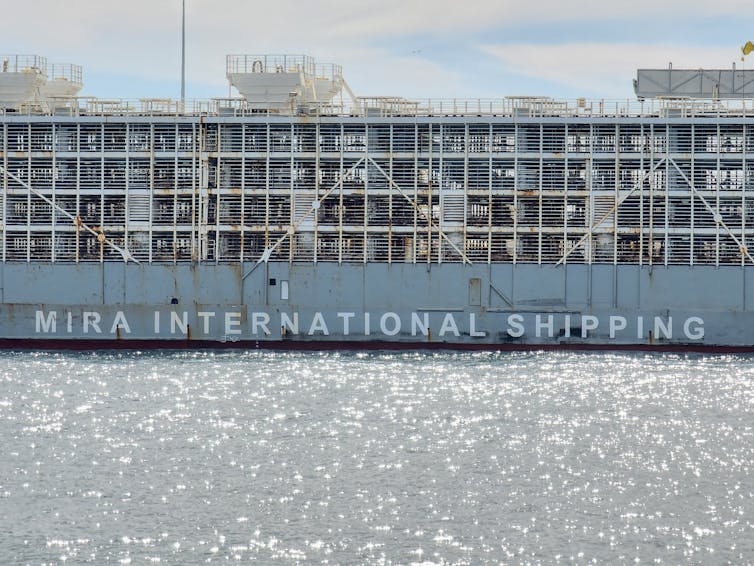
This month the federal government announced a plan to ban live sheep exports, set to come into effect from May 1 2028.
The announcement coincided with the release of a highly anticipated report by an independent panel set up to examine the issue.
Animal welfare advocates immediately hailed the news, having long campaigned for a ban.
But farming organisations have expressed deep concerns about its potential impact on the sector. They’ve also argued the four-year transition window won’t be nearly enough time to adjust.
Despite being something of an early mover, Australia is not the first country to implement a live export ban.
Neighbouring New Zealand imposed a total ban on live animal exports, which came into full effect in April last year.
In December, the United Kingdom also put forward legislation to ban live exports for slaughter and fattening. The issue continues to gain momentum across the European Union.
So are such bans really a death knell for the sheep industry, as is sometimes argued, or just an inevitable part of a necessary transition?
A deepening urban–rural divide
One of the earliest impacts of this proposal has been to ramp up tensions in Australia between state and federal governments, as well as between urban and rural communities.
Western Australia singlehandedly accounts for 99% of Australia’s live sheep exports. Groups opposed to the ban have framed it as just another example of Australia’s “inner city” east coast dictating terms to rural Western Australians.
But this “west versus the rest” narrative could itself be misleading.
Polling commissioned by the RSPCA found more than 70% of Western Australians were in favour of a ban, perhaps reflecting a more general urban-rural divide on the issue.
Will it really crush the sheep industry?
The size of the ban’s impact will obviously hinge on the importance of live exports to the sheep sector more generally, and the industry’s scope for adjustment. Adaptation could mean shifting this supply to the domestic processing market or expanding other enterprises.
Proponents of the ban argue that live exports are only a small component of the sheep industry. According to government figures, Australia’s lamb and mutton export industry was worth A$4.5 billion in 2023.
But live sheep exports by sea made up less than 2% of this trade, at around $77 million. To further emphasise this point, advocates of a ban have pointed out this trade equates to only 0.1% of Australia’s total agricultural exports.
In contrast, opponents of the ban would say these aggregate Australian figures significantly downplay live export’s economic importance to WA.
Despite a marked decline over the past decade, the sector still accounts for an estimated 5.4% of the state’s total sheep industry exports.
The live export market offers producers other benefits too. The ability to sell sheep to an alternative market can enhance the bargaining power of farmers when dealing with domestic processors.
In Ireland, where processing capacity is highly concentrated, the agriculture sector has fought vigorously to keep the live export trade.
Exporting live sheep is also an avenue for farmers in dry periods when feed is short.
How much should the industry be compensated?
The potential economic impact of the ban has been highly contested, but most estimates acknowledge there will be a financial loss.
The independent panel gave particular weight to the estimates generated for the WA government. These put the cost at around $123 million a year if no substitution of other enterprises took place, or $22 million a year if farmers turned to crop production.
When spread out on a per-farm basis, the losses estimated by some studies may appear relatively small.
But current financial and climatic challenges in the region are intense, and even small reductions in revenue could push some businesses and their owners past a tipping point.
The government has proposed a $107 million package to aid the transition, which includes $64.6 million to help sheep producers capitalise on existing and emerging opportunities, and $27 million to boost marketing of sheep products domestically and internationally.
The support is not just targeted at farmers. The government acknowledges that businesses right across the supply chain – hauliers, stock traders, feed producers – will all be impacted by the ban.
How effective this support will be depends on how it is implemented, the extent of its uptake, and how effectively it can soften the transition.
The planned marketing support will have a much more indirect impact, with considerable uncertainty as to how much the forecast losses can actually be offset by boosting demand.
Given the uncertainty around the actual costs that will be incurred, it is hard to assess the adequacy of the payments. Federal Agriculture Minister Murray Watt sees them as generous, pointing out that $107 million is five times the lower band estimate of annual losses.
The WA government, in contrast, has argued that the transition payments are wholly inadequate.
But in New Zealand, there were no transition payments associated with the export ban, and none appear to have been proposed in the UK either.
The situation in Australia reflects the historic importance of the live export sector to the sheep supply chain.
What’s next?
As part of the sheep industry’s social licence to operate, it would seem wise for businesses to plan for a future without live exports. Simultaneously, policymakers should work to increase the resilience of the sector against the significant financial and climatic challenges that it faces.
But politics is a fickle beast. In New Zealand, the recently elected coalition have now flagged plans to reverse the country’s ban, under sustained pressure from industry.
Australia’s National Party has already indicated that they too will push for a reversal.
While it is clear that a majority of the population are against live exports, that majority can be slimmer than one might think. A recent poll in New Zealand put support for the ban at just 51%.
Ultimately, this sort of political uncertainty is only likely to reduce the incentives for businesses to adjust.
Authors: Alan Renwick, Professor of Agricultural Economics, Lincoln University, New Zealand

















