

At last, Australia has fuel efficiency standards
- Written by Robin Smit, Adjunct Professor, School of Civil and Environmental Engineering, University of Technology Sydney
After decades of debate and no action, Australia’s New Vehicle Efficiency Standard has finally passed federal parliament. It will apply to new cars sold from July next year.
Setting a standard promises to cut transport emissions and send us further down the road to net zero by 2050.
But the long delay means we’re starting from the back of the pack. Australian passenger vehicles currently emit at least 50% more CO₂ than the global average. Emissions have been getting worse, not better.
Our new peer-reviewed and independent expert study, carried out by the Transport Energy/Emission Research consultancy, examines the inner workings of the new standard. We fed publicly available data into our model to find out whether the new standard will work as intended.
We found the new standard could significantly reduce lifetime emissions from light vehicles (cars, SUVs, utes and vans) sold in Australia from July 1 2025. But it was weakened by the changes made following a second round of consultation with industry. Unfortunately, the standard’s performance could be further undermined by the risks ahead.
Introducing the New Vehicle Efficiency Standard.How does the New Vehicle Efficiency Standard work?
The New Vehicle Efficiency Standard sets increasingly stringent targets for CO₂ exhaust emissions for new light vehicles sold between July 2025 and December 2029. Specific rules and design parameters together determine the scope and stringency of the standard.
Importantly, the standard does nothing to regulate emissions from vehicles already on the road and those purchased before July 1 2025. These vehicles will be on the road for many years to come.
But the standard’s ability to actually reduce emissions depends on its design. The devil is in the detail. Let’s take a closer look.
Exploring design options
The federal government experimented with different designs and consulted industry and the wider community before reporting back on design options.
In February the government defined three options: Option A (slow start); Option B (fast start and flexible); and Option C (fast start). Middle-of-the-road Option B was preferred, balancing “ambition and achievability”.
After further consultation, an updated report followed in March with changes to Option B. Specific large SUVs were moved across to the more lenient light commercial vehicle standard, which also became less stringent. Draft legislation was tabled the following day.
What we did
Although the government reports provide some useful information, there is insufficient detail to fully understand how the likely emission reductions were assessed.
So in our new research, we developed a tool to calculate changes in on-road exhaust CO₂ emissions for all five future vehicle model years (2025 to 2029) over their lifetime, using data for model year 2022.
We compared these results with a baseline scenario, which reflects the expected uptake of battery electric vehicles in the absence of the new standard.
In the European Union, emissions and sales data are publicly and freely available in the interests of transparency and accountability. This is not the case in Australia, where the Federal Chamber of Automotive Industries controls access to the data.
To get around this, we extracted information from the latest National Transport Commission report, as well as data from other online sources.
We combined vehicle sales and officially reported emissions performance data for Australian light vehicles (cars, SUVs, utes and vans) by make and model, with other required information, such as estimates of vehicle weight.
Finally, we considered the range of measures manufacturers may take to reduce emissions from their new vehicles, such as switching to electric or hybrid models or downsizing their combustion engines, to meet their emissions targets.
What we found
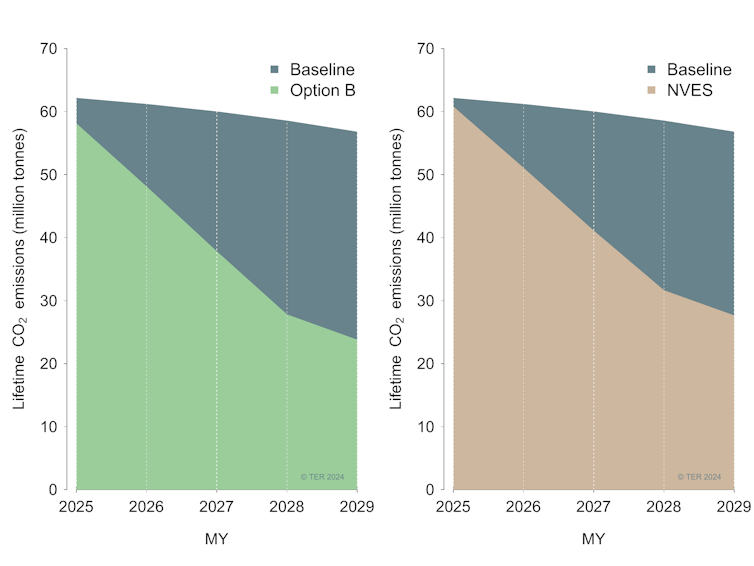
Our research estimates the New Vehicle Efficiency Standard will significantly reduce on-road lifetime CO₂ emissions for new vehicles purchased between 2025 and 2029.
We calculated the new standard would save 87 million tonnes of real-world CO₂ emissions. In comparison, the original “Option B” version of the standard would have saved 103 million tonnes.

Compared with having no fuel efficiency standards at all, we found the new standard would reduce emissions by just 2% for model year 2025 vehicles. But it ramps up to 51% for vehicles sold in 2029.
The final design of the standard is weaker than the originally proposed Option B, which would have cut emissions by about 6% for model year 2025, increasing to 58% for model year 2029.
The new standard also allows manufacturers to create and trade emission credits. This means that if a certain manufacturer is overachieving and reducing emissions faster than they need to, they can carry over credits to another model year for a certain period, or sell them to an underachieving manufacturer.
Beware of future risks
Some features of the New Vehicle Efficiency Standard could undermine its effectiveness.
To actually reduce emissions, the standard must capture on-road fuel consumption and emissions as closely as possible. Unfortunately, the new standard is still based on an outdated test developed in the 1970s that significantly underestimates fuel consumption and emissions. The government intends to update the test protocol and align with international best practice, but suggests waiting until at least mid-2028.
There’s also a risk the new standard design will further encourage the trend towards large heavy passenger vehicles, making it even harder to reduce emissions from road transport. Manufacturers’ emission performance targets (in grams of CO₂ per kilometer) are strongly determined by the average weight of their fleet, particularly in the Australian standard. This means a fleet packed with heavy SUVs will have a higher emissions allowance, thereby making the requirements potentially less stringent for manufacturers that choose to focus on large models.
Are we there yet?
Australia’s New Vehicle Efficiency Standard is a step in the right direction. But if we’re serious about hitting the net zero target for road transport, the new standard must be supported by a range of other policies. These include public awareness campaigns promoting a shift away from polluting modes of transport towards light and low emission vehicles.
The effectiveness of the new standard in actually reducing on-road emissions for new vehicles remains to be seen.
Some improvements are necessary to make the standard more robust, better guarantee its effectiveness and prevent the internationally well-known pitfalls and loopholes in vehicle emission standards. They include adoption of an up-to-date test protocol and including on-board fuel consumption monitoring, as is done overseas.
We’ve narrowly avoided being the last developed country without mandatory emission standards. Russia can now claim that title. But our research shows the new standard is quite a distance from the world’s best. No, unfortunately, we’re not there yet.
Authors: Robin Smit, Adjunct Professor, School of Civil and Environmental Engineering, University of Technology Sydney

















