

How to end the wasteful boom-bust cycle driving NZ’s infrastructure gap: new report
- Written by Timothy Welch, Senior Lecturer in Urban Planning, University of Auckland, Waipapa Taumata Rau
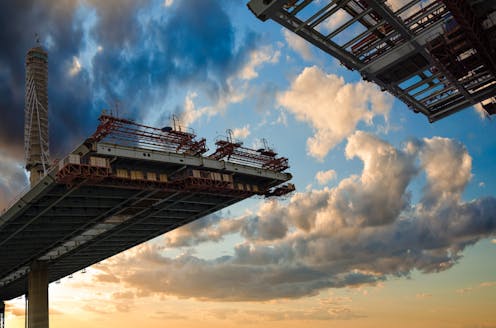
Debates about infrastructure often turn around money – with good reason. It’s estimated New Zealand’s infrastructure deficit – the amount we would need to spend to modernise, upgrade and build what we need today – is more than NZ$100 billion.
And this will double by 2030 if we don’t significantly increase spending now to avoid the even higher cost of falling further behind and having to catch up.
These are big numbers, but they are just numbers. The real problem is political. No matter which major party is in office, no recent government has seriously addressed the country’s long-term infrastructure needs.
Priorities should include modernising water systems to prevent leaks and contamination, expanding and improving road and rail networks to reduce congestion and support economic growth, and ensuring infrastructure can withstand the impacts of climate change and natural disasters.
Next week’s budget seems likely to continue the trend. Spending and tax cuts, and reducing debt, have already been well signalled. Building a few more big roads and installing tunnels and pipes is no substitute for what is truly required.
A report made available to media today from the Helen Clark Foundation and environmental consulting firm WSP – Bridging the Infrastructure Gap: Funding and Financing Aotearoa New Zealand – argues there is a better way. Central to this will be greater political consensus and longer-term planning.
Wasteful and unproductive
While there are several ways to fund infrastructure, the report argues a significant portion will need debt financing. And it reminds us New Zealand is still a reasonably low-debt nation.
As of 2022, Crown debt sat at around 57% of GDP, compared to an OECD average of 89%. Given the strong Crown balance sheet, there is capacity for further government borrowing for infrastructure projects.
As the report argues, however, money isn’t the real problem – political willpower is. Above all, there is a lack of multiparty support for prioritising a resilient future.
This became starkly evident with the recent change of government. Since the National-led coalition took office, we’ve seen infrastructure project cancellations and a significant shift in funding priorities.
As the Clark Foundation report highlights, the incoming government cancelled the iReX interisland ferry terminal project after $424 million had already been spent. Similarly, the previous Labour-led governments cancelled eight major road projects. Some of these have now been reinstated at a significantly higher cost.
This boom-bust cycle is wasteful and unproductive. The report emphasises the need for a stable, long-term vision supported by consistent investment levels across successive government terms.
Historically, this cycle has also led to many infrastructure assets reaching the end of their lives all at once. The need for substantial repairs or replacement leads in turn to urgent spending that could be avoided with better planning.
Big savings available
The lack of a long-term vision carries other costs, too. The decisions made today will affect multiple future generations. It is irresponsible to make critical, long-term, high-impact decisions about vital infrastructure on a three-year political cycle.
The Clark Foundation report recommends developing a 30-year national infrastructure plan. Not only would this provide greater certainty, it would unlock productivity benefits that could save between 13% and 26.5% on project costs.
But spending more and building more isn’t the only way to sustain infrastructure. We also need to use – and charge for – existing infrastructure more efficiently. There are examples of this already, such as a planned time-of-use charge for some Auckland roads, but far more can be done.
Other possibilities include new highway tolls and more targeted water-use charges. For instance, “volumetric charging” – metering – for water has had significant success on the Kāpiti Coast where it led to a 90% reduction in water lost to leakage, and a 26% decrease in private water use.
Transcending the political cycle
There are also more innovative and equitable ways to fund infrastructure that have long been used globally, including what is known as “value capture”. This is where an increase in rates revenue resulting from an infrastructure investment is used to fund or offset some of the cost of the infrastructure itself.
For example, in the United States, value-capture mechanisms were integral to funding the development of the Atlanta BeltLine, a 35-kilometre walking and cycling path, and eventual light rail route. Capturing the increase in property values along the corridor provided 40% of the project’s US$4.8 billion cost.
Hong Kong’s Mass Transit Railway (MTR) Corporation has successfully used value capture through land premiums and property development to fund its extensive rail network.
And in London, the Crossrail project (also known as the Elizabeth Line) partially funded its construction through a business rate supplement and a community infrastructure levy targeting properties that would benefit from the new rail line.
In New Zealand, targeted rates – a form of value capture – have been successfully used to fund projects such as the $400 Moa Point Sludge Minimisation Facility in Wellington. Financed through a levy on all city properties (excluding protected Māori land), the cost is spread over the life of the new facility.
It is not that feasible funding solutions for significant infrastructure investments don’t exist. Rather, as the Helen Clark Foundation and WSP report makes clear, it is the lack of a long-term plan transcending the political cycle that is holding the country back.
Bridging the Infrastructure Gap: Funding and Financing Aotearoa New Zealand will be publicly available on June 26.
Authors: Timothy Welch, Senior Lecturer in Urban Planning, University of Auckland, Waipapa Taumata Rau

















