

Why knock down all public housing towers when retrofit can sometimes be better?
- Written by Trivess Moore, Associate Professor, School of Property, Construction and Project Management, RMIT University
The Victorian government is planning Australia’s largest urban renewal project. The plan is to knock down and rebuild 44 large public housing towers in Melbourne. The government says these towers, built in the 1960s and ’70s, are no longer fit for purpose and will cost more to maintain and upgrade than to replace.
Rebuilding will allow 20,000 more people to live on these sites. However, most of the extra housing will be for private renters or owners. It will not add much more public or affordable housing.
Rebuilding involves breaking up public housing communities. Many tenants have already been forcibly displaced. Removing stock from the system to make way for future housing reduces the capacity to house people in need amid a housing crisis.
Tearing down so much concrete and other materials and rebuilding in a carbon-constrained world also raises concerns about the public value for money and the loss of embodied carbon in these old buildings. The materials and energy needed to erect a new building create a lot of greenhouse gas emissions. Construction produces almost a fifth of Australia’s emissions.
Some industry experts say the housing towers are structurally sound. They and other sustainability researchers argue that retrofits can bring the buildings up to modern standards.
This approach would improve thermal comfort, cut energy bills and produce fewer emissions. Some retrofitted buildings could have half the embodied energy of newly built ones. And communities could largely remain in place while the work is done.
Public housing complexes across Australia face similar renewal proposals. In each case, there are valid questions about the balance of public and private benefit.
So, how should decisions on public housing account for environmental, social and economic costs and benefits for all the people and interests involved? We draw on our recent research on life-cycle impacts and public housing tenant relocations to answer this question. Our research shows decisions on each tower that are underpinned by a proper process – one that considers all the evidence – could go either way: demolish and rebuild, or retrofit.
What are the options for ageing buildings?
Broadly, there are three options for older high-rise housing:
- maintain
- retrofit
- knock down and rebuild.
The first option is increasingly unviable. This is because of the urgent need to decarbonise our building stock and the impacts of decades of under-maintenance on such buildings.
In 2017, the Auditor-General’s Office found the Victorian government lacked the capacity to “reliably assess the condition of its stock, and consequently whether it is deteriorating at a rate faster than it is ageing”. Maintaining the current stock, while not knowing its condition, would require a massive policy shift and repair effort.
That leaves us with retrofits or demolition and rebuilding. The government has chosen the third option for all 44 towers.
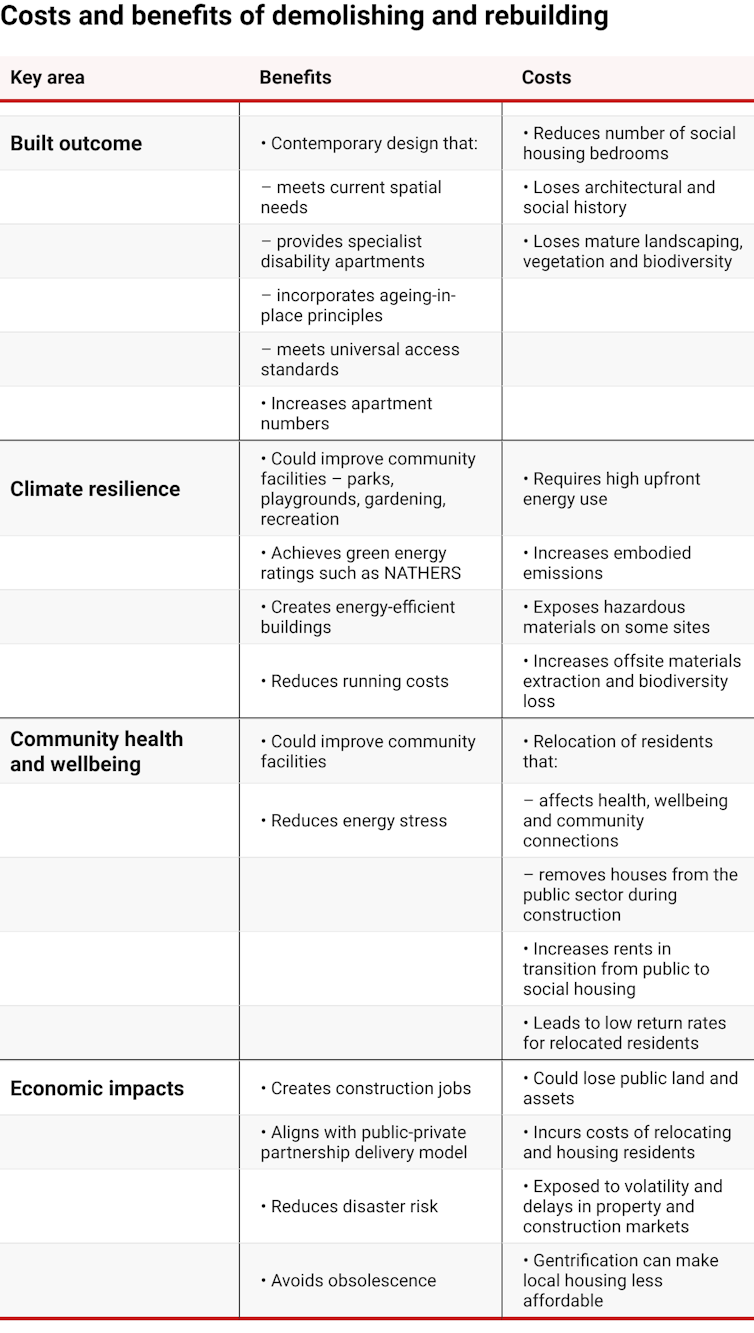
The table below sums up the broader costs and benefits of demolition and rebuilding.

 Table: The Conversation. Data: Authors, CC BY
Current decision-making is skewed
Proposals for public high-rise buildings often focus on direct, short-term economic costs and benefits. Typically, the equation centres on the costs of retaining buildings versus the windfalls from redevelopment, such as unlocking the latent value of land.
Proposed changes to the site, such as providing more dwellings and shifting management of public housing to non-government landlords, often alter this equation. Amid a housing crisis, housing supply is understandably high on the policy agenda. Decision-makers often neglect the environmental and social impacts.
Research has found retrofitting reduces embodied carbon, waste and other environmental impacts by up to 50% compared to rebuilding.
On top of this are the social impacts of redevelopment that demolishes people’s homes and breaks up communities. This leads to poorer health, economic and social outcomes for public housing tenants.
In considering all these impacts, the lack of publicly available information on the government’s decision-making is a glaring problem. This comes back to process.
In particular, there’s a need for transparency about the metrics and evidence used to make decisions, and for accountability for those decisions. At a minimum, independently verified studies of the environmental, social, health and economic costs and benefits over the buildings’ life cycle should be made public before decisions are made.
Retrofitting is a viable option
There are a number of examples where older high-rise housing has been retained and improved.
For example, in the Cité du Grand Parc in France, 530 apartments in three blocks needed renovation once demolition was ruled out. In this case, sustainability considerations held sway.
As well as improving the interior, winter gardens and balconies were added. This work extended living spaces and provided more natural light.
The award-winning project was planned so residents didn’t have to move out. Each flat was completed in around 12 to 16 days.
Closer to home, not-for-profit design agency OFFICE found the Victorian government could save more than A$88 million by refurbishing and including infill development rather than rebuilding the Barak Beacon public housing estate in Port Melbourne. Some 238 social housing dwellings could be added around the existing buildings.
The OFFICE report estimated not having to relocate the community would save $16 million. This approach could also reduce embodied energy by 54% and impacts of land use to produce building materials by 273%.
The Victorian government’s plans intensify the twin challenges of overcoming housing shortages and decarbonising buildings. As Australia’s high-rise housing stock ages, we need a co-ordinated, accountable and fair process for deciding the future of these buildings. This means balancing environmental, social, health and economic costs and benefits across all affected people and interests, based on the best information available.
Authors: Trivess Moore, Associate Professor, School of Property, Construction and Project Management, RMIT University
Table: The Conversation. Data: Authors, CC BY
Current decision-making is skewed
Proposals for public high-rise buildings often focus on direct, short-term economic costs and benefits. Typically, the equation centres on the costs of retaining buildings versus the windfalls from redevelopment, such as unlocking the latent value of land.
Proposed changes to the site, such as providing more dwellings and shifting management of public housing to non-government landlords, often alter this equation. Amid a housing crisis, housing supply is understandably high on the policy agenda. Decision-makers often neglect the environmental and social impacts.
Research has found retrofitting reduces embodied carbon, waste and other environmental impacts by up to 50% compared to rebuilding.
On top of this are the social impacts of redevelopment that demolishes people’s homes and breaks up communities. This leads to poorer health, economic and social outcomes for public housing tenants.
In considering all these impacts, the lack of publicly available information on the government’s decision-making is a glaring problem. This comes back to process.
In particular, there’s a need for transparency about the metrics and evidence used to make decisions, and for accountability for those decisions. At a minimum, independently verified studies of the environmental, social, health and economic costs and benefits over the buildings’ life cycle should be made public before decisions are made.
Retrofitting is a viable option
There are a number of examples where older high-rise housing has been retained and improved.
For example, in the Cité du Grand Parc in France, 530 apartments in three blocks needed renovation once demolition was ruled out. In this case, sustainability considerations held sway.
As well as improving the interior, winter gardens and balconies were added. This work extended living spaces and provided more natural light.
The award-winning project was planned so residents didn’t have to move out. Each flat was completed in around 12 to 16 days.
Closer to home, not-for-profit design agency OFFICE found the Victorian government could save more than A$88 million by refurbishing and including infill development rather than rebuilding the Barak Beacon public housing estate in Port Melbourne. Some 238 social housing dwellings could be added around the existing buildings.
The OFFICE report estimated not having to relocate the community would save $16 million. This approach could also reduce embodied energy by 54% and impacts of land use to produce building materials by 273%.
The Victorian government’s plans intensify the twin challenges of overcoming housing shortages and decarbonising buildings. As Australia’s high-rise housing stock ages, we need a co-ordinated, accountable and fair process for deciding the future of these buildings. This means balancing environmental, social, health and economic costs and benefits across all affected people and interests, based on the best information available.
Authors: Trivess Moore, Associate Professor, School of Property, Construction and Project Management, RMIT University 
















