

Modern Australian
The Times

Top economists give budget modest rating and doubt inflation will fall as planned

  • Written by Peter Martin, Visiting Fellow, Crawford School of Public Policy, Australian National University
Top economists give budget modest rating and doubt inflation will fall as planned

Asked to grade Treasurer Jim Chalmers’ third budget on his own criteria of delivering on “inflation in the near term and then growth in the medium term”, most of the 49 leading economists surveyed by the Economic Society of Australia and The Conversation have failed to give it top marks.

On a grading scale of A to F, 17 of the 49 economists – about one-third – give the budget an A or a B. Two have declined to offer a grade.

The result is a sharp comedown from Chalmers’ second budget in 2023. Two-thirds of the economists surveyed conferred an A or a B on that budget.

The economists chosen to take part in the post-budget Economic Society surveys are recognised by their peers as leaders in fields including macroeconomics, economic modelling, housing and budget policy.

Among them are a former head of the Department of Finance, a former Reserve Bank board member and former Treasury, International Monetary Fund and Organisation for Economic Co-operation and Development officials.

Thirteen of those surveyed – more than a quarter – give the budget a low mark of D or an E. None have given it the lowest possible mark of F.

Asked whether the budget was likely to achieve its aim of getting inflation back within the Reserve Bank’s 2-3% target band by the end of this year, and back to 2.75% by mid next year, 17 thought it would not. Only ten thought it would. A greater number – 21 – were not sure.
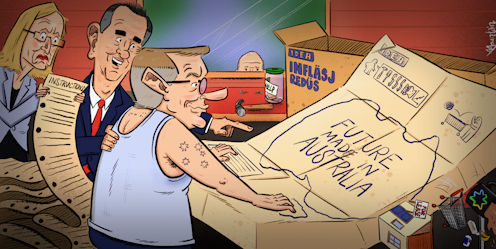
In his budget speech, Chalmers predicted inflation would come back to the Reserve Bank’s target band sooner than the 2025 expected by the Reserve Bank itself, “perhaps even by the end of this year”. The budget papers forecast an inflation rate of 2.75% by mid-2025, well within the target band and a half a percentage point lower than the bank’s forecast. The papers say two measures in the budget, not known to the Reserve Bank when it produced its forecasts in early May, explain why the budget forecast is half a percentage point lower. They are an extra year of energy bill relief of $300 per household and $325 for eligible small businesses and a further 10% increase in the maximum rate of Commonwealth Rent Assistance. If the lower budget forecast is correct, and if the Reserve Bank sticks to the letter of its agreement with the treasurer that requires it to aim for consumer price inflation between 2% and 3%, the bank is likely to cut interest rates late this year or early next year as inflation approaches its target zone. But economists including Flavio Menezes from The University of Queensland say while the budget measures might “mechanically” suppress measured inflation, they are: unlikely to alleviate underlying inflationary pressures and may even exacerbate them; for households not experiencing financial strain, lower energy bills could simply lead to increased spending in other areas. Former Reserve Bank board member Warwick Mckibbin says the bank is likely to “see through” (ignore) the largely temporary mechanical price reductions and “raise interest rates to where they should be”. Others surveyed, a minority, argue the economy is too weak for the extra spending in the budget to boost inflation through consumer spending. Former Finance Department Secretary Michael Keating says any stimulus is “likely to be swamped by the economic slowing well under way”. Independent economist Saul Eslake said the subsidies for energy and rent would inject only $3 billion into the economy in 2024-25. This meant any boost they would give to underlying inflation would be hardly “material”. Tax cuts matter more than energy rebates More important for boosting the economy would be previously budgeted Stage 3 tax cuts. These are set to inject $23.3 billion per year from June, climbing to $107.2 billion over four years. Eslake said the decision to reskew the tax cuts toward middle and lower earners had saved the government from the need to direct extra specific support to these people. Politically, the government could not have got away with doing nothing. But Eslake was appalled to discover that the cost of the single biggest spending item in the budget, the untied grants to the states, had blown out even more than expected. The special top-up for Western Australia is now set to cost $53 billion over 11 years instead of the $8.9 billion over eight years expected in 2018. How the national government could justify gifting $53 billion to the government of Australia’s richest state was beyond his comprehension. Big issues unaddressed A repeated theme among the economists was that the budget did very little to boost productivity or address persistent problems. Several described it as an election budget, others a budget driven by polling. Macquarie University’s Lisa Magnani said the lack of attention to home prices, the funding of public schools and the poor performance of Australian firms was concerning, given Chalmers’ claim it was a budget for “decades to come”. Former Department of Foreign Affairs chief economist Jenny Gordon said the budget had failed to tackle the distortions in the housing market and the financial sustainability of needed services including health care, aged care and childcare. Frank Jotzo: crunch time for tax. AAP Australian National University economist Frank Jotzo said crunch time for tax reform was coming, given the large baked-in increases in spending on defence, health and disability insurance and Australia’s over-reliance on income tax and company tax. McKibbin said Australia’s main economic problems were its lack of productivity growth, the big changes needed to bring about the energy transition, the surge in artificial intelligence, the risk of much lower export prices and global geopolitical uncertainty. The government should have tried to build a bipartisan consensus about how to fix these. Private investors were hanging back knowing that whatever the government did could be reversed at the next election. Although many of those surveyed welcomed the Future Made in Australia Act, some criticised its approach of “picking winners” and “wasting precious resources” by putting money into activities such as the manufacture of solar panels, which could be done more cheaply elsewhere. Bigger government Former Industry Department chief economist Mark Cully said it was in some ways one of the most consequential budgets in years. It locked in a clear shift towards higher spending and revenue, which, at around 26% of GDP, was higher than any other time Australia had been near full employment. Future Made in Australia was the most marked intervention by a government in shaping the future direction of the economy for decades. Individual responses. Click to open: Authors: Peter Martin, Visiting Fellow, Crawford School of Public Policy, Australian National University

Read more https://theconversation.com/top-economists-give-budget-modest-rating-and-doubt-inflation-will-fall-as-planned-230670

What’s Trending in Men’s Jewellery This Father’s Day!

Finding a Father’s Day gift that feels personal, stylish and genuinely wearable is not always easy. While socks and novelty mugs have traditionall...

Road Signs: Understanding Their Role in Clear and Effective Signage

Effective signage and display hardware can help businesses communicate information, promote products and organise customer or visitor movement. Road...

Bottle Label Printing: Key Factors to Consider Before Your Next Packaging Run

Effective packaging begins with understanding the product, bottle material, artwork and production requirements when planning bottle label printing. H...

Planning a Long-Distance Move With Interstate Movers Melbourne

Moving between states involves more planning than a typical local relocation. Along with packing and transporting household belongings, you need to...

Understanding the Role of an I/O Controller in Industrial Automation

Modern industrial systems depend on accurate communication between sensors, machines and control systems. An I/O controller can help manage this commu...

How the Right Mining Hose Supports Demanding Operations

Mining environments place considerable demands on equipment used for material transfer, water management and processing. Hoses operating in these co...

Simple Ideas for Making Social Gatherings More Memorable

We have all been to those parties where everyone just stands around the kitchen island, staring at their phones, waiting for someone else to make a mo...

Outdoor Wall Lights: Improving Exterior Lighting Around Your Home

Lighting can influence how a room looks, feels and functions, so the right fitting should be selected according to both appearance and practical req...

Commercial Office Cleaning: Combining Routine Office Cleaning With Melbourne Service

Keeping a workplace clean requires a service that can accommodate everyday tasks as well as the particular needs of the business. Professional comme...

Caravan Sales in Queensland: How to Find the Right Caravan for Sale QLD

Caravan ownership is about more than having somewhere to sleep while travelling. For many Queenslanders, it is one of the best ways to explore regio...

What Sir Walter Buffalo Turf Actually Costs in 2026 (And Why Quotes Vary So Much)

Two quotes landed on a Hills District homeowner's kitchen table last spring for the exact same 80-square-metre backyard. One said $12 a metre. The o...

Nearly 1,300 NSW Hospital Beds Are Occupied By People Who Are Ready To Go Home

1,276 people in NSW hospitals have been medically cleared for discharge but remain in hospital because they're still waiting for NDIS or aged care sup...

National Survey Launched to Measure Operational Impacts of Federal NDIS Policy Reforms

The effects of recent NDIS reforms are beginning to move beyond policy papers and into day to day service delivery. A new national survey is asking ...

Beyond the Nappy Cake: Baby Shower Gifts That Get Used

What new Australian parents unwrap, keep, and quietly thank you for months later. Six weeks after my daughter was born, I did an audit of the baby sh...

Parent-Advocates Are Reshaping Frontline Disability Service Delivery

Parents have always been part of the disability sector. They advocate, coordinate services, challenge decisions and often become the person holding ev...

Vista Cruises Enters "Two-Flagship Era" as Vista Aurora Completes Inaugural Voyage

Vista Aurora Sets Sail along the Yangtze. (Photo courtesy of the company)YICHANG, China — August 5, 2026 — Vista Aurora, a high-end interprovinc...

A Digital Preparation Checklist For International Medical Conferences

An international medical conference compresses many responsibilities into a few days. A delegate may need to present research, move between venues, ...

The Growing Popularity of Lab Grown Diamonds in Sydney and Hong Kong

The diamond industry has changed significantly in recent years as more buyers seek ethical, affordable, and sustainable alternatives to mined diamon...
















