

what are school policies on hair and why do they matter so much?
- Written by Kayla Mildren, PhD Candidate in the politics of school uniform policies, Griffith University
A Queensland dad recently took his four-year-old son out of the Gold Coast’s A.B. Paterson College because the school had ordered the boy to cut his long hair.
“Like other private schools, we have a uniform policy,” school principal Joanne Sheehy said. “Ours is intended to encourage all our students to be well-presented, respectful and unified.”
The story is a familiar one. Disputes over school uniform policies are repeatedly making the media. Frequently, these disputes concern hair.
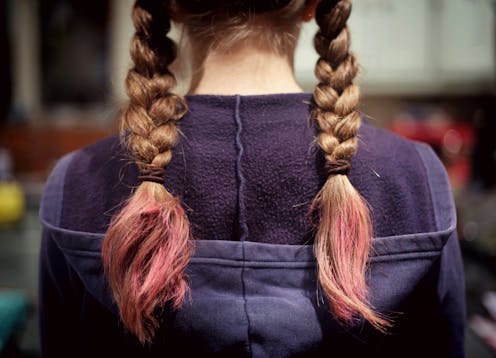
This includes students being barred from class photos for “unnaturally” coloured hair or a teacher cutting a student’s long hair. Students have also been disciplined for wearing cultural hairstyles such as braids, or turning up to school with styles such as mullets.
These stories are all part of a larger phenomenon I have examined in my new research: school policies on hair often enforce an idea of “good taste” that favour certain norms around gender, class and race.
My research
My research examines the hair polices of 50 senior high schools in Queensland (for students in Years 11 and 12).
It looked at what the policies are and how they are justified by schools.
This sample included government and independent schools. The independent or private schools were divided into Catholic and Protestant schools.
The schools came from a wide variety of locations, regions and socioeconomic contexts.
My findings
Hair policies are often a subset of a broader uniform policy that can cover makeup, jewellery, shoes, clothing and appearances in public areas.
Most schools had general justifications for their overall uniform policies, rather than specific discussion of their hair component.
These general justifications were around occupational health and safety, sun safety, school culture, school image, equality among students (through a uniform appearance) and legislative compliance or community endorsement (such as approval from their P&C association)
For example, one private Protestant school said:
[the school] recognises that during teenage years individuality is often desired and expressed through clothing choice. However, the uniform is a vital representation of the school and its ethos, value base and placement as a private school.
Where schools did talk specifically about hair, they emphasised “standards” and school image and tone.
As one government school said:
Undertaking a conservative hairstyle will ensure compliance with the high standards of dress and appearance in place at [this school] and thereby help to maintain a positive tone in the school community and ensure that our primary focus will be centred on learning.
The regulations for hair itself typically focused on acceptable length, colour and styling.
‘Appropriate’ lengths
There were regulations around hair being too long and too short, and about it being “appropriate” for male and female genders.
Of the government schools, 15 required long hair to be restrained and one required hair to be no shorter than a number two cut. Few sought to justify this regulation, although six schools did reference health and safety (for example, keeping long hair back during “practical” subjects or as a general safety measure). None explicitly connected this regulation to gender.
By contrast, private schools were heavily gendered. A total of 25 private schools (13 Catholic and 12 Protestant schools) required long hair to be restrained. Fourteen of these schools only applied this regulation to female students.
Thirteen schools (five Catholic and eight Protestant), required male students’ hair to be cut short. Appropriate length was often defined in exacting detail, specifying where hair may reach in relation to the student’s earlobes and eyebrows, the shortest blade permitted to cut hair, and whether tucking hair behind the ears was permissible. More lenient schools simply required hair to be clear of the collar.
If the requirement for female students to restrain long hair is cross-referenced with the requirement for male students to have short hair, there were 17 private schools that explicitly linked hair length with gender.
‘Natural’ colours
Schools were particularly concerned with keeping hair colour natural. Sixteen government schools banned “unnatural” hair colours, of which three additionally banned naturally coloured dye and two only permitted naturally coloured dye that “aligned” with the student’s hair.
As one government school said:
The hair styles not permitted include, but not limited to […] unnatural hair colours or awkwardly contrasting colours.
Of the 29 private schools that regulated hair, all banned “unnatural” hair colours, of which four additionally banned naturally coloured dye and four only permitted naturally coloured dye that “aligned” with the student’s hair.
As one Protestant school said:
Students are not permitted to dye, bleach or colour their hair to create stark contrasts, a colour or multiple colours away from their natural hair colour. All treatments must be subtle, aligned with the student’s natural hair colour and have the effect of being barely noticeable.
In “being barely noticeable”, a student can appear as part of a cohesive whole, united school community – a key value across the three school affiliations.
‘Conservative’ styles
Schools were also concerned to make sure hair was styled in certain ways. It was common to see a stipulation for students to either wear a “conservative” hairstyle or avoid an “extreme” one.
Government schools also listed a total of 24 unacceptable styles, Catholic schools provided 27 banned styles and Protestant schools listed 30. The table below details the most frequently banned styles, with regulations on length and colour for comparison.
My research found a noticeable difference between regulations on length and colour versus those on style. Across the three types of schools, 45 schools restrict hair colour, representing 90% of the sample. Similarly, 40 schools, or 80% of the sample, ban unrestrained long hair.
Yet the most frequently banned style, a rat’s tail, was only banned by 14 schools or 28% of the sample. The next most common – undercut and mohawk – were only banned by 13 and 12 schools, respectively. Mullets were specifically banned by nine schools.
So while there is a general consensus on inappropriate colour and length, there is only minimal consensus on what exact styles are “wrong” for school.
What do these rules really mean?
These policies are presented as objective “rules” and yet hair styles are imbued with social and cultural meanings. Dreadlocks or braids are common ways to wear hair in African cultures, for example.
The sociocultural connotations are further complicated by who has that haircut. For example, an undercut on a male student may be seen as trendy, on a female student it could be interpreted as a signifier of queer identity.
Then there’s the mullet. While it may be celebrated in national competitions and even seen as fashionable again, it can also signify bogan culture which many schools seem to find undesirable. Elite private schools, in particular, have repeatedly made headlines for banning the style.
Few of the commonly banned styles are easy to alter around school hours – a student cannot dye, remove dreadlocks, or grow out their hair each morning. So through these policies, the school also controls the students’ hair outside of school hours and in doing so, their gender, sexual, political or cultural identity.
What should schools do instead
Recent Australian research has called for school policies to be flexible when it comes to gender and culture so all students feel like they belong.
When schools are reinforcing inflexible ideas about gender, sexuality, culture, race and class they are not including all students. Schools should review their hair policies to:
remove gendered restrictions
remove culturally exclusionary regulations
question what norms are being privileged and
limit their impact on student’s bodily autonomy outside of school hours.
While schools maintain they want to project a certain standard we have to ask what that standard is and why it is projected as an ideal for our communities.
Authors: Kayla Mildren, PhD Candidate in the politics of school uniform policies, Griffith University

















