

What makes a winning halfpipe snowboarder like Scotty James?
- Written by: Jade Haycraft, PhD Candidate, Victoria University
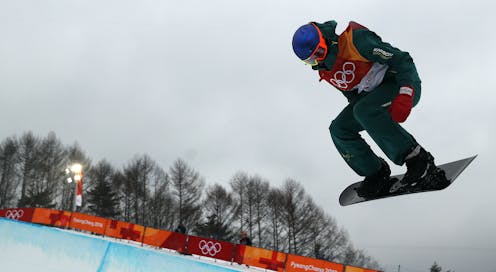
On Wednesday, Scotty James won Australia’s second medal at the Winter Olympics in Pyeongchang – bronze in the men’s snowboard halfpipe competition.
James’ medal adds to those won by fellow Australian Torah Bright (gold at the 2010 Vancouver Olympics and silver at Sochi in 2014) in the women’s snowboard halfpipe event.
What is snowboard halfpipe?
The snowboard halfpipe made its debut at the 1998 Nagano Olympics. The event takes place on a trough-like feature made of snow, built on a shaped earth base. The Olympic halfpipe is sloped at approximately 17-18°, and is between 150-170 metres long, 19-22m wide, and 6.7m high.
The halfpipe event consists of three runs lasting around 20-30 seconds, and involves between six and eight “hits” of the pipe. A “hit” is an aerial trick (jump, rotation and twist) off the top of the pipe.
Six judges score a competitor’s run based on each hit’s height, rotation, technique and degree of difficulty, with a score given out of 100. The highest and lowest scores are removed, and the final score is the average of the four remaining scores.
The best score of the three runs is recorded; the highest scores determine the medals.
The International Ski Federation’s snowboard judges’ manual specifically outlines the scoring criteria:
amplitude – with the greater the height of the jump off the top, the riskier the hit, and greater point scores;
difficulty – more rotations increases the difficulty, but also switch take-offs (opposite side to natural board stance), frontside or backside rotation, take-offs (on heel or toe side), different hand grab placements on board, blind landings (athlete can’t see where they are landing), combinations and sequential hard tricks, different rotational axis (lateral/longitudinal or horizontal), and an alley-oop (spin opposite direction to jump entry (for example, front entry to back spin);
execution – overall control throughout the run, and for each individual hit. It is also the ability to perform the positions of the intended trick once they have initiated it;
variety – changing the type of trick for each hit gets a higher score (for example backside then frontside, changed spin axis, different grabs);
combinations – consecutive difficult hits score higher;
pipe use – anything performed before an athlete crosses the marked finish line is counted in judging, with hits scoring higher if performed off the top of the pipe;
progression – introducing new tricks never seen in the sport is highly favoured; and
risk-taking – pushing to the maximum limit of ability is advantageous.
Judges deduct points for errors in a run based on the following criteria:
one-to-ten points for small mistakes (hand drag, flat landings, deck landings, and sliding);
11-20 points for medium mistakes (stop full, longer hand drags, heavy hand touches, slight butt touches, and revert to natural stance on board);
21-25 points for major mistakes (heavy butt or body landing, complete bailing from hit).
Injuries
The nature of snowboard halfpipe means most competitors risk serious injury – and possible death – throughout their career.
Halfpipe has the third-highest incidence of injury (behind big air and snowboard cross). There is a reported 1.6 injuries reported per 1,000 runs for men, and 2.3 injuries per 1,000 runs for women.
The most common injuries are to the lower arm/wrist, spine, and knee. As a result, current training practices focus heavily on giving athletes the physical tools to prevent these injuries.
Specifically, many programs target jumping/landing force, as this is the common factor of injury occurrence for snowboard halfpipe athletes. Training for “crash robustness” requires athletes to build joint strength and soft-tissue support in muscles and ligaments across the entire body.
Core strength to support and tolerate spinal loads during rotations, jumps and landings is also crucial in avoiding spinal injuries.
A horrific crash in the men’s snowboard halfpipe final from Pyeongchang.Physical demands
Snowboard halfpipe is an explosive, skill-based sport. While building “crash robustness” is integral, these athletes need to train to perform. They may seem laid-back and relaxed, but they are subjected to high physical load and fatigue induced by training and competition.
An average training day for halfpipe may consist of between ten and 12 runs (each lasting 20-30 seconds), plus hikes to the top of the pipe. This equates between two and four hours of training each day. Managing sub-zero temperatures and the effects of altitude on physical performance is also a concern.
Read more: Explainer: how Winter Olympic athletes cope with the cold
The northern hemisphere training and competition period can last between four and five months. But athletes like James may also train and compete during the southern hemisphere winters.
Halfpipe snowboarders do not require large muscle mass to compete; they prefer to remain lean to maximise their hit amplitude. Their physical training focuses on neuromuscular adaptations to induce greater muscle fibre recruitment, power/speed, and eccentric (muscle lengthening under tension) force absorption for landings.
Scotty James demonstrates core strength and neuromuscular gym training, and other off-snow training.A large majority of off-snow training focuses on sport-specific skill development, such as building co-ordination and the smoothness of trick execution. Athletes and coaches use a “gymnastic approach” to off-snow training – via trampolines, foam pits, and diving platforms/pools – to practice aerial skills in a safe landing environment.
So, behind his cool exterior, James has worked as hard as any other elite athlete on all aspects of his training to avoid injury and increase performance. Put together, this enabled him to stand on the podium to receive his bronze medal.
Authors: Jade Haycraft, PhD Candidate, Victoria University
Read more http://theconversation.com/what-makes-a-winning-halfpipe-snowboarder-like-scotty-james-91833


















