

How do I keep my fruit, veggies and herbs fresh longer? Are there any ‘hacks’?
- Written by Senaka Ranadheera, Associate Professor, The University of Melbourne
We all know fresh produce is good for us, but fruit, vegetables and herbs have a tendency to perish quickly if left uneaten.
This is because even after harvesting, produce from living plants tends to continue its biological processes. This includes respiration: producing energy from stored carbohydrates, proteins and fats while releasing carbon dioxide and water vapour. (Ever found a sprouting potato in your pantry?)
On top of that, fresh produce also spoils easily thanks to various microbes – both harmless and ones that can cause disease, called pathogens.
Simply chucking things in the fridge won’t solve the problem, as different types of plants will react differently to how they’re stored. So, how can you combat food waste and keep produce fresh for longer? Fortunately, there are some helpful tips.
Freshness and quality begin at the farm
Farmers always aim to harvest produce when it’s at an optimal condition, but both pre-harvest and post-harvest factors will affect freshness and quality even before you buy it.
Pre-harvest factors are agricultural, such as climatic conditions, soil type and water availability. Post-harvest factors include washing and cleaning after harvesting, transportation and distribution, processing and packaging, and storage.
As consumers we can’t directly control these factors – sometimes the veggies we buy just won’t be as good. But we can look out for things that will affect the produce once we bring it home.
One major thing to look out for is bruised, wounded or damaged produce. This can happen at any stage of post-harvest handling, and can really speed up the decay of your veggies and fruit.
Moisture loss through damaged skin speeds up deterioration and nutrient loss. The damage also makes it easier for spoilage microbes to get in.
To wash or not to wash?
You don’t need to wash your produce before storing it. A lot of what we buy has already been washed commercially. In fact, if you wash your produce and can’t get it completely dry, the added moisture could speed up decay in the fridge.
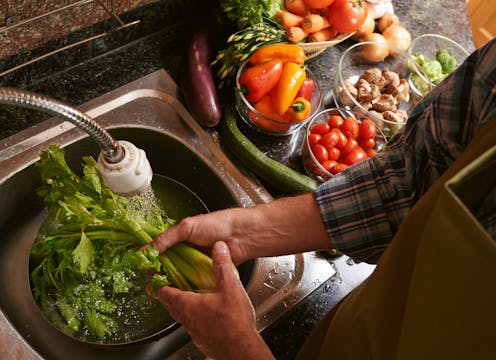
But washing produce just before you use it is important to remove dirt and pathogenic bugs.
Don’t use vinegar in your washing water despite what you see on social media. Studies indicate vinegar has no effect on lowering microbial loads on fresh produce.
Similarly, don’t use baking soda. Even though there’s some evidence baking soda can remove pesticide residues from the surface of some produce, it’s not advisable at home. Just use plain tap water.
Location, location, location
The main thing you need is the correct type of packaging and the correct location – you want to manage moisture loss, decay and ripening.
The three main storage options are on the counter, in the fridge, or in a “cool, dry and dark place”, such as the pantry. Here are some common examples of produce and where best to put them.
Bananas, onion, garlic, potatoes, sweet potato and whole pumpkin will do better in a dark pantry or cupboard. Don’t store potatoes and onions together: onions produce a gas called ethylene that makes potatoes spoil quicker, while the high moisture in potatoes spoils onions.
In fact, don’t store fruits such as apples, pears, avocado and bananas together, because these fruits release ethylene gas as they ripen, making nearby fruits ripen (and potentially spoil) much faster. That is, unless you do want to ripen your fruits fast.
All leafy greens, carrots, cucumbers, cauliflower and broccoli will do best in the low-humidity drawer (crisper) in the fridge. You can put them in perforated plastic bags to retain moisture but maintain air flow. But don’t put them in completely sealed bags because this can slow down ripening while trapping carbon dioxide, leading to decay and bad smells.
Some fruits will also do best in the fridge. For example, apples and citrus fruits such as oranges can keep fresh longer in the fridge (crisper drawer), although they can stay at room temperature for short periods. However, don’t store watermelon in the fridge for too long, as it will lose its flavour and deep red colour if kept refrigerated for longer than three days.
Most herbs and some leafy vegetables – like celery, spring onions and asparagus – can be kept with stems in water to keep them crisp. Keep them in a well-ventilated area and away from direct sunlight, so they don’t get too warm and wilt.
Experimenting at home is a good way to find the best ways to store your produce.Fight food waste and experiment
Don’t buy too much. Whenever possible, buy only small amounts so that you don’t need to worry about keeping them fresh. Never buy bruised, wounded or damaged produce if you plan to keep it around for more than a day.
“Process” your veggies for storage. If you do buy a large quantity – maybe a bulk option was on sale – consider turning the produce into something you can keep for longer. For example, banana puree made from really ripe bananas can be stored for up to 14 days at 4°C. You can use freezing, blanching, fermentation and canning for most vegetables.
Consider vacuum sealing. Vacuum packaging of vegetables and berries can keep them fresh longer, as well. For example, vacuum-sealed beans can keep up to 16 months in the fridge, but will last only about four weeks in the fridge unsealed.
Keep track. Arrange your fridge so you can see the produce easily and use it all before it loses freshness.
Experiment with storage hacks. Social media is full of tips and hacks on how best to store produce. Turn your kitchen into a lab and try out any tips you’re curious about – they might just work. You can even use these experiments as a way to teach your kids about the importance of reducing food waste.
Grow some of your own. This isn’t feasible for all of us, but you can always try having some herbs in pots so you don’t need to worry about keeping them fresh or using up a giant bunch of mint all at once. Growing your own microgreens could be handy, too.
Authors: Senaka Ranadheera, Associate Professor, The University of Melbourne

















