

the free people transported as convicts to Van Diemen’s Land
- Written by Kristyn Harman, Associate Professor in History, University of Tasmania
Emma Cotton (or Cotterell) sailed into Sydney harbour on the Rubicon in 1833 as a free immigrant. A 32-year-old woman of independent means, she took on needlework in the colony. Emma’s genteel life unravelled four years later when she appeared before a Sydney court charged with stealing a bundle of “wearing apparel”.
Emma was transported to Van Diemen’s Land (lutruwita or Tasmania) for seven years, then spent the rest of her life in Hobart. After her sudden death in February 1863, a local newspaper reported she was “better known as old Emma the fortune teller”. If Emma had been able to foretell her own future, she may have chosen to stay in London.
Conditions for convicts in Van Diemen’s Land were tough. Food was rationed. Many prisoners spent time in penal stations such as Port Arthur, female houses of correction known as “female factories”, probation stations, where convicts were required to serve the initial period of their sentences, or asylums. A prison for boys, Point Puer, was built next to Port Arthur. Some men laboured on road gangs.
Women often worked in colonists’ homes as domestic servants. Emma was assigned to work at the Police Magistrate’s office. She also did time, probably at the infamous wash tubs at the Cascades Female Factory in South Hobart.
Details of Emma’s case were carefully captured in a convict indent register. Now known as CON16, five of these rectangular registers with their spidery handwriting and tatty bindings survive. Among the many named in them are 627 men, women and children who arrived free or were born free in the Australian colonies but became convicts in Van Diemen’s Land.
Their stories have, until now, mostly been forgotten. They challenge popular narratives of Australian history suggesting only convicts from Britain and Ireland were transported to Van Diemen’s Land.
The youngest prisoner, a boy called Joseph Levy, was just ten when transported for perjury. The oldest was a 75-year-old man who laboured on a road gang.

As well as Indigenous convicts from the Cape colony (now part of South Africa) and New Zealand, more than 60 Aboriginal men from mainland Australia were transported as convicts during the 19th-century frontier wars.
In the Port Phillip District of New South Wales (now Victoria), some Aboriginal warriors engaged in economic sabotage. Yanem Goona, also known as “Old Man Billy Billy”, was thought to be a ringleader. When a large flock of sheep was driven off a station near Mt Arapiles in 1845, a white-led Native Police contingent tracked the missing animals, locating around 200 sheep in a “bush yard” built by local Aboriginal people.
Yanem Goona was arrested, tried and sentenced to ten years’ transportation to Van Diemen’s Land. When serving his initial probationary period at Norfolk Island, a visitor noted how the old man cried whenever he thought of home.
After being shipped to Van Diemen’s Land, Yanem Goona died in custody at the Impression Bay probation station on October 31 1848.
‘A good riddance’
Of these 627 people named and detailed in the register, 276 were sentenced in NSW. Forty-five went through the South Australian law courts, 29 were shipped from Victoria, and 19 from Western Australia. Within Van Diemen’s Land itself, 247 free people were sentenced to transportation and sent to Port Arthur and other convict establishments. The overwhelming majority, more than 88%, were male.
The first entry in the register is for Thomas Carroll, an Englishman who arrived free in Launceston in November 1831. Carroll opened a livery stables, advertising horses and gigs for hire, and his services breaking in fillies and colts. After moving to Hobart and working as a groom, Carroll was found guilty of stealing a saddle and sentenced to transportation for seven years. He was sent to work on a road gang a few miles from Hobart.
Peter Haley (or Caley) was a groom in Adelaide before being sentenced to transportation for ten years for horse stealing.
Born near Cape Town, Haley was a Khoisan man who arrived free in Sydney in 1839. By 1850 he had become a notorious horse thief. The following year he was transported to Van Diemen’s Land where he served 15 months at Cascades probation station before being sent into service at New Norfolk, a rural area located inland from Hobart. As a convict labourer, he continued to steal horses. His sentence was extended to transportation for life.
Ultimately, Haley absconded, joined a gang of bush-rangers, and was nicknamed “Black Peter”. Eventually the gang was captured, tried and executed. Haley was hanged in Hobart in February 1859 alongside one of his friends.
Not all formerly free people who became convicts in Van Diemen’s Land were sentenced to transportation. Occasionally their sentence was “death recorded”, meaning they were sentenced to death with an immediate reprieve, then transported instead.
Such was the case for Dola, a southeast Asian sailor found guilty in Adelaide of attempted murder on the high seas. When he and seven other convicts were sent to Hobart in June 1851 on the brig Union, the Adelaide Observer announced their departure under the headline “A Good Riddance”.
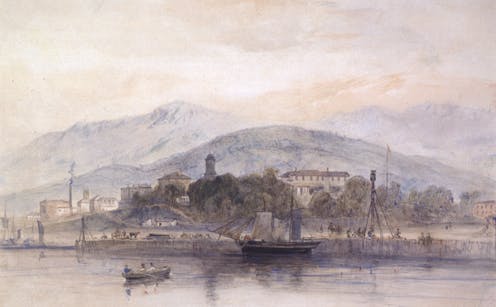
 The female factory from Proctors Quarry by John Skinner Prout, 1844.
Allport Library and Museum, State Library of Tasmania
The female factory from Proctors Quarry by John Skinner Prout, 1844.
Allport Library and Museum, State Library of Tasmania
83 ‘stripes on the breech’
The median age of these convicts was 42.5 years – much higher than today’s median age of 31 years for offenders. Only 10% were under the age of 20. However, there were some outliers.
Joseph Levy appeared before the Berrima Circuit Court in NSW in September 1841, aged ten. One of six children from a Catholic family living at Blacktown, Joseph was a key witness in a case involving an alleged horse-stabbing. Levy told the court the horse’s owner had promised him a cow and a calf if the boy said he had witnessed the attack. However, he hadn’t seen anything.
Levy was charged with perjury then transported to Van Diemen’s Land for seven years. While incarcerated at Point Puer, a facility for boys, Levy was punished many times. He received a total of 83 “stripes on the breech” and spent 61 days in solitary confinement. When his sentence expired in 1848, Levy was sent back to NSW.
Michael Caffray, meanwhile, was a carpenter from Dublin who came out to Van Diemen’s Land as a free migrant. He was 75 when tried in Hobart in 1836 for receiving 40 pounds of stolen mutton and sentenced to transportation for 14 years.
Caffray laboured on the Grass Tree Hill road gang on the outskirts of Hobart while under sentence. He died in 1854 from paralysis at Impression Bay on the Tasman Peninsula.
Violent interpersonal crimes (murder, manslaughter, rape and assault) account for only 8% of cases resulting in transportation to Van Diemen’s Land. Some crimes, such as larceny, burglary, housebreaking, robbery and stealing from a person (49.5% of cases), are not unexpected. Stealing animals (cattle, horses and sheep) also figure frequently (12.3% of cases).
However, offences we view as white collar crimes, which don’t attract lengthy prison sentences today, figure quite often. These include forgery, embezzlement, and fraud and false pretences.
Various bigamists, arsonists, military absconders and offenders, perjurers and those convicted of “unnatural offences” also lost their freedom. Convicts who offended while serving their sentences received further punishments.
All the free people who became convicts in Van Diemen’s Land had something in common. The activities they engaged in were criminalised, and they were seen as bad characters. Those who survived the system were viewed as “tainted” within their own lifetimes.
But the criminal deportation of these formerly free people tells us more about colonial Australian attitudes and values than it does about the individuals themselves.
Authors: Kristyn Harman, Associate Professor in History, University of Tasmania

















