

What causes landslides? Can we predict them to save lives?
- Written by Pierre Rognon, Associate Professor, University of Sydney
A devastating landslide struck several remote villages in the mountainous Enga province in Papua New Guinea late last week.
While it is too early for official confirmation, estimates place the death toll between 690 and 2,000 people, with thousands more missing. That only a few bodies have been recovered serves as a tragic reminder of the destructive power of these events.
The ongoing search and rescue operations have proven challenging. As often with landslides, secondary slides and rock falls are hampering efforts in the search zone. There’s also a lack of access to heavy digging machinery, and roads need to be cleared or repaired for assistance and equipment to arrive.
Even more critically, it is difficult to locate potential survivors, as landslides carry away buildings and their occupants in an unpredictable manner. What causes these devastating events and why are they so sudden and unpredictable?
What causes landslides?
Landslides happen when the pull from gravity exceeds the strength of the geomaterial forming the slope of a hill or mountain. Geomaterials can be as varied as rocks, sand, silt and clays.
Then, part of this slope starts sliding downhill. Depending on where the slope fails, the material sliding down can be just a few cubic metres or a few million cubic metres in volume.
Why do slopes fail? Most natural landslides are triggered by earthquakes or rainfall, or a combination of both.
Earthquakes shake the ground, stress it and weaken it over time. Rainwater can seep through the ground and soak it – the ground is often porous like a sponge – and add weight to the slope. This is why PNG is so prone to landslides, as it sits on an active fault and is subjected to heavy rainfalls.
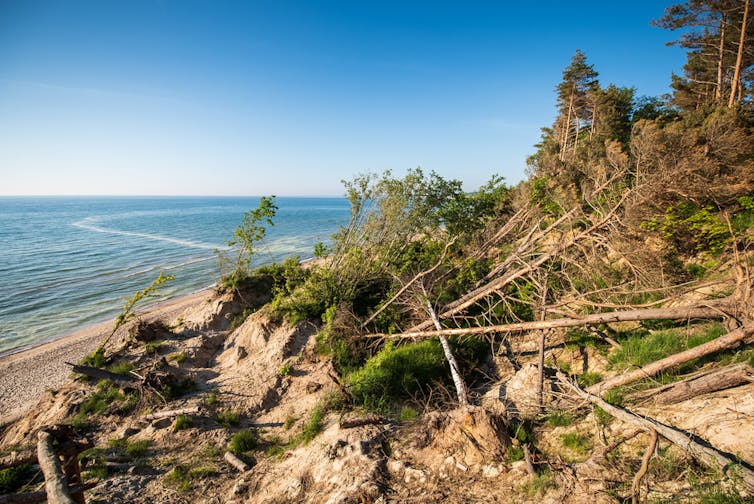
Another adverse effect of water is erosion: the constant action of waves undercuts coastal slopes, causing them to fail. Groundwater can also dissolve rocks within slopes.
Humans can (and do) cause landslides in several ways, too. For example, deforestation has a negative impact on slope stability, as tree roots naturally reinforce the ground and drain water out. Also, mine blasts produce small earthquake-like ground vibrations that shake slopes nearby.

Why can’t we predict landslides?
It’s very difficult to predict and mitigate landslide risk effectively. The Enga landslide and the thousands of deadly and costly landslides occurring every year worldwide suggest so. Even in Australia – the flattest continent in the world – home insurance policies don’t tend to cover landslide risk for a simple reason: this risk is difficult to estimate.
So what would it take to warn people of a coming landslide? You would need a prediction for earthquakes and rainfall, in addition to a perfect knowledge of the slope-forming geomaterial.
Under our feet, geomaterials may include multiple, entangled layers of various kinds of rocks and particulate materials, such as sand, silt and clays. Their strength varies from a factor of one to 1,000, and their spatial distribution dictates where the slope is likely to fail.
 Landslides carry material with them, including boulders, trees and other foliage.
Bargais/Shutterstock
Landslides carry material with them, including boulders, trees and other foliage.
Bargais/Shutterstock
To accurately assess the stability of the slope, a three-dimensional mapping of these materials and their strengths is needed. No sensor can provide this information, so geologists and geotechnical engineers must deal with partial information obtained at a few selected locations and extrapolate this data to the rest of the slope.
The weakest link of the chain – such as an existing fracture in a rock mass – is easily missed. This is an inevitable source of uncertainty when trying to predict how much material might slip.
We do know that the larger the volume of a landslide, the farther its runout distance. But it’s hard to gauge the exact size of a landslide, making predictions of runout distances and safe zones uncertain.
The question of “when will a landslide will occur” is also uncertain. Mechanical analysis enables us to estimate the vulnerability of a slope in a particular scenario, including earthquake magnitude and distribution of groundwater. But predicting if and when these triggers will happen is as “easy” as predicting the weather and seismic activity – a difficult task.
Unfortunately, all the money in the world can’t buy accurate landslide predictions – especially in remote parts of the world.
Authors: Pierre Rognon, Associate Professor, University of Sydney
Read more https://theconversation.com/what-causes-landslides-can-we-predict-them-to-save-lives-230968

















