Modern Australian
The Times

Why do so few people cycle for transport in Australia? 6 ideas on how to reap all the benefits of bikes

  • Written by Melanie Davern, Associate Professor, Director Australian Urban Observatory, Centre for Urban Research, RMIT University
Why do so few people cycle for transport in Australia? 6 ideas on how to reap all the benefits of bikes

Less than 1% of the 12 million Australians who travelled to work on Census Day in 2021 rode a bicycle to get there.

Bicycles are readily available and affordable. Cycling also supports healthy, liveable and sustainable cities.

Yet most of us shun this form of transport in Australia. The number of people cycling to work fell by 26.4% between 2016 and 2021.

So, on World Bicycle Day, we ask why is this form of transport so undervalued and neglected?

We offer the following ideas about what needs to happen so more of us use bicycles for everyday transport.

Vertical bar chart showing numbers in Australia who used active transport – cycling and walking – to get to work at each census date from 1976 to 2021
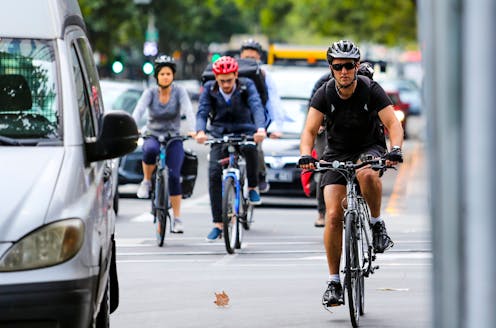
Chart: The Conversation. Data: Australian Bureau of Statistics, Australia's journey to work, CC BY 1. Improve cycling infrastructure across our cities Remember the pop-up cycling lanes during COVID and how quickly many of them vanished? With multiple local and state governments managing roads across the country, we have no way of knowing where all the painted or separated cycling lanes currently exist. Better-connected cycling infrastructure is needed to increase the use of bicycles for transport. At present we don’t understand how well, safely and equitably cycling routes connect up across Australian cities. 2. Use AI to help fill the gaps Deep-learning artificial intelligence (AI) methods can help pinpoint areas with limited or no cycling infrastructure across the nation. The Australian Urban Observatory will lead a new research project to trial this technology. AI could help governments identify neighbourhoods lacking cycling infrastructure and end-of-trip facilities, street signs, measure cycling participation and monitor cycling lanes to ensure they’re well marked and maintained. Deep-learning AI is already used to improve cycling performance. It has huge potential to support detailed, cost-effective, real-time identification, management and maintenance of cycling infrastructure. A big advantage of AI is it can be scaled up. Once trained, AI models can be replicated across many neighbourhoods to identify urban design features that support cycling. It’s even more useful when combined with citizen science and rider experiences, as we plan to do. This AI technology requires high-resolution satellite imagery and spatial data to identify objects and features. Imagery collected by organisations such as Australia Post, transport departments and road maintenance companies would be perfect for AI analysis. We welcome approaches from potential industry partners for our project. 3. Use simulations to evaluate decisions on cycling Our cities are growing fast. This creates many challenges, including climate change, traffic congestion, air quality and health. To tackle these challenges, we need evidence to minimise trial-and-error decision-making. Virtual laboratories can be very useful for evaluating policies and investments before they are put into effect. The key question for decision-makers is where to invest for maximum benefit and minimal harm. Computer transport simulation models can help answer this question. These models can calculate changes in traffic, cycling uptake and emissions before infrastructure is built. They have traditionally been used to build business cases for infrastructure investment. However, these models have often neglected cycling. The result is a lack of quantitative, case-specific evidence to support investment decisions on cycling infrastructure. That’s why we developed the Transport Health Assessment Tools for Brisbane and Melbourne. The results show the health benefits of walking and cycling. A smiling older man ride a bicycle along a cycle path through a park Policymakers’ decision-making has neglected cycling’s benefits for health, wellbeing and liveability. IndianFaces/Shutterstock 4. Plan with a focus on cycling Australia will have to do more than set up a Net Zero Economy Authority to get to net zero. Electric vehicles won’t solve the problem soon. Transport produces about a fifth of Australia’s emissions but its share is predicted to grow, becoming the largest source of emissions by 2030. Cycling offers transport that’s almost free, sustainable, time-efficient and healthy. Walking and cycling are no-brainer options to get to net zero sooner. We can measure basic walkability across neighbourhoods, but where is the connected urban policy support for cycling? We need academics, policymakers and cycling advocates to work together on these problems. It would be great to see “bicycle mayors” such as Chennai’s Felix John in our cities. Places like the Netherlands and New Zealand give priority to cycling through planning policies and infrastructure such as bike paths and dedicated cycle lanes. The result is high rates of cycling, including children, women and older people who are considered more vulnerable road users. Australian rates of cycling for transport are dismally low. There’s also a huge gender gap. Cyclists wait in line on a cycle path for the lights to change Commuters cycle home from work in London. Joe Kuis/Shutterstock 5. Make active transport a funding priority Government infrastructure policies prioritise large, costly road megaprojects, such as Victoria’s A$26 billion North East Link. They entrench many harms of car use, including carbon emissions and other pollution, and displace more active and sustainable forms of travel. By comparison, walking and cycling infrastructure is cheap and small scale. But to get the greatest benefit it must be broadly spread and connected. We need comprehensive cycling infrastructure plans for our cities that put cycling projects ahead of megaroads for funding. The federal budget provided an extra $3.2 billion for the over-budget North East Link in Victoria. It announced $100 million for a National Active Transport Fund and a national approach to sustainable urban development. Halting or deferring funding for massive road projects could free up enough money to transform metropolitan cycling networks. That would support a shift away from cars, creating savings as road projects could be deferred or cancelled. 6. Connect cycling to long-term health benefits A lack of safe cycling infrastructure denies vulnerable road users the use of this sustainable and healthy transport. This has a long-term and compounding effect: if people don’t take up cycling when young it translates into fewer adult cyclists later. They miss out on being physically active through cycling and its life-long health benefits. Cycling improves physical and mental health. Some studies suggest cyclists are happier and more productive workers. There’s an incentive for employers to support cycling – even at their desks. Cycling also benefits children by improving their health, social wellbeing and academic performance. For all these reasons, cycling is an undervalued mode of transport that needs urgent support. It’s critical for healthy, sustainable and liveable cities of the future. Authors: Melanie Davern, Associate Professor, Director Australian Urban Observatory, Centre for Urban Research, RMIT University

Read more https://theconversation.com/why-do-so-few-people-cycle-for-transport-in-australia-6-ideas-on-how-to-reap-all-the-benefits-of-bikes-229811

What’s Trending in Men’s Jewellery This Father’s Day!

Finding a Father’s Day gift that feels personal, stylish and genuinely wearable is not always easy. While socks and novelty mugs have traditionall...

Road Signs: Understanding Their Role in Clear and Effective Signage

Effective signage and display hardware can help businesses communicate information, promote products and organise customer or visitor movement. Road...

Bottle Label Printing: Key Factors to Consider Before Your Next Packaging Run

Effective packaging begins with understanding the product, bottle material, artwork and production requirements when planning bottle label printing. H...

Planning a Long-Distance Move With Interstate Movers Melbourne

Moving between states involves more planning than a typical local relocation. Along with packing and transporting household belongings, you need to...

Understanding the Role of an I/O Controller in Industrial Automation

Modern industrial systems depend on accurate communication between sensors, machines and control systems. An I/O controller can help manage this commu...

How the Right Mining Hose Supports Demanding Operations

Mining environments place considerable demands on equipment used for material transfer, water management and processing. Hoses operating in these co...

Simple Ideas for Making Social Gatherings More Memorable

We have all been to those parties where everyone just stands around the kitchen island, staring at their phones, waiting for someone else to make a mo...

Outdoor Wall Lights: Improving Exterior Lighting Around Your Home

Lighting can influence how a room looks, feels and functions, so the right fitting should be selected according to both appearance and practical req...

Commercial Office Cleaning: Combining Routine Office Cleaning With Melbourne Service

Keeping a workplace clean requires a service that can accommodate everyday tasks as well as the particular needs of the business. Professional comme...

Caravan Sales in Queensland: How to Find the Right Caravan for Sale QLD

Caravan ownership is about more than having somewhere to sleep while travelling. For many Queenslanders, it is one of the best ways to explore regio...

What Sir Walter Buffalo Turf Actually Costs in 2026 (And Why Quotes Vary So Much)

Two quotes landed on a Hills District homeowner's kitchen table last spring for the exact same 80-square-metre backyard. One said $12 a metre. The o...

Nearly 1,300 NSW Hospital Beds Are Occupied By People Who Are Ready To Go Home

1,276 people in NSW hospitals have been medically cleared for discharge but remain in hospital because they're still waiting for NDIS or aged care sup...

National Survey Launched to Measure Operational Impacts of Federal NDIS Policy Reforms

The effects of recent NDIS reforms are beginning to move beyond policy papers and into day to day service delivery. A new national survey is asking ...

Beyond the Nappy Cake: Baby Shower Gifts That Get Used

What new Australian parents unwrap, keep, and quietly thank you for months later. Six weeks after my daughter was born, I did an audit of the baby sh...

Parent-Advocates Are Reshaping Frontline Disability Service Delivery

Parents have always been part of the disability sector. They advocate, coordinate services, challenge decisions and often become the person holding ev...

Vista Cruises Enters "Two-Flagship Era" as Vista Aurora Completes Inaugural Voyage

Vista Aurora Sets Sail along the Yangtze. (Photo courtesy of the company)YICHANG, China — August 5, 2026 — Vista Aurora, a high-end interprovinc...

A Digital Preparation Checklist For International Medical Conferences

An international medical conference compresses many responsibilities into a few days. A delegate may need to present research, move between venues, ...

The Growing Popularity of Lab Grown Diamonds in Sydney and Hong Kong

The diamond industry has changed significantly in recent years as more buyers seek ethical, affordable, and sustainable alternatives to mined diamon...