

Charging ahead: how Australia is innovating in battery technology
- Written by: Jonathan Knott, Associate Research Fellow in Battery R&D, University of Wollongong
Lithium-ion remains the most widespread battery technology in use today, thanks to the fact that products that use it are both portable and rechargeable. It powers everything from your smartphone to the “world’s biggest battery” in South Australia.
Demand for batteries is expected to accelerate in coming decades with the increase in deployment of electric vehicles and the need to store energy generated from renewable sources, such as solar photovoltaic panels. But rising concerns about mining practices and shortages in raw materials for lithium-ion batteries – as well as safety issues – have led to a search for alternative technologies.
Many of these technologies aren’t being developed to replace lithium-ion batteries in portable devices, rather they’re looking to take the pressure off by providing alternatives for large-scale, stationary energy storage.
Australian companies and universities are leading the way in developing innovative solutions, but the path to commercial success has its challenges.
Read more: A month in, Tesla's SA battery is surpassing expectations
Australian alternatives
Flow batteries
In flow batteries the cathode and anode are liquids, rather than solid as in other batteries. The advantage of this is that the stored energy is directly related to the amount of liquid. That means if more energy is needed, bigger tanks can be easily fitted to the system. Also, flow batteries can be completely discharged without damage – a major advantage over other technologies.
ASX-listed battery technology company Redflow has been developing zinc-bromine flow batteries for residential and commercial energy storage. Meanwhile, VSUN Energy is developing a vanadium-based flow battery for large-scale energy storage systems.
Flow batteries have been receiving considerable attention and investment due to their inherent technical and safety advantages. A recent survey of 500 energy professionals saw 46% of respondents predict flow battery technology will soon become the dominant utility-scale battery energy storage method.
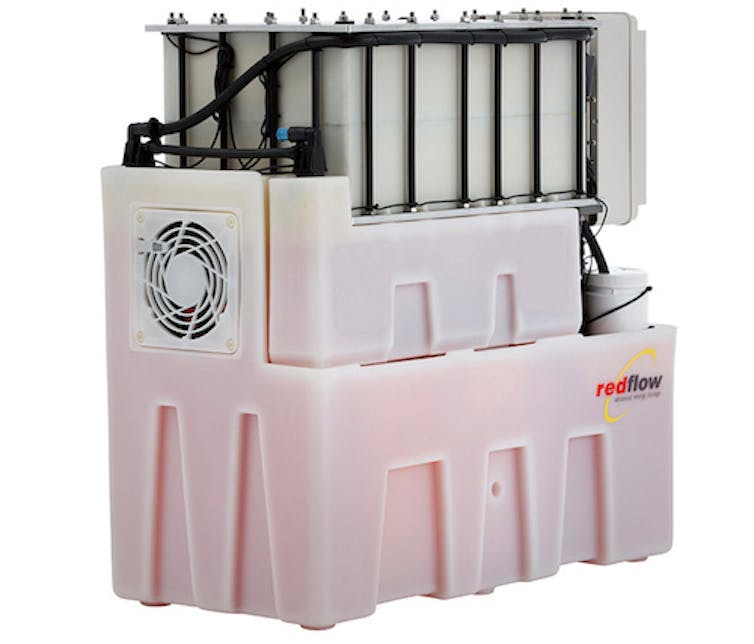 Redflow ZBM2 zinc-bromine flow battery cell.
from Redflow
Redflow ZBM2 zinc-bromine flow battery cell.
from Redflow
Ultrabatteries
Lead-acid batteries were invented in 1859 and have been the backbone of energy storage applications ever since. One major disadvantage of traditional lead-acid batteries is the faster they are discharged, the less energy they can supply. Additionally, the lifetime of lead-acid batteries significantly decreases the lower they are discharged.
Energy storage company Ecoult has been formed around CSIRO-developed Ultrabattery technology – the combination of a lead-acid battery and a carbon ultracapacitor. One key advantage of this technology is that it is highly sustainable – essentially all components in the battery are recyclable. Ultrabatteries also address the issue of rate-dependent energy capacity, taking advantage of the ultracapacitor characteristics to allow high discharge (and charge) rates.
These batteries are showing excellent performance in grid-scale applications. Ecoult has also recently received funding to expand to South Asia and beyond.
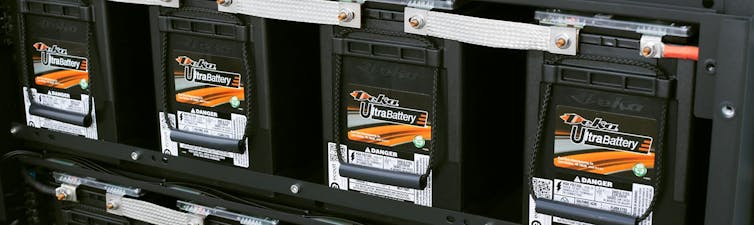 Ecoult Ultrabatteries photographed during installation on site.
from www.ecoult.com
Ecoult Ultrabatteries photographed during installation on site.
from www.ecoult.com
Read more: Politically charged: do you know where your batteries come from?
Repurposed storage solutions
Rechargeable batteries are considered to have reached their “end of life” when they can only be charged to 80% of their initial capacity. This makes sense for portable applications – a Tesla Model S would have a range of 341 km compared to the original 426 km. However, these batteries can still be used where reduced capacity is acceptable.
Startup Relectrify has developed a battery management system that allows end of life electric vehicle batteries to be used in residential energy storage. This provides a solution to mounting concerns about the disposal of lithium-ion batteries, and reports that less than 5% of lithium-ion batteries in Europe are being recycled. Relectrify has recently secured a A$1.5m investment in the company.
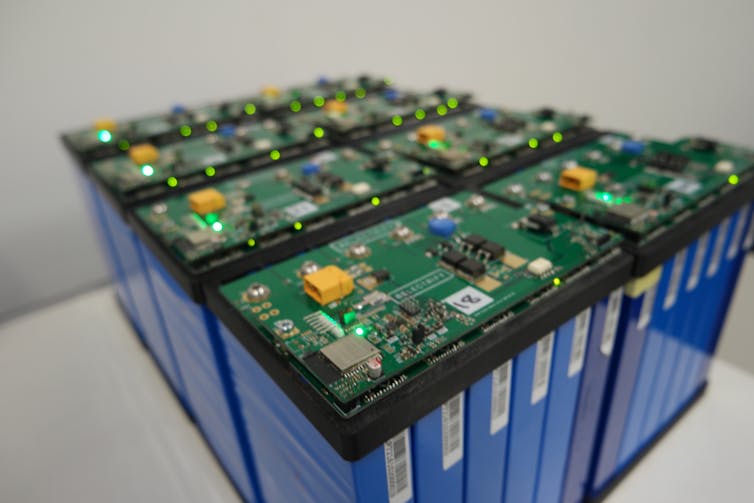 Relectrify’s smart battery management system.
from Relectrify
Relectrify’s smart battery management system.
from Relectrify
Thermal energy storage
Energy can be stored in many forms – including as electrochemical, gravitational, and thermal energy. Thermal energy storage can be a highly efficient process, particularly when the sun is the energy source.
Renewable energy technology company Vast Solar has developed a thermal energy storage solution based on concentrated solar power (CSP). This technology gained attention in Australia with the announcement of the world’s largest CSP facility to be built in Port Augusta. CSP combines both energy generation and storage technologies to provide a complete and efficient solution.
1414 degrees is developing a technology for large-scale applications that stores energy as heat in molten silicon. This technology has the potential to demonstrate very high energy densities and efficiencies in applications where both heat and electricity are required. For example, in manufacturing facilities and shopping centres.
Research and development
Sodium-ion batteries
At the University of Wollongong I’m part of the team heading the Smart Sodium Storage Solution (S4) Project. It’s a A$10.5 million project to develop sodium-ion batteries for renewable energy storage. This ARENA-funded project builds upon previous research undertaken at the University of Wollongong and involves three key battery manufacturing companies in China.
We’ve selected the sodium-ion chemistry for the S4 project because it sidesteps many of the raw materials issues associated with lithium-ion batteries. One of the main materials we use to manufacture our batteries is sodium chloride – better known as “table salt” – which is not only abundant, but also cheap.
We’ll be demonstrating the sodium-ion batteries in a residential application at University of Wollongong’s Illawarra Flame House and in an industrial application at Sydney Water’s Bondi Sewage Pumping Station.
 Sydney’s iconic Bondi Beach – the location for the demonstration of sodium-ion batteries.
Paul Jones/UOW
Sydney’s iconic Bondi Beach – the location for the demonstration of sodium-ion batteries.
Paul Jones/UOW
Gel-based zinc-bromine batteries
Gelion, a spin-off company from the University of Sydney, is developing gel-based zinc-bromine batteries – similar to the Redflow battery technology. They are designed for use in residential and commercial applications.
The Gelion technology is claimed to have performance comparable with lithium-ion batteries, and the company has attracted significant funding to develop its product. Gelion is still in the early stages of commercialisation, however plans are in place for large-scale manufacturing by 2019.
Challenges facing alternatives
While this paints a picture of a vibrant landscape of exciting new technologies, the path to commercialisation is challenging.
Not only does the product have to be designed and developed, but so does the manufacturing process, production facility and entire supply chain – which can cause issues bringing a product to market. Lithium-ion batteries have a 25 year headstart in these areas. Combine that with the consumer familiarity with lithium-ion, and it’s difficult for alternative technologies to gain traction.
One way of mitigating these issues is to piggyback on established manufacturing and supply chain processes. That’s what we’re doing with the S4 Project: leveraging the manufacturing processes and production techniques developed for lithium-ion batteries to produce sodium-ion batteries. Similarly, Ecoult is drawing upon decades of lead-acid battery manufacturing expertise to produce its Ultrabattery product.
Read more: How to make batteries that last (almost) forever
Some challenges, however, are intrinsic to the particular technology.
For example, Relectrify does not have control over the quality or history of the cells it uses for their energy storage – making it difficult to produce a consistent product. Likewise, 1414 degrees have engineering challenges working with very high temperatures.
Forecasts by academics, government officials, investors and tech billionaires all point to an explosion in the future demand for energy storage. While lithium-ion batteries will continue to play a large part, it is likely these innovative Australian technologies will become critical in ensuring energy demands are met.
Authors: Jonathan Knott, Associate Research Fellow in Battery R&D, University of Wollongong
Read more http://theconversation.com/charging-ahead-how-australia-is-innovating-in-battery-technology-90169


















