

Fresh water and key conditions for life appeared on Earth half a billion years earlier than we thought
- Written by Hugo Olierook, Senior Research Fellow in Geology, Curtin University
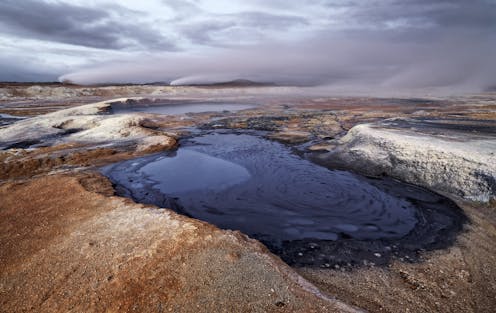
We need two ingredients for life to start on a planet: dry land and (fresh) water. Strictly, the water doesn’t have to be fresh, but fresh water can only occur on dry land.
Only with those two conditions met can you convert the building blocks of life, amino acids and nucleic acids into tangible bacterial life that heralds the start of the evolutionary cycle.
The oldest life on Earth left in our fragmented rock record is 3.5 billion years old, with some chemical data showing it may even be as old as 3.8 billion years. Scientists have hypothesised life might be even older, but we have no records of that being the case.
Our new study published in Nature Geoscience provides the first evidence of fresh water and dry land on Earth by 4 billion years ago. Knowing when the cradle of life – water and land – first appeared on Earth ultimately provides clues as to how we came to be.
Water and land: the essences of life
Imagine you’ve stepped into a time machine and gone back 4 billion years ago. As the dials whirr to a halt, you look out and see a vast ocean all around you. Not blue as you know it, but brown with iron and other dissolved minerals. You look up into the sky and it’s dark orange, with a smog of carbon dioxide and regular flashes from incoming meteors. Inhospitable to life.
This is what scientists think Earth looked like 4 billion years ago. But did it?
Just as you abandon all hope for life, you spot it on the horizon: land. Kicking the time machine into travel mode, you fly across to this expanse of emerged rock and touch down.
You quickly realise you’ve stepped onto a volcanic island, with lava spewing across its flanks. But you also feel raindrops on your nose, and you spot water collecting in little pools at the base of the volcano. Cautiously you cup your hands and have a taste … it’s fresh! The first proof there was fresh water on Earth, at least by 4 billion years ago.
Fresh water and emerged land go hand in hand. If all land is underwater, then you can only have salty, ocean water. This is because salty water wants to encroach under land, a phenomenon known as seawater intrusion.
So, if you find fresh water, you must have dry land – and a reasonably large expanse of it.

How do we know there was fresh water and land on the early Earth?
Fresh water is very different from sea water. Obviously, you might say, but how do you know if one or both were present on Earth if you can’t actually go back in a time machine?
The answer is in the rock record and chemical signals preserved in that time capsule. Earth is a bit over 4.5 billion years old, and the oldest rocks scientists have found are just a little older than 4 billion years.
To really understand our planet in its first 500 million years, we have to turn to crystals that once came from older rocks and ended up deposited in younger rocks.
Unlike rocks, the oldest preserved crystals go back as far as 4.4 billion years. And the bulk of these super-old crystals comes from one place on Earth: the Jack Hills in Western Australia’s midwest.
This is precisely where we went. We dated over a thousand crystals of a mineral called zircon, famed for its extreme resistance to weathering and alteration.
That’s quite important, as over the span of billions of years, a lot of later processes can erase the primary chemical signal when the crystals first formed. Most other types of minerals are much easier to alter, a process that would erase their original chemistry and not provide us with clues into Earth’s deep past.
 A zircon crystal under the microscope.
Hugo Olierook/Curtin University
A zircon crystal under the microscope.
Hugo Olierook/Curtin University
Truly ancient grains
Our work shows that about 10% of all the crystals we analysed were older than 4 billion years. That might seem small, but it’s an enormous amount of super-old grains compared to other places around the world.
To figure out whether these grains held a record of fresh water, we used tiny beams of ions on these dated zircon grains to measure the ratio of heavier to lighter oxygen. This ratio, known as an oxygen isotopic ratio, is thought to be nearly constant through time for seawater, but much lighter for fresh water.
Conspicuously, a small portion of zircon crystals from 4 billion years ago had a very light signature that could only have formed from the interaction of fresh water and rocks.
Zircon is extremely resistant to alteration. For the Jack Hills’ zircon to obtain this light oxygen signature, the rock altered by fresh water had to melt and then re-solidify to impart the light oxygen isotopic signature into our zircon.
Thus, fresh water had to be present on Earth before 4 billion years ago.
Whether life also began so early in Earth’s history is a question we can’t quite be sure of yet. But we’ve at least found evidence for the cradle of life on Earth some time before 4 billion years ago – extremely early in our planet’s 4.5-billion-year history.
Authors: Hugo Olierook, Senior Research Fellow in Geology, Curtin University

















