

‘We’re all trained to be good obedient children, but what do you want?’ Delving into the inner lives of women in neoliberal China
- Written by Wanning Sun, Professor of Media and Cultural Studies, University of Technology Sydney
Yuan Yang is what migration academics call a “1.5 generation migrant” – meaning she was born in her country of origin and then migrated to another country as a child.
She belongs, too, to what Chinese people call jiulinhou – the generation of people born in the 1990s. As a writer, she is interested in the experience of individuals like her – young women eager to make something of their lives.
Private Revolutions: Coming of Age in a New China – Yuan Yang (Bloomsbury)

A journalist who reported on China as a correspondent for the Financial Times, Yang knows firsthand the editorial constraints of China reporting. In fact, a new study finds the vast majority of articles published in British media outlets between 2020 and 2023 framed China negatively, sometimes strongly so. For myriad, complex reasons, the dominant image of China constructed by foreign correspondents is largely one-dimensional, simplistic, and increasingly conforms to a Cold War editorial framework.
Increasingly, China is portrayed as an economic powerhouse, an authoritarian regime and a security threat. Some foreign correspondents, after a stint there, feel they know enough about China to write a book. Some claim to have found the ultimate “truth about China”. Consequently, the Chinese population is mostly imagined by Western readers as a monolith and faceless crowd: divided into those who are victims of a repressive Chinese regime, or heroic individuals who dare to defy the system.
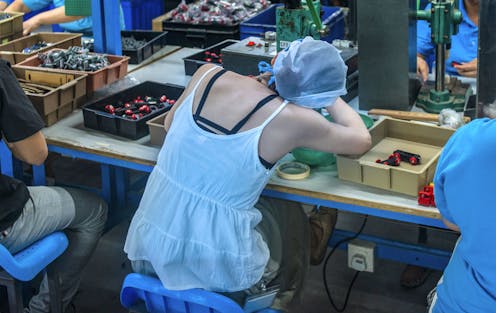
Ordinary Chinese people living their mundane, unremarkable everyday lives are persistently missing. While Western media do report on the phenomenon of rural-to-urban migration in China, the cultural and emotional lives of rural migrants – their hopes and aspirations, worries and frustrations in private life, especially in intimate, familial relations – remain largely unknown.
As a journalist writing to meet the editorial agenda of her paper, Yuan Yang may not have been able to step outside the Financial Times’ negative framework of China reporting. However, her book does not fall into this trap. For this reason, she may not achieve the phenomenal fame of someone such as Jung Chang, author of Wild Swans, the story of three generations of Chinese women (published in 1991), which some claim pandered to Western readers’ pre-existing perceptions. The publishing world does not always reward nuance and complexity.
 Goodreads
Yang’s book Private Revolutions is set in the the decades of economic reform, beginning in the 1980s, when China transformed from a socialist to a neoliberal market economy. This transformation resulted in the gradual withdrawal of state support in areas such as health, education and employment, and other market-oriented reforms.
As the state gradually outsourced the responsibility for such services to individual citizens, this has inevitably transformed people’s inner selves. Some China scholars call this process the privatisation of selfhood. The individuals in Yang’s book are caught up in this social transformation. Theirs are stories of inner revolution as they respond to, cope with, or even thrive in a dramatic new world.
Solving the problem of fear
Yang tells the stories of four women who grew up from the 1990s onwards. Three were born in rural China in very humble circumstances. The fourth was born and brought up in the city, but is the child of rural migrants. We follow their lives from the primary and middle school years in their villages.
Their lives revolve around leaving the village, getting a job in the city, finding a life partner, and in some cases, raising children. All of them battle, with varying success, with policy constraints, family expectations, and the vagaries of personal circumstances.
Siyue, whose parents left the village to start a business in the city of Shenzhen, grows up with her grandmother in rural Jiangsu province and goes on to run a private tuition company in Beijing. She falls pregnant to a man who leaves her, ending up a single mum with a three-year old daughter Eva. However, she prefers to bring up Eva with a “two-woman team” (herself and her mother) rather than find a husband.
Along with raising a child, Siyue’s education business is surviving, despite suffering a major setback during the COVID lockdown. Siyue has learned from experience the greatest fear in life is fear itself. Talking to parents living with the pressure of China’s traditional education system, who fear their children’s failure, Siyue often says,“you have to solve the problem of fear before you solve anything else”.
Goodreads
Yang’s book Private Revolutions is set in the the decades of economic reform, beginning in the 1980s, when China transformed from a socialist to a neoliberal market economy. This transformation resulted in the gradual withdrawal of state support in areas such as health, education and employment, and other market-oriented reforms.
As the state gradually outsourced the responsibility for such services to individual citizens, this has inevitably transformed people’s inner selves. Some China scholars call this process the privatisation of selfhood. The individuals in Yang’s book are caught up in this social transformation. Theirs are stories of inner revolution as they respond to, cope with, or even thrive in a dramatic new world.
Solving the problem of fear
Yang tells the stories of four women who grew up from the 1990s onwards. Three were born in rural China in very humble circumstances. The fourth was born and brought up in the city, but is the child of rural migrants. We follow their lives from the primary and middle school years in their villages.
Their lives revolve around leaving the village, getting a job in the city, finding a life partner, and in some cases, raising children. All of them battle, with varying success, with policy constraints, family expectations, and the vagaries of personal circumstances.
Siyue, whose parents left the village to start a business in the city of Shenzhen, grows up with her grandmother in rural Jiangsu province and goes on to run a private tuition company in Beijing. She falls pregnant to a man who leaves her, ending up a single mum with a three-year old daughter Eva. However, she prefers to bring up Eva with a “two-woman team” (herself and her mother) rather than find a husband.
Along with raising a child, Siyue’s education business is surviving, despite suffering a major setback during the COVID lockdown. Siyue has learned from experience the greatest fear in life is fear itself. Talking to parents living with the pressure of China’s traditional education system, who fear their children’s failure, Siyue often says,“you have to solve the problem of fear before you solve anything else”.
 The market district in Shenzen, China.
Fotos593/Shutterstock
‘We’re together aren’t we?’
June was born into a poor family of miners in the mountainous area of southern China. After losing her mother in a mining accident as a teenager, she goes to work in a garment factory near Shanghai. She studies hard to enter a mediocre local university, moves to Beijing where she falls in love with a man, and starts hunting for jobs while earning money as a private tutor.
Although she actively explores the opportunities Beijing has to offer, she and her boyfriend find the city too expensive for them to buy an apartment. The Chinese population is divided between those who have urban hukou (residential registration status) and those with rural hukou. As temporary rural hukou holders, they are not entitled to housing, education, and health care benefits enjoyed by local urban residents. It is hard for them to settle down. Her boyfriend wants to get married, but she doesn’t see the point of marriage or having children. Whenever he brings up the topic, she says, “We’re together, aren’t we?”
While June is not a woman who “has it all”, she is proud to earn enough money to survive in Beijing and still send some back to home to support her family in the village. To June, success is about “finding meaning in work and feeling a sense of progress and accomplishment”.
Labour activism
Leiya’s parents go to Shenzhen to work, leaving her behind in the village with her grandparents. Like many “left-behind children”, she drops out of high school and goes to Shenzhen to try her luck. After working in different factories, she becomes involved in labour activism. This means she must find ways to circumvent myriad obstacles from local government officials, while holding down a job in the factory and raising her daughter.
Leiya comes to know many female migrant workers from various provinces in China, now in their fifties. These women are getting near retirement age. Some fear getting laid off before they have paid enough social insurance to allow them to retire with a pension, others don’t have social insurance at all.
Leiya wants to do something to help these women. With funding from a charitable foundation and the local government, she starts a support centre to advocate for migrant women. She is keen to empower them, and keeps asking them not to always think from their bosses’ points of view. “We’re all trained to be good obedient children, but what do you want”?
The market district in Shenzen, China.
Fotos593/Shutterstock
‘We’re together aren’t we?’
June was born into a poor family of miners in the mountainous area of southern China. After losing her mother in a mining accident as a teenager, she goes to work in a garment factory near Shanghai. She studies hard to enter a mediocre local university, moves to Beijing where she falls in love with a man, and starts hunting for jobs while earning money as a private tutor.
Although she actively explores the opportunities Beijing has to offer, she and her boyfriend find the city too expensive for them to buy an apartment. The Chinese population is divided between those who have urban hukou (residential registration status) and those with rural hukou. As temporary rural hukou holders, they are not entitled to housing, education, and health care benefits enjoyed by local urban residents. It is hard for them to settle down. Her boyfriend wants to get married, but she doesn’t see the point of marriage or having children. Whenever he brings up the topic, she says, “We’re together, aren’t we?”
While June is not a woman who “has it all”, she is proud to earn enough money to survive in Beijing and still send some back to home to support her family in the village. To June, success is about “finding meaning in work and feeling a sense of progress and accomplishment”.
Labour activism
Leiya’s parents go to Shenzhen to work, leaving her behind in the village with her grandparents. Like many “left-behind children”, she drops out of high school and goes to Shenzhen to try her luck. After working in different factories, she becomes involved in labour activism. This means she must find ways to circumvent myriad obstacles from local government officials, while holding down a job in the factory and raising her daughter.
Leiya comes to know many female migrant workers from various provinces in China, now in their fifties. These women are getting near retirement age. Some fear getting laid off before they have paid enough social insurance to allow them to retire with a pension, others don’t have social insurance at all.
Leiya wants to do something to help these women. With funding from a charitable foundation and the local government, she starts a support centre to advocate for migrant women. She is keen to empower them, and keeps asking them not to always think from their bosses’ points of view. “We’re all trained to be good obedient children, but what do you want”?
 Young Chinese migrant workers take part in an examination at a factory in Dongguan city, Guangdong province, in 2007.
Zhan youbing/AAP
Leiya and her husband must also negotiate the generational conflict between she and her daughter. Her daughter sees Leiya as stingy with money, rude and uncouth. Leiya sees her daughter as tempestuous, disobedient and wasting money on make-up and fashion. She wishes her daughter would study hard instead.
Then there is Sam. She is the only woman who, despite her parents’ humble background, manages to live an urban, middle-class life. She was born in Shenzhen where her parents worked in factories. She went to a university in another city and met the author as a sociology graduate studying Chinese labour policy.
Sam has developed a strong interest in left-wing politics, especially activism in the labour movement. Having worked in labour NGOs as both an officer and a volunteer, much of her work involves tactfully mediating between the media, the government and labour organisations.
As the political space for activism dwindles further, Sam opts to go overseas to pursue her PhD studies. She is not yet sure what her future will be: as an academic who stays overseas, or returning to China to apply her academic skills to labour activism.
A breath of fresh air
Yang’s book is a breath of fresh air. Readers will emerge from it realising Chinese people are, well, just like them. Despite living in a very different political system, they are also chasing their own dreams of upward mobility. They’re trying to get ahead in life, often with stress and frustrations, but also a sense of achievement.
The microscopic lens through which these individuals’ stories are told is richly informative, shedding light on big-picture issues including urbanisation, migration, and economic liberalisation under the auspices of an authoritarian government.
Yuan Yang is at once a reporter, a consummate storyteller, a self-appointed anthropologist and most importantly, a friend to the people she writes about.
Authors: Wanning Sun, Professor of Media and Cultural Studies, University of Technology Sydney
Young Chinese migrant workers take part in an examination at a factory in Dongguan city, Guangdong province, in 2007.
Zhan youbing/AAP
Leiya and her husband must also negotiate the generational conflict between she and her daughter. Her daughter sees Leiya as stingy with money, rude and uncouth. Leiya sees her daughter as tempestuous, disobedient and wasting money on make-up and fashion. She wishes her daughter would study hard instead.
Then there is Sam. She is the only woman who, despite her parents’ humble background, manages to live an urban, middle-class life. She was born in Shenzhen where her parents worked in factories. She went to a university in another city and met the author as a sociology graduate studying Chinese labour policy.
Sam has developed a strong interest in left-wing politics, especially activism in the labour movement. Having worked in labour NGOs as both an officer and a volunteer, much of her work involves tactfully mediating between the media, the government and labour organisations.
As the political space for activism dwindles further, Sam opts to go overseas to pursue her PhD studies. She is not yet sure what her future will be: as an academic who stays overseas, or returning to China to apply her academic skills to labour activism.
A breath of fresh air
Yang’s book is a breath of fresh air. Readers will emerge from it realising Chinese people are, well, just like them. Despite living in a very different political system, they are also chasing their own dreams of upward mobility. They’re trying to get ahead in life, often with stress and frustrations, but also a sense of achievement.
The microscopic lens through which these individuals’ stories are told is richly informative, shedding light on big-picture issues including urbanisation, migration, and economic liberalisation under the auspices of an authoritarian government.
Yuan Yang is at once a reporter, a consummate storyteller, a self-appointed anthropologist and most importantly, a friend to the people she writes about.
Authors: Wanning Sun, Professor of Media and Cultural Studies, University of Technology Sydney 
















