

Modern Australian
The Times

Trying to save money? Our research suggests paying in cash – while you still can

  • Written by Lachlan Schomburgk, PhD Researcher in Marketing, University of Adelaide
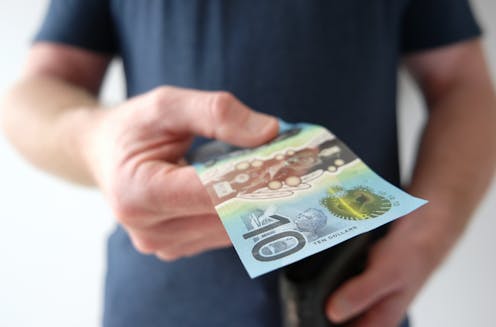
Trying to save money? Our research suggests paying in cash – while you still can

Cash is in crisis. In Australia, it’s now only used for 16% of in-person transactions, down from about 70% in 2007.

The situation is so dire that on Monday, independent federal MP Andrew Gee introduced a private member’s bill that would force businesses to accept cash or else face big fines.

Woman makes EFTPOS payment using phone
Digital wallets mean even physical bank cards are no longer required. Christiann Koepke/Unsplash

The reality is that over the past decade, technological advancements have utterly transformed the way we pay for goods and services.

Phones and smartwatches can now easily be used to pay by card, and buy-now-pay-later schemes and cryptocurrency payments offer further alternatives.

The shift away from cash only accelerated throughout the COVID pandemic, as health experts recommended avoiding using it for hygiene reasons.

Despite these big changes in how we spend money, Australians have perhaps been more focused on how much amid a stubborn cost-of-living crisis.

In light of this, our research team wanted to investigate how our choice of payment method can interact with our actual spending habits.

Our latest research offers a simple solution for anyone looking to save money — carry more cash!

Read more: Money transporter Armaguard is in peril. Could cash be dead sooner than we think?

We pay less when we pay cash

Drawing on both academic and industry sources, our research team combined the results from more than four decades of prior research on spending behaviour and payment methods into a large dataset.

This data spanned 71 research papers, 17 countries, and more than 11,000 participants. State-of-the-art meta-analysis techniques then allowed us to collectively analyse the results from all these prior studies, and re-examine their insights.

We found that cashless payments were indeed associated with higher levels of consumer spending compared to cash transactions, something that is referred to in the literature as the “cashless effect”.

This cashless effect was consistent across all other payment methods in the data set.

Put simply, it doesn’t matter whether you use a credit card, debit card or a buy-now-pay-later service – you are likely to spend more money using cashless methods than when you pay with cash.

The pain of paying

Under the traditional economic view that consumers behave rationally, there should be no differences in spending behaviour between different payment methods – money is money after all.

But the existence of the cashless effect shows that the payment methods we use do indeed influence our spending behaviour.

The leading theory to explain this effect attributes it to differences in the “pain of paying”, a concept first coined in 1996 that describes the emotions we feel when spending money.

Importantly, our choice of payment method can influence the level of pain felt.

Woman's hands open wallet showing two $20 notes
Spending cash means holding and losing a tangible object that we feel like we own. Michael Leslie/Shutterstock

When paying with cash, we have to physically count out notes and coins and hand them over. Humans seek to avoid losses, and paying by cash sees us physically lose a tangible object.

Conversely, nothing has to be handed over to pay cashlessly. We don’t lose anything tangible with a swipe or a tap, so it feels less painful.

Preliminary neurological evidence suggests that the “pain of paying” isn’t just an abstract metaphor, and we may feel actual psychological pain with each transaction we make.

Research employing functional magnetic resonance imaging (fMRI) scans to observe brain activity in consumers has shown that paying activates brain regions related to experiencing psychological discomfort.

Mother and a young child drive dodgem car together in theme-park
Using cash slows us down, helping us keep track of spending. StockLite/Shutterstock

Picture this: You’re at a theme park, excited for a fun day. You use your smartwatch to pay for snacks, souvenirs and rides. It’s all so convenient that you don’t realise how much you’re spending until you check your account later and see that you have completely blown your budget!

This is the cashless effect in action − if nothing is physically handed over, it’s easy to lose track of how much is spent.

A great tool for budgeting – while it lasts

The cost of living crisis has made spending control front-of-mind for many people. Our meta-analysis suggests that returning to “cold hard cash” whenever possible could be one valuable tool to help.

The increased friction felt when using cash could help people better control their money, even just by providing a moment to pause and consider whether a transaction is necessary.

This could help individuals make more mindful decisions, saving money while they can in an increasingly cashless world.

Authors: Lachlan Schomburgk, PhD Researcher in Marketing, University of Adelaide

Read more https://theconversation.com/trying-to-save-money-our-research-suggests-paying-in-cash-while-you-still-can-231499

What’s Trending in Men’s Jewellery This Father’s Day!

Finding a Father’s Day gift that feels personal, stylish and genuinely wearable is not always easy. While socks and novelty mugs have traditionall...

Road Signs: Understanding Their Role in Clear and Effective Signage

Effective signage and display hardware can help businesses communicate information, promote products and organise customer or visitor movement. Road...

Bottle Label Printing: Key Factors to Consider Before Your Next Packaging Run

Effective packaging begins with understanding the product, bottle material, artwork and production requirements when planning bottle label printing. H...

Planning a Long-Distance Move With Interstate Movers Melbourne

Moving between states involves more planning than a typical local relocation. Along with packing and transporting household belongings, you need to...

Understanding the Role of an I/O Controller in Industrial Automation

Modern industrial systems depend on accurate communication between sensors, machines and control systems. An I/O controller can help manage this commu...

How the Right Mining Hose Supports Demanding Operations

Mining environments place considerable demands on equipment used for material transfer, water management and processing. Hoses operating in these co...

Simple Ideas for Making Social Gatherings More Memorable

We have all been to those parties where everyone just stands around the kitchen island, staring at their phones, waiting for someone else to make a mo...

Outdoor Wall Lights: Improving Exterior Lighting Around Your Home

Lighting can influence how a room looks, feels and functions, so the right fitting should be selected according to both appearance and practical req...

Commercial Office Cleaning: Combining Routine Office Cleaning With Melbourne Service

Keeping a workplace clean requires a service that can accommodate everyday tasks as well as the particular needs of the business. Professional comme...

Caravan Sales in Queensland: How to Find the Right Caravan for Sale QLD

Caravan ownership is about more than having somewhere to sleep while travelling. For many Queenslanders, it is one of the best ways to explore regio...

What Sir Walter Buffalo Turf Actually Costs in 2026 (And Why Quotes Vary So Much)

Two quotes landed on a Hills District homeowner's kitchen table last spring for the exact same 80-square-metre backyard. One said $12 a metre. The o...

Nearly 1,300 NSW Hospital Beds Are Occupied By People Who Are Ready To Go Home

1,276 people in NSW hospitals have been medically cleared for discharge but remain in hospital because they're still waiting for NDIS or aged care sup...

National Survey Launched to Measure Operational Impacts of Federal NDIS Policy Reforms

The effects of recent NDIS reforms are beginning to move beyond policy papers and into day to day service delivery. A new national survey is asking ...

Beyond the Nappy Cake: Baby Shower Gifts That Get Used

What new Australian parents unwrap, keep, and quietly thank you for months later. Six weeks after my daughter was born, I did an audit of the baby sh...

Parent-Advocates Are Reshaping Frontline Disability Service Delivery

Parents have always been part of the disability sector. They advocate, coordinate services, challenge decisions and often become the person holding ev...

Vista Cruises Enters "Two-Flagship Era" as Vista Aurora Completes Inaugural Voyage

Vista Aurora Sets Sail along the Yangtze. (Photo courtesy of the company)YICHANG, China — August 5, 2026 — Vista Aurora, a high-end interprovinc...

A Digital Preparation Checklist For International Medical Conferences

An international medical conference compresses many responsibilities into a few days. A delegate may need to present research, move between venues, ...

The Growing Popularity of Lab Grown Diamonds in Sydney and Hong Kong

The diamond industry has changed significantly in recent years as more buyers seek ethical, affordable, and sustainable alternatives to mined diamon...
















