

Bad weather, hills and the dark deter cyclists, particularly women. So what can we do about it?
- Written by Richard Bean, Research Fellow, School of Information Technology and Electrical Engineering, The University of Queensland
The gender gap in urban cycling worldwide is staggering. Most cyclists are young to middle-aged men – hence phenomena such as “lycra cyclists” or “mamils”.
In Anglo countries, including Australia, only one in four commuter cyclists and one in three recreational cyclists are women. This is not healthy. While cycling is good for everyone, women stand to gain more because they typically exercise less than men.
Women are also at higher risk of osteoporosis, arthritis, anxiety, depression and various autoimmune diseases. So they need more of the type of exercise like cycling that builds bone density, strengthens muscles, helps manage weight and improves mood.
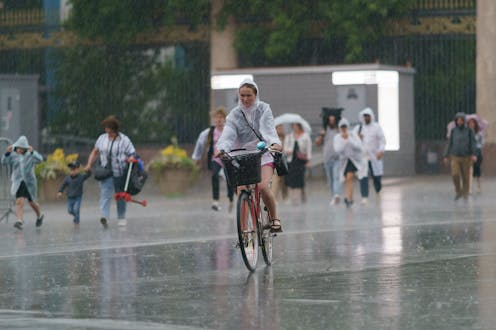
So what’s stopping women from cycling? Our new research analysed more than 200 million bike-sharing trips in ten cities worldwide, including Brisbane, over a period of 14 years. We found that slopes, darkness and bad weather affect numbers of female cyclists more than male cyclists.
The expectations of female users of bike-sharing schemes are probably similar to the expectations of female cyclists in general. Our findings point to a number of solutions to close the gender gap in cycling.
Women face specific barriers to cycling
Gender-specific barriers to cycling range from lower confidence to lower strength (on average). Sprawling cities, which create long distances between destinations, and a lack of high-quality cycling infrastructure are known to deter women from cycling.
However, some barriers are due to the natural environment.
For example, women may avoid cycling or choose to cycle only in the daytime. When it’s dark, they fear assaults or victimisation. This is a problem in cities such as Brisbane and Sydney where it gets dark by 5pm in winter, so women are reluctant to cycle home after work.
Many workplaces have dress codes and some expect women to wear skirts, heels and makeup. As a result, these employees may avoid commuting by bike in rainy, cold or humid weather, especially where end-of-ride facilities, such as showers, are missing at work.
Cycling infrastructure is often located on floodplains, such as along rivers. In flood-prone areas, such as much of eastern Australia, women may avoid cycling in wet weather due to fear of slippery, flooded roads and paths.
Sun exposure along uncovered paths can be a deterrent too. Women are more health-conscious and bear more responsibility for their family’s heath and wellbeing.
Finally, women tend to prefer moderate-intensity exercise and less vigorous travel. This may lead them to avoid cycling in hilly areas.
Climate change may increase or decrease some of these natural barriers to cycling depending on location.
How big is the gender impact of natural barriers?
So far, studies linking gender and cycling have been sparse. Partly this is because transport surveys and observations are difficult and costly.
In our study, we took a different approach: we used data harvested from digital bike-sharing systems. Trip and gender data were matched with weather, slope and sunset/sunrise data from various public agencies. Then, we built statistical models for ridership.
In most cities, we found rain and wind deterred female riders more than male riders.
For example, in New York, an extra 1 millimetre of rain per hour reduced the number of male riders by 35% and female riders by 39% (all else being equal). Similarly, for every 1 metre per second increase in wind speed, male riders reduced by 5.4% and female riders by 5.8%.
Where slopes were more than 1%, we found a significant difference between male and female rider counts in most cities.
Finally, male ridership was higher in the dark (before sunrise or after sunset) in all cities.
How can bicycles become a girl’s best friend?
Women tend to prefer cycling that is safe, non-strenuous and seamlessly incorporated into their daily routines. Providing maximum separation from cars along main streets and in street junctions and applying traffic-calming devices in neighbourhood streets can help improve safety. So would creating off-road cycling tracks, such as through parks.
We also offer some recommendations to help eliminate natural barriers.
Electric bikes offer much potential here. They require much less effort to ride than conventional bicycles. Thus, they enable longer trips, greater comfort in hilly and windy places, and faster trips in the dark or rain.
Therefore, cities could consider full or partial electrification of bike-share fleets.
Another strategy is to minimise the exposure of bike paths. Paths can be covered by manufactured shelters or tree canopies, and even artificially cooled by fans. This would reduce the effects of heat, sun, wind and rain.
Some good examples and ideas come from tropical or desert climes, such as Singapore and Dubai, rather than from temperate places.
To deal with safety and security concerns in the dark, whether actual or perceived, cities need to provide better lighting along cycling routes.
More broadly, easily cyclable urban areas should become the goal of urban planning.
Dutch road design makes easier, safer cycling a priority.Authors: Richard Bean, Research Fellow, School of Information Technology and Electrical Engineering, The University of Queensland

















