

A strange intermittent radio signal from space has astronomers puzzled
- Written by Manisha Caleb, Lecturer, University of Sydney

When astronomers turn our radio telescopes out towards space, we sometimes detect sporadic bursts of radio waves originating from across the vast expanse of the universe. We call them “radio transients”: some erupt only once, never to be seen again, and others flicker on and off in predictable patterns.
We think most radio transients come from rotating neutron stars known as pulsars, which emit regular flashes of radio waves, like cosmic lighthouses. Typically, these neutron stars spin at incredible speeds, taking mere seconds or even a fraction of a second to complete each rotation.
Recently, we discovered a radio transient that isn’t like anything astronomers have seen before. Not only does it have a cycle almost an hour long (the longest ever seen), but over several observations we saw it sometimes emitting long, bright flashes, sometimes fast, weak pulses – and sometimes nothing at all.
We can’t quite explain what’s going on here. It’s most likely a very unusual neutron star, but we can’t rule out other possibilities. Our research is published in Nature Astronomy.
A lucky find
Meet ASKAP J1935+2148 (the numbers in the name point to its location in the sky). This periodic radio transient was discovered using CSIRO’s ASKAP radio telescope on Wajarri Yamaji Country in outback Western Australia.
The telescope has a very wide field of view, which means it can survey large volumes of the universe very quickly. This makes it very well suited for detecting new and exotic phenomena.
Using ASKAP, we were simultaneously monitoring a source of gamma rays and searching for pulses from a fast radio burst, when we spotted ASKAP J1935+2148 slowly flashing in the data. The signal leapt out because it was made up of “circularly polarised” radio waves, which means the direction of the waves corkscrews around as the signal travels through space.

Our eyes cannot differentiate between circularly polarised light and ordinary unpolarised light. However, ASKAP functions like a pair of polaroid sunglasses, filtering out the glare from thousands of ordinary sources.
After the initial detection, we conducted further observations over several months using ASKAP and also the more sensitive MeerKAT radio telescope in South Africa.
The slowest radio transient ever found
ASKAP J1935+2148 belongs to the relatively new class of long-period radio transients. Only two others have ever been found, and ASKAP J1935+2148’s 53.8 minute period is by far the longest.
However, the exceptionally long period is just the beginning. We have seen ASKAP J1935+2148 in three distinct states or modes.
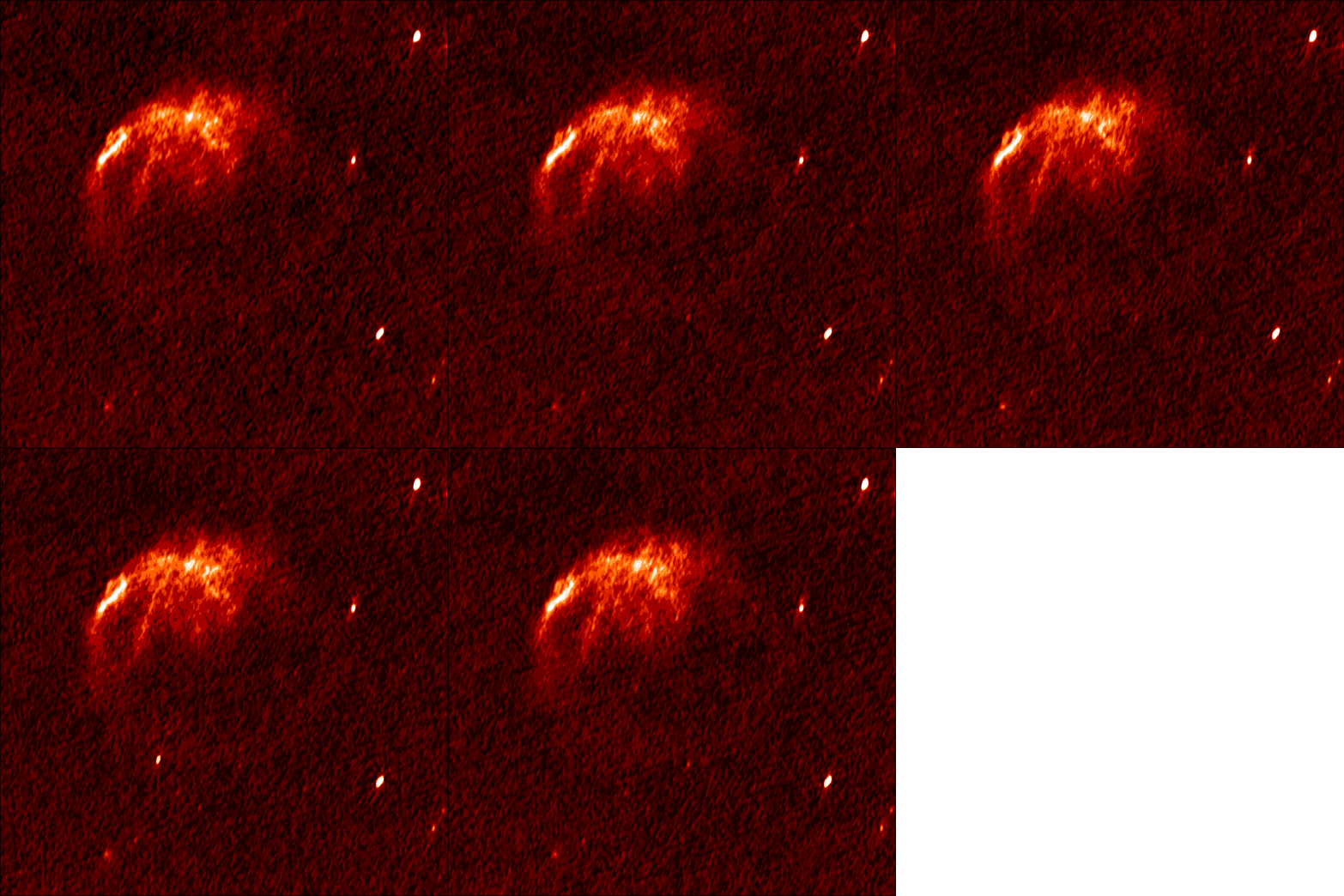 ASKAP J1935+2148 blinking on and off. The glowing cloud above is the remains of a long-ago exploded star called a supernova remnant.
Emil Lenc, CC BY-NC
ASKAP J1935+2148 blinking on and off. The glowing cloud above is the remains of a long-ago exploded star called a supernova remnant.
Emil Lenc, CC BY-NC
In the first state, we see bright, linearly (rather than circularly) polarised pulses lasting from 10 to 50 seconds. In the second state, there are much weaker, circularly polarised pulses lasting only about 370 milliseconds. The third state is a quiet or quenched state, with no pulses at all.
These different modes, and the switching between them, could result from an interplay of complex magnetic fields and plasma flows from the source itself with strong magnetic fields in the surrounding space.
Similar patterns have been seen in neutron stars, but our current understanding of neutron stars suggests they should not be able to have such a long period.
Neutron stars and white dwarfs
The origin of a signal with such a long period remains a profound mystery, with a slow-spinning neutron star the prime suspect. However, we cannot rule out the possibility the object is a white dwarf – the Earth-sized cinder of a burnt-out star that has exhausted its fuel.
White dwarfs often have slow rotation periods, but we don’t know of any way one could produce the radio signals we are seeing here. What’s more, there are no other highly magnetic white dwarfs nearby, which makes the neutron star explanation more plausible.
One explanation might be that the object is part of a binary system in which a neutron star or white dwarf orbits another unseen star.
This object might prompt us to reconsider our decades-old understanding of neutron stars or white dwarfs, particularly in how they emit radio waves and what their populations are like within our galaxy. Further research is needed to confirm what the object is, but either scenario would provide valuable insights into the physics of these extreme objects.
The search continues
We don’t know how long ASKAP J1935+2148 has been emitting radio signals, as radio astronomy surveys don’t usually search for objects with periods this long. Moreover, radio emissions from this source are only detected for a mere 0.01% to 1.5% of its rotation period, depending on its emission state.
So we were quite fortunate we happened to catch sight of ASKAP J1935+2148. It’s quite likely there are many other objects like it elsewhere in our galaxy, waiting to be discovered.
Authors: Manisha Caleb, Lecturer, University of Sydney

















