

Modern Australian
The Times

Hydration is really important for learning. How much do kids need to drink?

  • Written by Talitha Best, Professor of Psychology, CQUniversity Australia
Hydration is really important for learning. How much do kids need to drink?

Last month, Ballarat Clarendon College began a trial to ban water bottles in the classroom for students in Years 5 to 9. According to the school, “early feedback” indicated it had reduced noise and bathroom breaks during class time.

Along with becoming a status symbol and fashion item, water bottles are now considered essential for school.

So how much water do children need in a day? And what impact does it have on their brains?

How much fluid do children and teenagers need?

The amount of fluid children need will depend on the weather and how much physical activity they do. But as a general guide:

  • children aged four to eight should have about 1.2 litres per day

  • boys nine to 13 should have 1.6 litres

  • girls nine to 13 should have 1.4 litres

  • boys over 14 should have 1.9 litres

  • girls over 14 should have 1.6 litres.

As the Australian Dietary Guidelines stress, it is preferable to meet most fluid needs by drinking plain water. If your child does not like drinking water you could consider adding a squeeze of juice.

Research suggests many school-aged children do not drink enough and arrive at school already dehydrated. A 2017 study involving 6,469 children (aged four to 17) from 13 countries (not including Australia) found 60% of children and 75% of adolescents did not consume enough water from fluids.

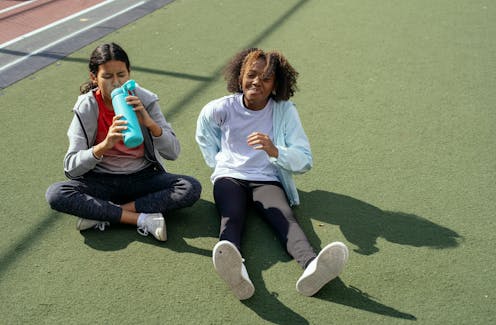
A young girl drinks from a bottle. Children sit on nearby grass.
Our brains need water so we can think and regular emotions. Kampus Production/Pexels, CC BY

How often do they need to drink?

There is no specific advice about how often children and adolescents need to drink. But the main message from research is students need to start drinking from the time they get up.

Having a drink of water first thing in the morning regulates the body and brain to use water well, setting up mental performance for the rest of the day.

Research also tells us children need to keep drinking substantial amounts of water (about 250-300ml) throughout the day, rather than just taking little sips here and there to keep the brain in a hydrated state.

Why is water so important for our brains?

About 75% of all brain mass is water and our brains need water to keep working.

Among other functions, water helps brain cells and tissue to balance hormone levels, maintain proper blood flow and deliver vitamins, minerals and oxygen to your brain.

Even mild levels of dehydration can increase levels of the hormone cortisol, which can lead to feeling nervous, tense and irritable. This can muddle up the brain’s processing of information as well as our energy levels, emotions and behaviour.

So if students are adequately hydrated it sets up their brains to be in an optimal state to concentrate and pay attention at school.

How can water help learning?

Beyond helping our bodies to function, research also shows drinking water can help our brains to learn.

A 2020 study of German children in Year 5 and 6 showed those who had at least 50% of their daily water requirements (about 1 litre) over a four hour period in the morning had better memory performance overall.

The research showed children’s ability to pay attention to visual information was much better after drinking water, compared to no water.

A 2019 US study looked at the the impact of water on young people’s “cognitive flexibility”. This is the capacity to think about multiple concepts at the same time or quickly switch thinking between two concepts.

Over four days, children aged nine to eleven were given different amounts to drink. Those who drank up to 2.5 litres of water over 24 hours (even more than the recommended adequate amount) were better at switching between mental tasks compared to those who drank lesser amounts.

A hand holds a glass of water.
Drinking adequate water helps brains to learn. Engin Akyurt/Unsplash, CC BY

Water as part of children’s routines

Having other regular moments for drinking water can also help create steady routines for children and young people. Routines are an important way to manage attention, emotions and behaviour.

Water breaks don’t necessarily need to be during class time (particularly if schools are finding them disruptive). But they do need to be at predictable times during the day.

So, having a drink of water when kids wake up, at meal times, when kids get to school, at the start or end of classes and when they get home can all provide useful anchor points.

Authors: Talitha Best, Professor of Psychology, CQUniversity Australia

Read more https://theconversation.com/hydration-is-really-important-for-learning-how-much-do-kids-need-to-drink-231485

Road Signs: Understanding Their Role in Clear and Effective Signage

Effective signage and display hardware can help businesses communicate information, promote products and organise customer or visitor movement. Road...

Bottle Label Printing: Key Factors to Consider Before Your Next Packaging Run

Effective packaging begins with understanding the product, bottle material, artwork and production requirements when planning bottle label printing. H...

Planning a Long-Distance Move With Interstate Movers Melbourne

Moving between states involves more planning than a typical local relocation. Along with packing and transporting household belongings, you need to...

Understanding the Role of an I/O Controller in Industrial Automation

Modern industrial systems depend on accurate communication between sensors, machines and control systems. An I/O controller can help manage this commu...

How the Right Mining Hose Supports Demanding Operations

Mining environments place considerable demands on equipment used for material transfer, water management and processing. Hoses operating in these co...

Simple Ideas for Making Social Gatherings More Memorable

We have all been to those parties where everyone just stands around the kitchen island, staring at their phones, waiting for someone else to make a mo...

Outdoor Wall Lights: Improving Exterior Lighting Around Your Home

Lighting can influence how a room looks, feels and functions, so the right fitting should be selected according to both appearance and practical req...

Commercial Office Cleaning: Combining Routine Office Cleaning With Melbourne Service

Keeping a workplace clean requires a service that can accommodate everyday tasks as well as the particular needs of the business. Professional comme...

Caravan Sales in Queensland: How to Find the Right Caravan for Sale QLD

Caravan ownership is about more than having somewhere to sleep while travelling. For many Queenslanders, it is one of the best ways to explore regio...

What Sir Walter Buffalo Turf Actually Costs in 2026 (And Why Quotes Vary So Much)

Two quotes landed on a Hills District homeowner's kitchen table last spring for the exact same 80-square-metre backyard. One said $12 a metre. The o...

Nearly 1,300 NSW Hospital Beds Are Occupied By People Who Are Ready To Go Home

1,276 people in NSW hospitals have been medically cleared for discharge but remain in hospital because they're still waiting for NDIS or aged care sup...

National Survey Launched to Measure Operational Impacts of Federal NDIS Policy Reforms

The effects of recent NDIS reforms are beginning to move beyond policy papers and into day to day service delivery. A new national survey is asking ...

Beyond the Nappy Cake: Baby Shower Gifts That Get Used

What new Australian parents unwrap, keep, and quietly thank you for months later. Six weeks after my daughter was born, I did an audit of the baby sh...

Parent-Advocates Are Reshaping Frontline Disability Service Delivery

Parents have always been part of the disability sector. They advocate, coordinate services, challenge decisions and often become the person holding ev...

Vista Cruises Enters "Two-Flagship Era" as Vista Aurora Completes Inaugural Voyage

Vista Aurora Sets Sail along the Yangtze. (Photo courtesy of the company)YICHANG, China — August 5, 2026 — Vista Aurora, a high-end interprovinc...

A Digital Preparation Checklist For International Medical Conferences

An international medical conference compresses many responsibilities into a few days. A delegate may need to present research, move between venues, ...

The Growing Popularity of Lab Grown Diamonds in Sydney and Hong Kong

The diamond industry has changed significantly in recent years as more buyers seek ethical, affordable, and sustainable alternatives to mined diamon...

Modern AI SEO Agency vs Traditional SEO: What’s the Difference

Search engine optimisation has changed dramatically over the past few years. Search engines have become smarter, user behaviour has evolved, and bus...
















