

A shocking 79% of female scientists have negative experiences during polar field work
- Written by Rebecca Duncan, PhD Candidate in Polar Marine Ecology and Climate Change, University of Technology Sydney
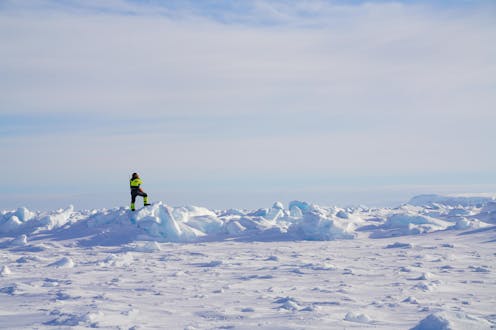
Every day, women are working on frontier science in Earth’s unforgiving polar environments. Our study, published today in PLOS Climate, investigated what their experiences are actually like.
Fieldwork in the Arctic and Antarctica is a critical part of the scientific research that’s addressing the unprecedented challenges of global climate change. It ranges from day trips to living onboard research ships in the Arctic and Southern Oceans, to spending months at research bases in the polar regions.
Women play a critical role in just about all of it. They take on fieldwork roles from research assistant to team leader. However, our survey found women overwhelmingly report negative experiences during polar fieldwork.
Conditions need to change – institutions and fieldwork leaders have a responsibility to consider women’s needs. They also must increase accountability for problematic behaviour.
What did our survey find?
From September to November 2023, we surveyed women undertaking fieldwork in polar regions.
We received over 300 responses from around the world. The survey group, aged 18–70+, captured a range of ethnicities, life experiences and career stages.
Alarmingly, we found 79% of respondents had negative experiences while doing fieldwork in the Arctic and Antarctica. These were driven by difficult team dynamics, lack of accountability for bullying or harassment, challenges with communication and sexism.
Reprehensible conditions were reported by up to a quarter of respondents, including sexual harassment, psychosocial harm, violence, racism and homophobia.
Inherent to polar field work is close-quarter living. Only a third of respondents reported having access to personal space during fieldwork. This can be difficult at the best of times, and particularly when coupled with bullying or harassment.
Combined with poor leadership, it’s a recipe for ruin. Imagine being stuck for days, weeks or months with a toxic team culture and nowhere to turn.
It’s clear why one of the most pervasive negative experiences reported was problematic field team dynamics.

Women don’t want to appear ‘problematic’
Women caught in these circumstances frequently feel they can’t speak up. They don’t trust their report will be confidential, or don’t have access to reliable reporting structures.
Even when such structures exist, inherent cultural issues often prevent women from speaking out. Women, particularly early in their career, are concerned about being seen as “problematic” and having their opportunities limited.
Women who do report harassment often find there’s a lack of accountability and consequences for the wrongdoer, or they’re “let off the hook due to personal connections” and unbalanced power dynamics. Worse still, some women report further bullying as a result of speaking up.
Read more: Antarctic stations are plagued by sexual harassment – it's time for things to change
Unsurprisingly, those we surveyed reported sexism as a prevalent and deeply negative experience. While huge headway has been made since the days of polar research being dominated by white men, a lingering of male dominance prevails.
Many women report an inequity of gender roles. Women are commonly assigned an unequal load of cooking and cleaning, and constrained to more lab-based roles than their male counterparts.
Women also describe an under-expectation of their physical strength or that “male colleagues need less experience to be taken more seriously”. On a personal note, I have had scientific equipment taken from me in the field and told “this is not women’s work”.
Anecdotally, this gender bias translates into women not being offered opportunities due to concerns ranging from being “too emotional”, to their family life (or future family) getting in the way.
 The author posing with ice core drilling equipment.
Stuart Thomson
The author posing with ice core drilling equipment.
Stuart Thomson
Even in field teams where sexism is intentionally addressed, gender bias prevails in other, less obvious ways. During fieldwork, women have difficulty managing menstruation due to lack of privacy, weather and scarcity of toilet breaks.
Some women don’t go into the field at all because of this reason, missing out on valuable learning and work opportunities.
Read more: People stationed in Antarctica menstruate too – and it's a struggle. Here's how we can support them
Additionally, most equipment – such as one-piece snowsuits or frostbite face coverings – is not designed with women’s bodies in mind. This puts women at unequal risk of cold injuries.
How can we support women in polar fieldwork?
Our research identified that very few polar fieldwork expeditions had a clear code of conduct or harassment reporting structure. It is absolutely critical we fix this at an institutional level so women can safely speak up.
A good starting point is the draft code of conduct from the Association of Early Career Polar Scientists.
Prior to departure, institutions must provide mandatory training on team dynamics and equity, diversity and inclusion, particularly for people in leadership. Everyone involved should foster proactive, flexible and empathetic environments where women can advocate for themselves and others.
We found that despite negative experiences, most women wanted to continue doing polar research. It is addictive, exciting and often deeply rewarding work, necessary to understand the rapid environmental changes affecting our planet.
The stereotypical qualities of women – such as being accommodating, patient and nurturing – can be critical to thriving in extreme environments. Women belong in the Arctic and Antarctica, and all field sciences for that matter. They commonly bring a unique perspective to scientific tasks, and being a woman should never be identified as a weakness.
Read more: White continent, white blokes: why Antarctic research needs to shed its exclusionary past
Authors: Rebecca Duncan, PhD Candidate in Polar Marine Ecology and Climate Change, University of Technology Sydney

















