

The secrets of Maya child sacrifice at Chichén Itzá uncovered using ancient DNA
- Written by Adam "Ben" Rohrlach, Mathematician and Ancient DNA Researcher, University of Adelaide
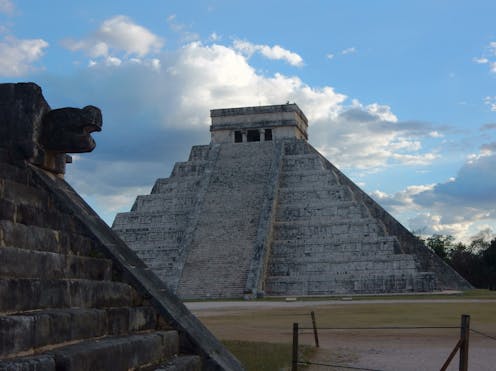
After analysing the remains of 64 ancient sacrificed individuals, most of whom were children, researchers have revealed new details about human sacrifice at the ancient Maya site of Chichén Itzá.
Published today in Nature, these results show that contrary to popular belief, every one of the ritually sacrificed individuals was male. Additionally, many of them were closely related, including two pairs of identical twins, evoking important themes of Mayan mythology.
These ancient genomes also show that, despite European colonialism, the genetic legacy of the ancient Maya continues in today’s Indigenous people from the region.
Discovery of the ancient chultún at Chichén Itzá
The Maya civilisation was a Mesoamerican culture on the Yucatán peninsula in Mexico. The city of Chichén Itzá emerged at around 250 CE and ended in 1697 CE with the Spanish conquest of the region. It was one of the largest and most influential Mayan cities, and a political centre of the civilisation.
Today, Chichén Itzá is one of the most intensively studied archaeological sites in all of Mesoamerica. It contains two ceremonially important features. Most well-known is Chichén Itzá’s largest structure, El Castillo (also known as the Temple of Kukulkán).
Important, too, was the Sacred Cenote (also known as the Well of Sacrifice), a natural sinkhole leading to an underground water source. Dredging excavations since the early 1900s have recovered, among other things, golden artefacts and human skeletons from the bottom of the cenote.

During the 1967 construction of an airport runway 300 metres northeast of the Sacred Cenote, a chultún (a human-made cistern typically built for storing drinkable water) was discovered.
The chamber and an adjacent cave contained many skeletal remains covered by mostly undisturbed bark and limestone powder, as well as animal bones and ceramic objects.
Radiocarbon dating placed these ritual sacrifices over a 500-year period, from approximately 600 CE until 1100 CE, around the time of Chichén Itzá’s decline.
 a) Location of the Maya region in the Americas. b) Geographical locations of Chichén Itzá and Tixcacaltuyub in the Yucatan peninsula. c) Stratigraphy for the chultún and the adjacent cave in which the burial was found. d) Location of the chultún within the archaeological site of Chichén Itzá and its relation to El Castillo. Image taken from DOI.
Rodrigo Barquera
a) Location of the Maya region in the Americas. b) Geographical locations of Chichén Itzá and Tixcacaltuyub in the Yucatan peninsula. c) Stratigraphy for the chultún and the adjacent cave in which the burial was found. d) Location of the chultún within the archaeological site of Chichén Itzá and its relation to El Castillo. Image taken from DOI.
Rodrigo Barquera
*add DOI link to above ^ *
It is thought the sacrifices were associated with the agricultural cycles of corn, an important staple crop for the Maya. Or they may have been given as offerings to the Maya rain deity Chaac.
However, despite years of study, many questions about the use of Chichén Itzá and whether the Mayan people had left a genetic legacy remained unanswered.
Who was sacrificed and placed in the chultún?
Due to Spanish accounts from the 16th century, and skeletal remains dredged from the Sacred Cenote, it was believed mostly young women and girls were sacrificed at the site.
However, our new genetic results of remains found in the chultún showed each of the individuals was male. Previous analyses showed that about half of the sacrificed individuals were between the ages of 3 to 6 years, and none had reached adulthood.
 The remains of one of the sacrificed individuals from the chultún at Chichén Itzá. Photo taken during the original excavation in 1967. Reproduced here with permission.
Márquez Morfín, Lourdes. 'Osario infantil en un chultún en Chichen Itza.' Memorias de la XVII Mesa Redonda de la Sociedad Mexicana de Antropología.
The remains of one of the sacrificed individuals from the chultún at Chichén Itzá. Photo taken during the original excavation in 1967. Reproduced here with permission.
Márquez Morfín, Lourdes. 'Osario infantil en un chultún en Chichen Itza.' Memorias de la XVII Mesa Redonda de la Sociedad Mexicana de Antropología.
By studying DNA collected from the petrous bones (the site in which the inner ear sits, and one of the densest bones in the human organism) of the skeletons, we learned that one-quarter of the individuals were closely related. This is much higher than we normally observe in other studies, even for ancient cemeteries.
Twins in Mayan mythology
Even more intriguing was the discovery of two pairs of identical twins in the Chultún. Identical twins occur in only around 0.4% of pregnancies, and so observing two pairs of twins out of 64 individuals is unlikely to happen by chance. Hence, we think they may have been specially selecting twins for these sacrifices.
This discovery did not come as a surprise to us, given the importance of twins in Mayan mythology and Classic Maya art.
For example, twins and sacrifice are central themes in the sacred Mayan Book, the Popol Vuh, where the Hero Twins Hunahpú and Xbalanqué outwit the gods of the underworld and avenge their murdered father and his brother (who were also twins).
 ‘Supernatural beings’: the Hero Twins, depicted by Mexican muralist Diego Rivera in 1957.
Public domain
‘Supernatural beings’: the Hero Twins, depicted by Mexican muralist Diego Rivera in 1957.
Public domain
The discovery of identical twins and other close relatives in a ritual mass burial of male children suggests young boys may have been selected for sacrifice because of their biological kinship, and the importance of twins in Maya mythology.
Genetic continuity into today
We also sampled DNA from 68 present-day Maya people from the nearby town of Tixcacaltuyub. By comparing the modern and ancient genomes, the study revealed long-term genetic continuity.
However, when comparing the genes associated with immunity, clear differences could be observed between the pre- and post-colonial era Maya individuals. Namely, present-day individuals carry genes that increased resistance to many of the diseases introduced in the 1500s by Europeans during the colonial period, especially for typhoid fever caused by Salmonella.
This shows that not only the present-day Maya of southeastern Mexico carry the genetic legacy of its past inhabitants, but they carry the signatures of overcoming past diseases through centuries.
Overall, this study shows an intimate portrait of ritual life at Chichén Itzá. These fascinating results suggest the genetic legacy of the ancient Maya inhabitants is still present in the peoples and communities that live in the region surrounding the ancient city of Chichén Itzá today.
Authors: Adam "Ben" Rohrlach, Mathematician and Ancient DNA Researcher, University of Adelaide

















