

South Australia’s enigmatic pink sand was born in ice-covered Antarctic mountains, new research shows
- Written by Stijn Glorie, Associate Professor of Geology, University of Adelaide
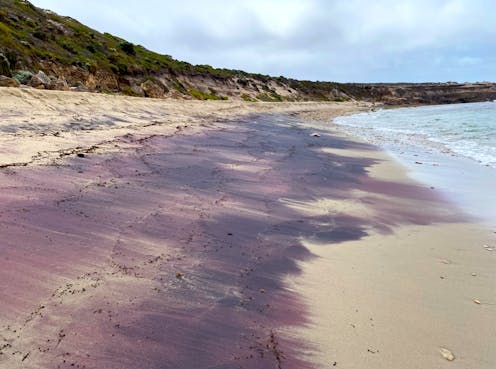
In parts of South Australia, long stretches of beach are often blanketed in large patches of pink sand. Strong swells can dump drifts of reddish grains of garnet along the shore – but the origin of these colourful crystals has until now been a mystery.
Garnet is rare in beach sand, as it is destroyed by prolonged exposure to the waves and currents of the ocean. If we find large amounts of garnet in beach sand, it means there must be a local source of garnet-bearing rock. But where is this rock?
The hunt for the source of South Australia’s pink sand took us thousands of kilometres and half a billion years back in time, to a previously undiscovered mountain range we believe is now buried deep beneath the Antarctic ice sheet. Our new study is published in Communications Earth & Environment.
A local source?
Geologists get excited when we find garnet in beach sand or other sediments, because these minerals grow deep in Earth’s crust, in the same kind of conditions in which diamonds are formed.
One way diamonds or garnets can reach the surface is via carrot-shaped volcanic structures called kimberlite pipes. There are kimberlites (and diamonds) to be found in South Australia – at Eurelia, for example. However, these deposits are far from the coast, are not very abundant, and are only around 170–190 million years old – so they are unlikely to be the source of our beach garnets.
Another way garnet can reach the surface is via prolonged erosion.
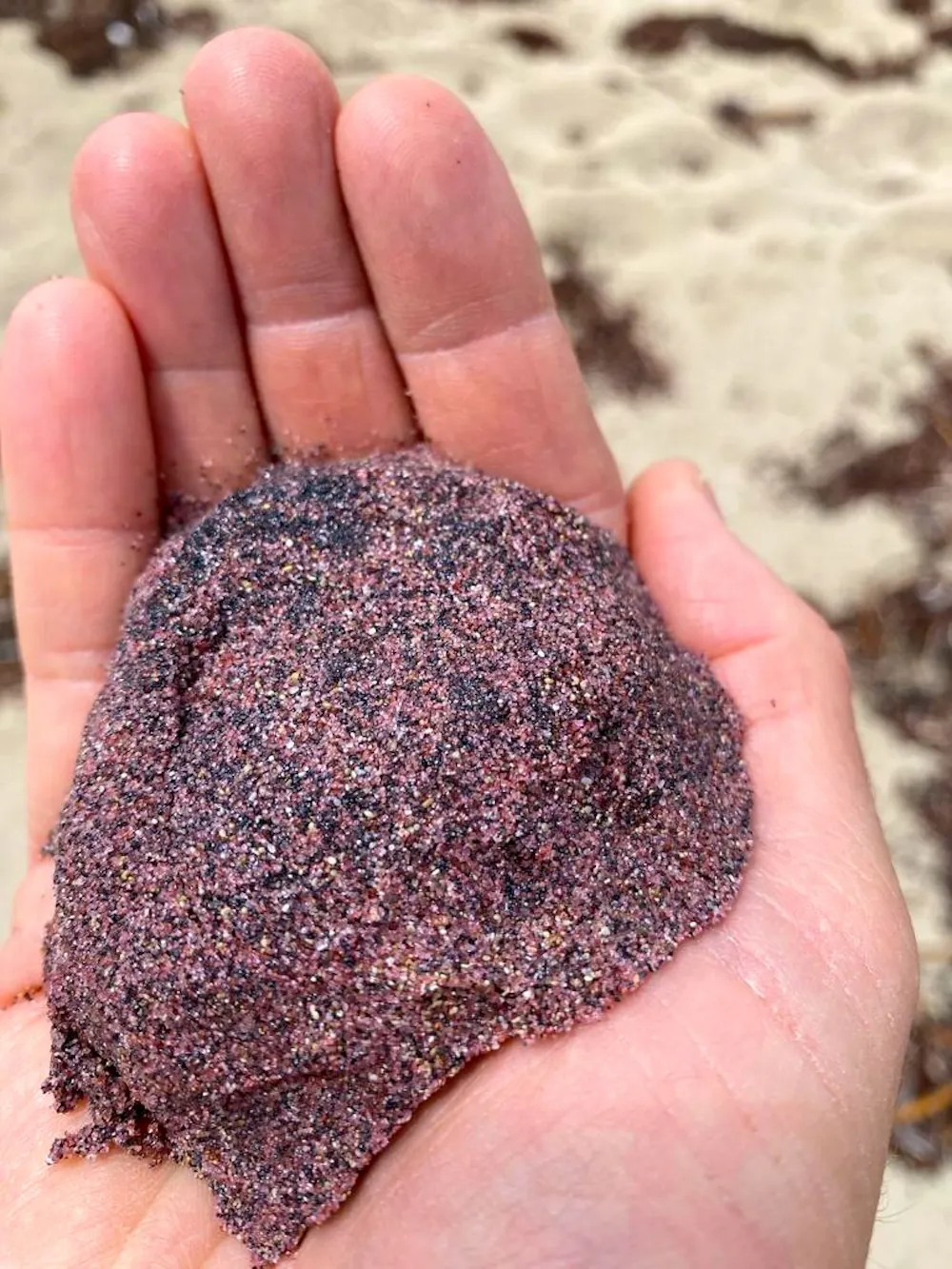
Garnet typically forms in greater volumes in places where the crust is thick, such as under mountains. As the mountains erode, the garnet may be revealed as a record of the former mountain belt.
So another possible origin for the beach garnets is the erosion of the Adelaide Fold Belt. This mountain belt, which stretched north from Adelaide for hundreds of kilometres, developed between 514 million and 490 million years ago.
A third possible source is the Gawler Craton, a huge slab of ancient rock beneath South Australia with outcrops in the Adelaide Fold Belt. The Gawler Craton contains plenty of garnet, which formed in several episodes between 3.3 billion and 1.4 billion years ago.
To find the source of our beach sand garnets, we set out to find their ages. Very old garnets could be from the Gawler Craton, while younger ones would have the Adelaide Fold Belt as a more likely origin.
A timing mismatch
We analysed several hundred grains of coastal garnet, and found the majority of them formed around 590 million years ago. Far from answering our questions, this result only raised more.
The beach sand garnets were far too young to have come from the Gawler Craton, but too old to have come from the eroding Adelaide Fold Belt. In fact, this time around 590 million years ago is thought to have been a tectonically quiet period in the region, where we would not expect garnet to grow.
Our dating results effectively ruled out a local source for the garnets. So what was left?
Long-distance travellers
If the garnets did not come from a local source, we can say two things about them. First, they must have travelled in a way that would not grind them to smithereens. Second, they must have been stored locally in a protected environment before finding their way onto the beaches.
A possible solution that meets both these criteria can be found at Hallet Cove Conservation Park, located on the South Australian coast around 20 kilometres south of Adelaide.
Here we find exposed sedimentary rocks that were formed around 280 million years ago, during a very icy phase of Earth’s history. The ice is important, because glaciers and icebergs can transport large volumes of rock over long distances without damaging their internal structure.
Furthermore, garnets found in glacial sediments on Kangaroo Island, which were deposited around the same time as the Hallet Cove sediments, were dated to around 590 million years as well. The garnets were not born in these deposits, but were transported into them by ice flow.
A former land bridge
So, if the beach garnets were stored in sedimentary glacial deposits along the South Australian coast since the Late Palaeozoic Ice Age, before being washed onto the shore, where did they come from originally?
During the Late Palaeozoic Ice Age around 280 million years ago, Australia was connected to Antarctica in a large landmass called Gondwana, covered by a massive ice sheet.
Reconstructions of ice flow at this time suggest glaciers would have brought ice northwest from what are now the Transantarctic Mountains in East Antarctica.
The Transantarctic Mountains are the expression of an older mountain belt, the Ross Orogen, which started developing around 550 million years ago but was not experiencing any peak garnet-forming conditions until around 520 million years ago – 60 million years after the garnet in the pink sands. So we are getting warmer, but the Transantarctic Mountains are not a suitable source either.
A hidden treasure
There is one outcrop of rock in East Antarctica where garnets of the right age have been found, near the Skelton Glacier in Southern Victoria Land. However, such a small outcrop could not have produced the large volume of garnet we see on Australian shores.
This outcrop sits at the edge of a colossal area of some 2 million square kilometres buried beneath a thick ice sheet. We postulate that this area contains abundant garnet that grew in an unknown mountain belt around 590 million years ago.
It is currently not possible to sample the rock under this ice sheet to confirm our theory. But it is conceivable that millions of years of ice transport eroded the bedrock beneath, and transported the ground-up rock – including garnets – northeastwards towards the area that has now split into the coastlines of Antarctica and Australia.
The transported rock was then delivered to the South Australian coast some 280 million years ago and stored in sedimentary deposits such as Hallet Cove. Here it sat undisturbed until erosion eventually released the garnets into the sea – and then, finally, onto South Australia’s beaches.
Authors: Stijn Glorie, Associate Professor of Geology, University of Adelaide

















