

Just 5% of therapies tested in animals end up as as human drugs, new study shows
- Written by Adrian Esterman, Professor of Biostatistics and Epidemiology, University of South Australia
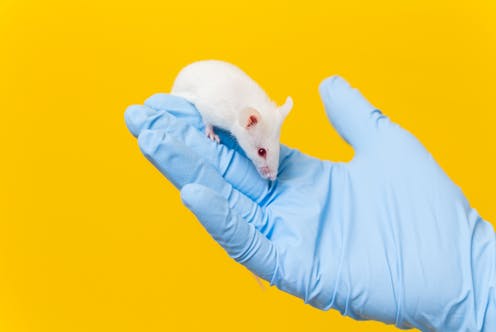
New drugs are generally tested on animals such as mice and rats before being tested on people. The results of these animal studies are often reported in the media, perhaps raising hope these “miracle”, “promising” or “dramatic” findings will one day be replicated in humans and lead to a new drug.
But in a study published today, we find out how few of these therapies tested in animals receive regulatory approval for use in humans and end up on the market.
The Swiss and UK researchers found just 5% made the grade and for those that were successful, the process took an average ten years.
Here’s why so few drug candidates in animal trials end up as human therapies.
Animal studies have their place, but are flawed
Animal studies can be valuable for learning about diseases and finding possible drug targets. But they can’t fully tell us how safe and effective treatments will be for humans.
For example, some potential treatments for Alzheimer’s, stroke and cancer worked well in animals but didn’t work the same in people.
So the authors looked at what percentage of therapies successfully moved from animal studies to human use, the time this took, and whether the results from animal and human studies agreed.
They did this by combining and analysing the results of studies published before August 2023 using a variety of techniques.
They assessed the quality of the included studies using a meta-analysis (which combines the results of several studies) to work out whether positive outcomes in animal studies translated into positive outcomes from human studies.
In total, 122 papers were included in a brief overview known as a “narrative summary”, with 62 of these included in the meta-analysis.
The researchers then used a statistical technique called “survival analysis” to estimate the time it took for therapies to progress from animal studies to clinical trials and regulatory approval.
What they found
Overall, the researchers found that of 367 therapeutic interventions tested in 54 human diseases:
- 50% progressed from animal studies to human clinical trials
- 40% progressed to randomised controlled trials (large, clinical phase 3 trials, the ones generally needed before regulatory approval)
- 5% received regulatory approval.
Their meta-analysis showed 86% of positive results in animal studies were translated into positive results in subsequent human trials.
For animal studies that progressed, the researchers found it took an average:
- five years for animal studies to reach any human study
- seven years to reach a randomised controlled trial
- ten years for regulatory approval.
Why the gap?
The authors found many of the animal studies were not well designed, making their results less valid.
For example, most did not include blinding, where the investigator does not know which animal received each treatment, or randomisation of animals to treatments.
Many animal studies also involved too few animals to provide reliable evidence of whether the treatment was successful.
Animal studies often involve young, healthy animals, while human patients may have multiple health conditions and be older. Animal studies often focus on how a drug works on a molecular level, while human studies prioritise the drug’s overall effectiveness.
Finally, the outcomes measured in animal studies might not always reflect the most important clinical outcomes for patients.

The authors suggested researchers need to focus on the quality and relevance of animal studies if we are to improve drug development.
Researchers need to ensure studies are well-designed, use appropriate animal models, and measure outcomes that matter to patients.
The authors also recommended closer collaboration between animal and human researchers to help bridge the gap between preclinical and clinical research.
How worried should we be?
The use of animals in research raises many ethical questions about the suffering and harm inflicted on them for potentially limited human benefit.
The high failure rate of animal studies in translating to human therapies amplifies these concerns, as it questions the justification for using animals in research.
The discrepancy between animal and human results highlights the limitations of animal models in accurately predicting human responses to drugs. This raises questions about the scientific validity of relying solely on animal data for drug development decisions.
However, on the bright side, the high failure rate and cost of animal studies has spurred the development of alternative research methods that do not rely on animals.
These include in vitro (laboratory) studies, human-relevant cell and tissue models, organ-on-a-chip systems, and computational in silico modelling which involves simulation on computers.
Clearly, it would be wonderful if we did not need to use animals in drug development. But with the increasing use of alternative methods such as computer modelling, and the advent of artificial intelligence to design new drugs and minimise animal testing, this might be in sight.
Authors: Adrian Esterman, Professor of Biostatistics and Epidemiology, University of South Australia

















