

Ending native forest logging would help Australia’s climate goals much more than planting trees
- Written by Kate Dooley, Research Fellow, School of Geography, Earth and Atmospheric Sciences, The University of Melbourne
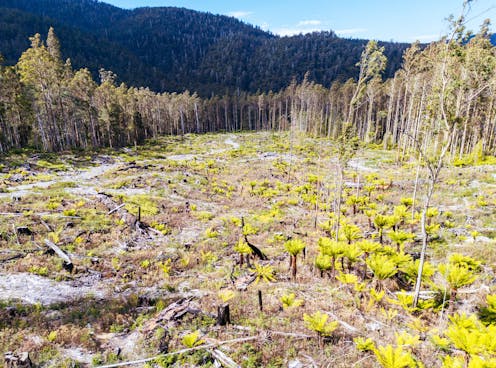
Australia contains some of the world’s most biologically diverse and carbon-dense native forests. Eucalypts in wet temperate forests are the tallest flowering plants in the world and home to an array of unique tree-dwelling marsupials, rare birds, insects, mosses, fungi and lichen, many of which have not even been catalogued by scientists. Yet our country remains in the top ten list globally for tree cover loss, with almost half of the original forested areas in eastern Australia cleared.
This loss has been devastating for Australia’s native plants and animals and contributes to global warming through vast amounts of carbon emissions. The global biodiversity and climate change crises are inextricably linked – we cannot solve one without the other.
Earth’s ecosystems, such as forests, coastal wetlands and tundra, contain enormous amounts of carbon. But deforestation and degradation by humans is likely to send global warming past 1.5°C, even if we achieve net-zero fossil fuel emissions. Protecting native forests is a critical way to prevent emissions, which must be achieved in parallel with a rapid transition to clean energy.
What is being overlooked in current international climate policy under the Paris Agreement is the crucial role of biodiversity in maintaining healthy ecosystems and their integrity, which keeps carbon stored in forests, not the atmosphere. Healthy ecosystems are more stable and resilient, with a lower risk of trees dying and lower rates of carbon emissions.
The way we currently count carbon stores risk creating incentives to plant new trees rather than protect existing forests. Yet old-growth forests store vastly more carbon than young saplings, which will take decades or even centuries to reach the same size.
On January 1 this year, both Victoria and Western Australia ended native forest logging in state forests. This is a good start. But the rest of Australia is still logging native forests. Extensive land clearing continues for agriculture and urban development, as well as native forest harvesting on private land.
Two states down, more to go
The end of native timber logging in two states is a chance for new approaches to our forests, which recognise the contribution of biodiversity to healthy forest ecosystems, as well as endangered species protection and clean water supplies.
Ending native forest logging isn’t entirely simple. In Victoria, consultation on the future of state forests is ongoing. The Victorian Environmental Assessment Council is due to release its final recommendations in July.
The Victorian government has also put in place a Forestry Transition Program to help forest contractors find alternative work in forest and land management. Some of these transition programs are proving controversial.
In Western Australia, around 2.5 million hectares of the state’s south-west forests will be protected under a new Forest Management Plan. Protection of these landscapes is critical, as they have been hit by another die-back event due to drought and record heat.
These forests hold significant cultural and ecological value. Known in Noongar as “djarilmari”, they are vital habitats for diverse plants and animals, including endemic species such as the ngwayir (western ringtail possum) and the giant jarrah trees.
What about other states and territories?
In New South Wales, the government is looking into proposals for a Great Koala National Park, which would bring together state forests from the Clarence Valley to south of Coffs Harbour. But with no decision yet made, logging continues along both the north and south coasts, which were also hard hit by the Black Summer bushfires of 2019-20.
In Tasmania, native forest logging fell sharply between 2012 and 2019. This cut emissions by around 22 million tonnes of carbon dioxide equivalent per year, equivalent to almost a quarter of Australia’s transport emissions.
Recent policy changes protecting giant trees will help protect some patches of forests. But native forest logging is set to expand in other areas, including clear felling of old-growth rainforest and tall wet eucalypt forest.
Native forest logging is slated to end in 70,000 hectares of south-east Queensland state forests at the end of this year, under a longstanding Native Timber Action Plan. But logging and widespread land clearing continues elsewhere in the state, ensuring Australia’s place in the top 10 deforestation hotspots.

Can ending native forest logging help the climate?
We’ll need to go further and ban logging in all native forests in Australia to help meet our net-zero emissions target, while meeting timber demand from better-managed and increased plantations.
Stopping native forest logging avoids the emissions released when forests are cut and burned. It would also allow continued forest growth and regrowth of previously logged areas, which draws down carbon from the atmosphere and increases the amount held in the forest ecosystem.
The natural biodiversity of our native forests makes them more resilient to external disturbances such as climate change. These forests have larger and more stable carbon stocks than logged areas, newly planted forests and plantations.
If we compare forests protected for conservation with those harvested for commodity production in the Victorian Central Highlands, research shows conservation delivers the greatest climate benefits through continued forest growth and accumulating carbon stocks.
There are growing calls to create the Great Forests National Park to the north and east of Melbourne, which would protect a further 355,000 hectares and more than double protected forests in the Central Highlands.
Net zero: deep, rapid, sustained cuts needed
The world’s nations are aiming to reach “net zero” by mid-century. Meeting this target will require deep and rapid cuts in carbon dioxide emissions as well as pulling carbon out of the atmosphere into land sinks, especially forests.
The land sector is unique in that it can be both a source (logging, agriculture) and a sink (forest regrowth, for instance) for carbon. The natural way forests take up carbon can be increased through natural regrowth or plantations.
Unfortunately, the current approach, based on IPCC guidelines, to counting this type of natural carbon storage can lead to perverse outcomes.
The carbon sink from forest regrowth only counts towards the “removals” part of net zero when it results from changes we make, such as ending native forest logging. It doesn’t count if it’s regrowth after a natural event such as a bushfire. It’s important to count only human-induced changes in our climate targets.
Tree planting, on the other hand, can be counted towards net-zero targets, despite the fact that newly planted trees will take centuries to sequester as much carbon as found in an old-growth forest.
This type of accounting – known as flow-based accounting – can mean a premium is placed on planting and maintaining young forests with high carbon uptake rates, overlooking the substantial benefits of protecting larger trees in native forests.
That is, this approach favours carbon sequestration (the process of taking carbon out of the atmosphere and storing it in wood) over carbon storage (the total carbon stocks already contained in a forest).
A comprehensive approach to forest carbon accounting would recognise both flows of carbon (as sequestration) and carbon stocks (as storage) contribute to the benefits that native forests offer for reducing emissions.
 Replanting trees is good – but protecting existing forests is better.
Janelle Lugge/Shutterstock
Replanting trees is good – but protecting existing forests is better.
Janelle Lugge/Shutterstock
Carbon accounting needs more clarity
This becomes a problem when forests and fossil fuels are included in a net accounting framework, such as the one used in Australia’s national greenhouse gas inventory.
In net accounts, emissions (from fossil fuel and land sectors) within a year are added to removals, which includes the sequestration of carbon into forests and other ecosystems.
Because this type of accounting only counts the flows of carbon – not existing stocks – it omits the climate benefits of protecting existing forests, whose stored carbon dwarfs the amount Australia emits from fossil fuels each year.
But if we separated out targets for the fossil fuel and land sectors, we could properly treat forest carbon stocks as an asset, giving us incentives to protect them.
Another problem with net accounting is it treats all carbon as equivalent, meaning a tonne of carbon sequestered in trees compensates for a tonne of carbon from burned fossil fuels. This has no scientific basis. Carbon dioxide emissions are effectively permanent, as the buried carbon we dig up and burn stays in the atmosphere for millennia, while carbon in trees is temporary in comparison.
As trees grow, their carbon storage compensates for earlier logging and clearing emissions, which is an important climate benefit. But we’re not comparing apples and apples – forest carbon doesn’t compensate for fossil fuel emissions.
Logging bans are important – but no substitute for ending oil and gas
While ending the clearing and logging of native vegetation is vital for both climate and biodiversity, it’s no substitute for preventing emissions from fossil fuels.
To make this clearer, we must urgently set separate targets for emissions cuts for fossil fuels and increased carbon removal in the land sector. This will ensure phasing out fossil fuel use is not delayed by planting trees, and that the carbon stocks of biodiverse and carbon-dense native forests are protected.
Authors: Kate Dooley, Research Fellow, School of Geography, Earth and Atmospheric Sciences, The University of Melbourne

















