

Mothers have long been absent from dystopian stories. ‘Maternal cli-fi’ is changing the narrative
- Written by Rachel Williamson, Senior Tutor in English, University of Canterbury
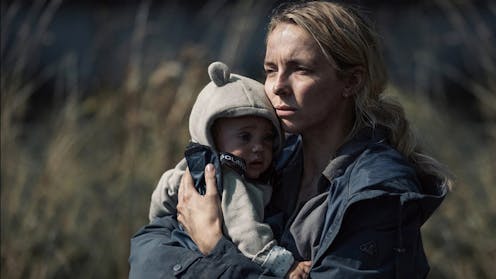
Writing over 30 years ago, feminist film scholar E. Ann Kaplan famously described mothers in cinema as “an absent presence” – background figures that might facilitate the narrative but who are rarely, if ever, its focus.
I am palpably reminded of this watching the opening scenes of Mahalia Belo’s assured debut feature film The End We Start From.
Skilfully adapted by Alice Birch from Megan Hunter’s 2017 novella, the film opens in the bathroom of a London townhouse.
The headless torso of the heavily pregnant unnamed woman (the excellent Jodie Comer) potters in the background, chattering to her off-screen partner (Joel Fry). Steam from a running bath slowly clouds the camera lens. The sounds of rushing water drown the woman out until she is silenced.
The End We Start From is an ecological disaster story set in a near-future London besieged by floods, so it is unsurprising the film opens with this watery submersion.
Nonetheless, it is hard not to read the scene as a nod to the long cinematic history of erasing mothers. Belo sets this tradition up only to tear it back down in her insistence on viewing the cataclysmic events through the eyes of a new mother.
Motherhood as catastrophe
Centring a survival story on a new mother has its roots in mainstream portrayals of motherhood as difficult and depleting.
Popular culture is rife with discussions of mothers who feel they have “lost themselves” in their new maternal role.
The film begins dramatically, pairing the breaking of the woman’s waters with the heavy deluge pounding London. The sequence crosscuts between closeups of Comer’s face and disorientating angles of rising water levels, reaching a crescendo as the baby’s head crowns at the exact moment flood waters erupt through the windows and doors of the couple’s home.
Despite the small budget and limited special effects, the moment packs a wallop. In pairing motherhood with mother nature, the film depicts birth as both a beginning and an end, a seismic event that, however ordinary, feels biblical in scale.
Reproduction has long featured in dystopian texts as a metaphor for exploring anxieties around technological interventions, threats to human agency, and the creeping eradication of personal freedoms.
But mothers themselves have been demonstrably absent.
Frequently dead, appearing only in memories and dreams as per Cormac McCarthy’s apocalyptic novel The Road (2006) or even Margaret Atwood’s feminist dystopia The Handmaid’s Tale (1985), critics have argued mothers in speculative fiction are little more than “empty spaces or hollowed out characters”.
In a reversal of this trope, the absent father-figure haunts The End We Start From, seen only in flickering glimpses by the mother at the centre.
The film is part of a growing dystopian subgenre of “maternal cli-fi” seeking to upend this tradition of absent mothers. Other examples include Clare Moleta’s novel Unsheltered (2021), Diane Cook’s novel The New Wilderness (2020), and the Australian TV series The Commons (2019).
These works depict characters navigating worlds ravaged by climate change and environmental disaster. Not surprisingly, climate fiction has experienced a surge in popularity as events like the 2022 Auckland floods and Australian bushfires render the seemingly unimaginable frighteningly real.
What distinguishes maternal cli-fi from climate fiction more broadly is its use of motherhood as a narrative strategy to raise ethical questions about the future of the world and our place in it.
Is it OK to still have children?
In the face of profound environmental precarity and an uncertain global future, many women are questioning whether or not to have children at all.
Up to 60% of millennial and gen Z women cite global warming as a key factor when considering parenthood, while one in three Australian women under the age 30 say they are reconsidering having (more) children due to climate anxiety.
Maternal cli-fi takes these fears seriously, personalising the global and bringing the world’s crises closer to home.
As many modern mothers will attest, motherhood lends itself well to ambivalence and uncertainty, often manifesting in guilt, doubt and second-guessing.
Although tempting to dismiss maternal cli-fi as depressing and grim, The End We Start From also finds pleasure in unexpected places. Scenes between mother and infant are intimate and bodily, bathed in chiaroscuro lighting to create an embryonic cocoon at odds with the environmentally ravaged society-on-the-brink.
Further reprieve from the simmering violence comes via the woman’s burgeoning friendship with another new mum (an effervescent Katherine Waterston), providing solace and support.
The End We Start From does not answer whether we should continue to have children in a world where our future is anything but guaranteed.
Instead, this tender, fierce film seeks to excavate the mother from her place of erasure and remind us of the ethical potential of the maternal point of view.
Belo has described how motherhood prompted her to view “the world slightly differently” – a perspective maternal cli-fi implores us to share.
The End We Start From is now streaming on Apple TV.
Authors: Rachel Williamson, Senior Tutor in English, University of Canterbury

















