

Defunct satellites burning up in the atmosphere could damage the ozone layer. Here’s how
- Written by Robyn Schofield, Associate Professor and Associate Dean (Environment and Sustainability), The University of Melbourne
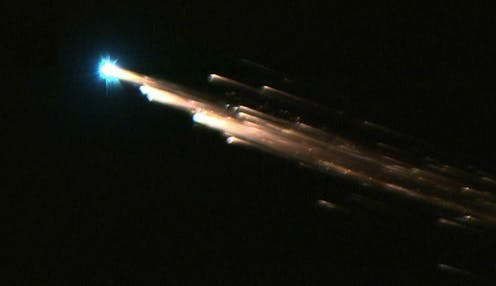
Communications companies such as Starlink plan to launch tens of thousands of satellites into orbit around Earth over the next decade or so. The growing swarm is already causing problems for astronomers, but recent research has raised another question: what happens when they start to come down?
When these satellites reach the end of their useful life, they will fall into Earth’s atmosphere and burn up. Along the way, they will leave a trail of tiny metallic particles.
According to a study published last week by a team of American researchers, this satellite rain may dump 360 tonnes of tiny aluminium oxide particles in the atmosphere each year. The aluminium will mostly be injected at altitudes between 50 and 85 kilometres, but it will then drift down to the stratosphere – home to Earth’s protective ozone layer.
What does that mean? According to the study, the satellite’s contrail could facilitate ozone-destroying chemical reactions. That’s not wrong, but as we will see the story is far from simple.
How does ozone get destroyed?
Ozone loss in the stratosphere is caused by “free radicals” – atoms or molecules with a free electron. When radicals are produced, they start cycles that destroy many ozone molecules. (These cycles have names Dr Seuss would admire: NOx, HOx, ClOx and BrOx, as all involve oxygen as well as nitrogen, hydrogen, chlorine and bromine, respectively.)
These radicals are created when stable gases are broken up by ultraviolet light, which there is plenty of in the stratosphere.
Nitrogen oxides (NOx) start with nitrous oxide. This is a greenhouse gas naturally produced by microbes, but human fertiliser manufacturing and agriculture has increased the amount in the air.
The HOx cycle involves hydrogen radicals from water vapour. Not much water vapour makes it into the stratosphere, though events like the Hunga Tonga–Hunga Ha'apai underwater volcanic eruption in 2022 can sometimes inject large amounts. Water in the stratosphere creates numerous small aerosol particles, which create a large surface area for chemical reactions and also scatter more light to make beautiful sunsets. (I will come back to both of these points later.)
How CFCs made the ‘ozone hole’
ClOx and BrOx are the cycles responsible for the most famous damage to the ozone layer: the “ozone hole” caused by chlorofluorocarbons (CFCs) and halons. These chemicals, now banned, were commonly used in refrigerators and fire extinguishers and introduced chlorine and bromine to the stratosphere.
CFCs rapidly release chlorine radicals in the stratosphere. However, this reactive chlorine is quickly neutralised and locked up in molecules with nitrogen and water radicals.
What happens next depends on aerosols in the stratosphere, and near the poles it also depends on clouds.
Aerosols speed up chemical reactions by providing a surface for them to occur on. As a result, aerosols in the stratosphere release reactive chlorine (and bromine). Polar stratospheric clouds also remove water and nitrogen oxides from the air.
So in general, when there are more stratospheric aerosols around we are likely to see more ozone loss.
An increasingly metallic stratosphere
The details of the specific injection of aluminium oxides by falling satellites would be quite complex. This is not the first study to highlight the growing stratospheric pollution from re-entering space junk.
In 2023, researchers studying aerosol particles in the stratosphere detected traces of metals from spacecraft re-entry. They found that 10% of stratospheric aerosols already contain aluminium, and predicted this will increase to 50% over the next 10–30 years. (Around 50% of stratospheric aerosol particles already contain metals from meteorites.)

We don’t know what effect this will have. One likely outcome would be that the aluminium particles seed the growth of ice containing particles. This means that there would be more smaller, cold, reflective particles with more surface area on which chemistry can occur.
We also don’t know how aluminium particles will interact with the sulfuric acid, nitric acid and water found in the stratosphere. As a result, we can’t really say what the implications will be for ozone loss.
Learning from volcanoes
To really understand what these aluminium oxides mean for ozone loss, we need laboratory studies, to model the chemistry in more detail, and also look at how the particles would move around in the atmosphere.
For example, after the Hunga Tonga–Hunga Ha'apai eruption, the water vapour in the stratosphere quickly mixed around the southern hemisphere, and then moved toward the pole. At first, this extra water caused intense sunsets, but a year later, these water aerosols are well diluted across the whole southern hemisphere and we no longer see them.
 The Hunga Tonga–Hunga Ha'apai eruption in 2022 injected huge amounts of water vapour into the stratosphere.
NASA
The Hunga Tonga–Hunga Ha'apai eruption in 2022 injected huge amounts of water vapour into the stratosphere.
NASA
A global current called the Brewer-Dobson circulation moves air up into the stratosphere near the equator and back down again at the poles. As a result, aerosols and gases can only stay in the stratosphere for at most six years. (Climate change is speeding up this circulation, which means the time that aerosols and gases are in the stratosphere is shorter.)
The famous eruption of Mt Pinatubo in 1991 also created beautiful sunsets. It injected more than 15 million tonnes of sulfur dioxide in to the stratosphere, which cooled the Earth’s surface by a little over half a degree Celsius for around three years. This event is the inspiration for geoengineering proposals to slow down climate change by deliberately putting sulfate aerosols into the stratosphere.
Many questions remain
Compared to Pinatubo’s 15 million tonnes, 360 tonnes of aluminium oxide seems like small potatoes.
However, we don’t know how aluminium oxides will behave physically under stratospheric conditions. Will it make aerosols that are smaller and more reflective – thus cooling the surface, much like stratospheric aerosol injection geoengineering scenarios?
We also don’t know how aluminium will behave chemically. Will it create ice nuclei? How will it interact with nitric and sulfuric acid? Will it release locked-up chlorine more effectively than current stratospheric aerosols, facilitating ozone destruction?
And of course, the aluminium aerosols won’t stay in the stratosphere forever. When they eventually fall to the ground, what will this metal contamination do in our polar regions?
All these questions need to be addressed. By some estimates, more than 50,000 satellites may be launched between now and 2030, so we had better address them quickly.
Authors: Robyn Schofield, Associate Professor and Associate Dean (Environment and Sustainability), The University of Melbourne

















