

The 'recycling crisis' may be here to stay
- Written by: Trevor Thornton, Lecturer, School of Life and Environmental Sciences, Deakin University
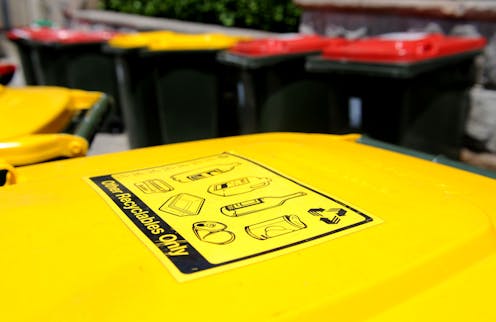
Over the weekend, Victoria’s Environment Protection Authority issued notices for a major recycling company to stop receiving waste at two of its sites.
While the full consequences of these notices are yet to be realised, in the short term this means at least one council will have to dump kerbside recycling in landfill.
Read more: Australian recycling plants have no incentive to improve
This isn’t a new problem. It’s a result of China’s decision to stop accepting Australia’s recyclables, and a clear sign we’ve been playing catch-up but not focusing on sustainable solutions. We need to work out how to deal with recycling in Australia – and determine how much it will cost, and who will pay.
We’re missing a piece of the financial puzzle
Kerbside collections are of course funded by householders as part of their annual rates. After China stopped buying Australian recycling we saw the garbage component of rates rise, so the collection aspect of the costs seems to be addressed. But of course there are a range of materials that cannot be placed in kerbside bins, but can be recycled.
As reported recently in The Age, analysis by an environmental consultancy has found the prices consumers may have to pay to ensure there are systems in place to recycle a range of specific items. For example, it would cost A$16 to recycle a mattress. Given that my local landfill charges A$23 to dispose of a mattress, it seems to make economic sense to pay into a compulsory recycling scheme (and I would not have to transport the mattress to the landfill, which is another bonus).
However, the piece of the loop that is missing is the encouragement (by levies or incentives), for businesses to use more recycled materials in their products.
It does not make sense to collect and stockpile recyclable materials until commodity prices are high enough to justify sorting them. This habit makes us dependent on overseas markets and creates domestic issues.
Nor is it good to have a stop-start approach, in which recyclables are sorted properly when there is space, but sent to landfill when there is not (or have householders call the council fortnightly to see whether they should place their recycling bin out).
A recycling industry association has provided a ten-point plan for resolving what they consider the essential issues with recycling. This very positive list includes investing waste levy funds into recycling, providing incentives for companies to use more recycled material, and educating consumers and businesses on recycling issues.
Encouraging businesses to use more recycled material is crucial. Instead of just reporting how much of their waste is recycled rather than sent to landfill, all organisations should report on the percentage of materials they buy from recycled sources.
This would help consumers make better buying decisions, and give guidance for governments to target specific sectors or programs to increase the use of recyclables.
Better systems
We need a “fresh eyes” approach to how we manage waste, focusing equally on the environmental, economic and social aspects of this issue. One barrier is the lack of a centralised approach by all three spheres of government. It doesn’t make sense for state or local governments to have to to manage this large-scale infrastructure issue in isolation.
The largest portion of responsibility for waste management lies with the generator, but that is not to say others may not have a level of involvement. We all have some responsibility for the waste we create in our own homes, and how we dispose of it. Besides recycling, that also means (where possible) avoiding and reducing trash, and buying items made with recyclables – this is called “closing of the loop”.
Some businesses have made significant efforts to reduce their dependence on virgin raw materials, and are using recycled material to either make or package their products. But we do not hear much about this.
Perhaps it is time for a scheme similar to the “Buy Australian” program or energy efficiency stars, which would enable consumers to readily identify the level of recycled material in a product. Currently it is very difficult to tell.
Retailers often say they’re driven by consumers in what they can provide, so why not use our supposed power to force improvements (and more importantly, reductions), in use of virgin materials?
The banning of plastic bags by supermarkets was consumer-driven – so now is the time to encourage companies to reduce their waste burden. Perhaps you can approach a retailer about excess packaging, or make sure you check the label to see if an item was made or packaged with recycled materials.
Read more: Electronic waste is recycled in appalling conditions in India
As we move towards a federal election we should also be asking what our political parties are proposing to do about our waste crisis. It’s time to ask local candidates about their sustainable plan for resolving Australia’s issues with recycling, waste management and reducing resource use.
Authors: Trevor Thornton, Lecturer, School of Life and Environmental Sciences, Deakin University
Read more http://theconversation.com/the-recycling-crisis-may-be-here-to-stay-112055

















