

Here’s how ‘microgrids’ are empowering regional and remote communities across Australia
- Written by: Simon Wright, Senior Research Fellow, Energy & Circularity, Gulbali Institute, Charles Sturt University
Small collections of electricity generators, or “microgrids”, have long been used in disaster recovery, when network supply falters during bushfires or cyclones.
But now the technology is being used to provide secure, 24-7 supplies of clean energy in Australian communities where connection to the main electricity grid is but a pipedream.
Sometimes owned by local communities, renewable energy microgrids are slowly replacing dirty diesel generators. Solar energy is by far the most common source of generation for these microgrids, which usually also entail energy storage such as batteries, pumped hydro or hydrogen.
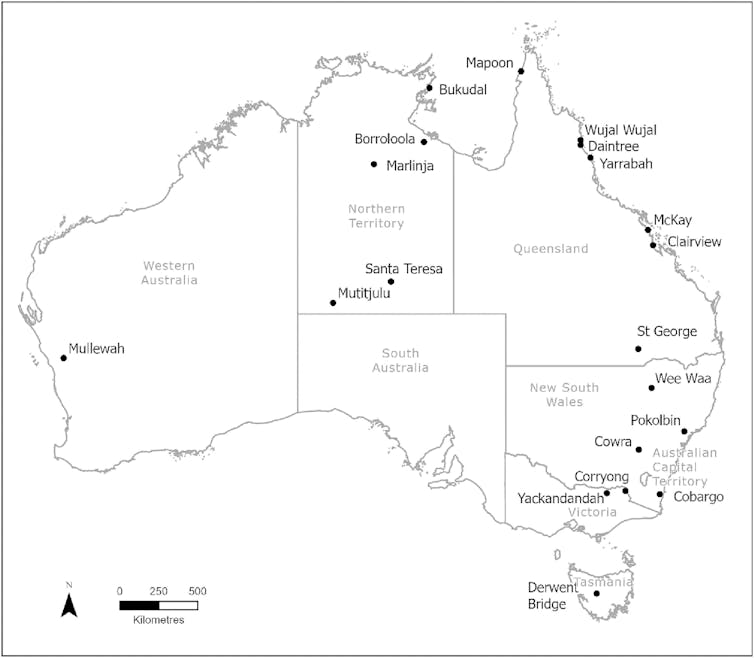
New research by my colleagues and I investigated 20 microgrid feasibility projects across Australia. Our findings demonstrate the crucial role microgrids can play in the energy transition, when backed by all levels of government.
What is a microgrid?A national survey of microgrids
In Australia and around the world, many communities are attracted to renewable energy microgrids. The benefits include energy security, reliability, equity, autonomy and emissions reduction.
Above all, microgrids offer a viable alternative to the national electricity grid. They enable communities to take control of their own energy destiny through local generation and ownership.
The projects we investigated were funded by the federal government through the A$50.4 million Regional and Remote Communities Reliability Fund.
Some were on the fringe of the grid, in places experiencing constant supply outages, while others were entirely off-grid. Most communities wanted to protect themselves from grid outages, access cheaper power and avoid being cut off for long periods after natural disasters.
Remote Indigenous communities sought to reduce dependence on dirty, antiquated and unreliable diesel generators. They were also concerned about the hazards of storing large amounts of fuel in the community.
Intermittent electricity supply severely limits not only cooking, cooling and refrigeration, but also the pumping and heating of water for sanitation purposes.
Through a series of semi-structured interviews, we explored each project’s drivers, barriers and opportunities.

The Marlinja microgrid is a shining example
About 60 people live in the remote Marlinja community, 700 kilometres south of Darwin in the Northern Territory. This is the traditional lands of the Mudburra and Jingili people.
In the past, especially during the wet season, the community suffered repeated power outages from the grid. These could take days to be repaired by the electricity network service provider.
Pre-paid meters exacerbated the situation, stifling access to power and water for residents due to the high kilowatt cost of electricity purchased using access cards.
Today, Marlinja is home to a grid-connected 100-kilowatt solar array and a 136Kwh battery, sufficient to meet the daytime and nighttime energy needs of most residents.
The grid connection ensures continuity of supply, particularly at night if the battery reserves are exhausted.
Marlinja’s Solar-Powered Community Centre (Original Power)Marlinja is the first Indigenous community-owned microgrid in Australia.
The community-focused Indigenous energy organisation Original Power developed an innovative community benefit sharing scheme, with support from NT government-owned retailer Jacana Energy.
Clean energy communities coordinator Lauren Mellor helped the community raise $750,000 from Original Power’s philanthropic networks, with some seed funding from government. She says the microgrid will reduce energy costs in the community:
When the battery runs out, then residents will flip back onto the grid, so residents will be saving at least 70% on their power bills.
Importantly, these savings flow directly back to residents. This ensures the benefits of the scheme are shared across the community. The NT government also saves money by burning less diesel.
However, despite strong demand for electricity from the neighbouring school and cattle stations, NT regulations currently prevent the Marlinja community from selling surplus electricity back to the grid. This is partly due to grid instability, a situation that should improve when additional battery capacity comes online.
Common obstacles to rapid rollout
The experience of the Marlinja community reflects feedback from other microgrid projects. The main obstacles were:
- outdated regulations designed for centralised rather than distributed power generation
- the need for more government investment, to achieve critical mass and economies of scale
- the social change required, to allow communities to develop new business models and approaches to benefit sharing and ownership.
This last element ensures more of the value generated by the microgrid remains in the host communities, rather than going to distant shareholders in Australia or overseas.
This perhaps is the most exciting aspect of Marlinja. By generating a model of investment and ownership for Marlinja, Original Energy and other fellow collaborators have opened the door for other regional and remote communities.
Rather than continuing to rely on intermittent and expensive fossil fuels, they can embrace electricity generation that supports local economic development and investment, through community ownership and empowerment.
 Marlinja residents welcome solar power having struggled with blackouts for years.
AAP Image/Supplied by Original Power, Rachel Mounsey
Marlinja residents welcome solar power having struggled with blackouts for years.
AAP Image/Supplied by Original Power, Rachel Mounsey
Regional communities with different motivations
Other regional communities have embraced microgrids to address different challenges.
The 2019 bushfires devastated coastal communities in southern New South Wales. Consequently, Cobargo wants solar and storage to provide energy security and maintain essential services in the event of future unanticipated grid outages.
Yackandandah in northeast Victoria has been pursuing a similar path for more than a decade. The community wants to reduce energy costs and emissions while building greater network resilience.
The town has long been home to three community microgrids. These are collections of houses generating, storing and even sharing electricity between dwellings using solar, batteries and smart metering.
The longer term vision of this deeply engaged community is to construct a whole-of-town grid, supported by the two community-scale batteries already in place.
Bring on the benefits
The rapid transition to renewable energy brings many opportunities and challenges. Much of the media coverage has focused on community concerns about the construction of energy infrastructure. Yet, the opportunity that renewables pose, to stimulate economic development and bring greater autonomy to regional and remote communities, barely rates a mention.
Microgrids provide one exciting example of where clean energy technology can deliver economic, environmental and social benefits to these communities.
Authors: Simon Wright, Senior Research Fellow, Energy & Circularity, Gulbali Institute, Charles Sturt University


















