

The end of superpower conflict was ‘a fantasy era’. The West underestimated Russia and China – the cold wars are back
- Written by Peter J. Dean, Director, Foreign Policy and Defence, United States Studies Centre, University of Sydney
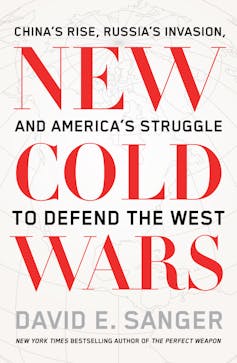
“This is a book about a global shock that took Washington by surprise: the revival of superpower conflict,” reads the introduction of New Cold Wars, by Pulitzer prize-winning New York Times journalist David E. Sanger.
From the fall of the Berlin Wall in 1989 to the invasion of Ukraine in February 2022, he writes,
there was a sense of certainty that the greatest byproduct of America’s undeniable victory in the Cold War was something like a permanent era of peace among the world’s nuclear superpowers.
Three years into Vladimir Putin’s three-day “special military operation” in Ukraine, the effects of Russia’s continuing illegal and immoral invasion are still reverberating around the world.
Putin’s use of military force to further his imperialistic ambitions in Europe has led to a reordering that few international analysts would have thought possible only a short while ago.
Review: New Cold Wars: China’s Rise, Russia’s Invasion and American’s Struggle to Defend the West – David E. Sanger (Scribe)
Putin’s “no limits” partnership with the People’s Republic of China has been followed by his embrace of one of the most reclusive, internationally sanctioned regimes in the world: the Russia–North Korea defence pact.
China has been supporting and enabling Russian aggression in Europe, while exercising soft and hard power across the Indo-Pacific.
A centrepiece of modern Chinese power is one of the largest expansions in military capability in modern history, including a massive boost to nuclear weapons. Over recent years, China has increasingly used coercive power to further its objectives.
Meanwhile, the ongoing Israel–Gaza conflict threatens to expand across the Middle East.
All these conflicts have exposed rifts and driven wedges in international and domestic political agendas.
Sanger’s work can easily be seen as a chronicle of how China and Russia have emerged as revisionist powers, willing to use coercion and outright force to change regional power dynamics and the global order. But at the real heart of his fourth book is the reaction of the United States and the West to these moves.
After four decades at the New York Times, where his focus is on foreign policy, Sanger is uniquely qualified to lay out his vision of the contemporary international order. As he writes, “I travelled the world with five US presidents – Clinton, Bush, Obama, Trump and Biden” and “heard […] from their lips and those of their closest advisors.”

Propaganda and cyberattacks
Two other consistent themes of the modern international order are propaganda and constant cyberattacks, where the era of “strategic competition” plays out daily in the realm of conflict. In this era, misinformation and disinformation go well beyond Pravda, the official Communist Party organ of the old Soviet Union, or China Daily.
 Today, propaganda’s role is not just to fashion an alternative vision for global order, but to sow the seeds of discord inside Western states, using social media to divide and undermine democracies and their societies. This world of disinformation and misinformation is one of alternative facts and no truth – where nefarious actors paint a dystopian alternative reality of “the West” as communities of division and discord.
In reflecting on the state of contemporary international relations, it is not too difficult to think we might be in a period that is a precursor to global calamity. While the world may not yet be in crisis, it does seem to be dominated by chaos.
It is on this canvas that Sanger paints his portrait of international politics.
His portrait of the modern world of global strategic competition – or, as he titles it, the “New Cold Wars” – dives into the depths of the strategic competition between Russia and China and the West. It tells the story of America at the crossroads.
The fantasy of Russia, China and the West
Sanger describes the once “almost universally held assumption” in US foreign policy circles, until the early 2010s,
that Russia and China – a fast-declining power and a fast-rising one – would integrate themselves into the West in their own ways.
It was believed economics would “trump nationalism and territorial ambition” – that Putin would value his oil and gas revenues more than territorial expansion, and Xi Jinping would focus on “the urgent issue of keeping China’s astounding domestic growth from falling back to earth”, so wouldn’t risk “immediate challenges to the United States’ global predominance”.
This, Sanger writes, has “come to be regarded as a fantasy era”.
Today, propaganda’s role is not just to fashion an alternative vision for global order, but to sow the seeds of discord inside Western states, using social media to divide and undermine democracies and their societies. This world of disinformation and misinformation is one of alternative facts and no truth – where nefarious actors paint a dystopian alternative reality of “the West” as communities of division and discord.
In reflecting on the state of contemporary international relations, it is not too difficult to think we might be in a period that is a precursor to global calamity. While the world may not yet be in crisis, it does seem to be dominated by chaos.
It is on this canvas that Sanger paints his portrait of international politics.
His portrait of the modern world of global strategic competition – or, as he titles it, the “New Cold Wars” – dives into the depths of the strategic competition between Russia and China and the West. It tells the story of America at the crossroads.
The fantasy of Russia, China and the West
Sanger describes the once “almost universally held assumption” in US foreign policy circles, until the early 2010s,
that Russia and China – a fast-declining power and a fast-rising one – would integrate themselves into the West in their own ways.
It was believed economics would “trump nationalism and territorial ambition” – that Putin would value his oil and gas revenues more than territorial expansion, and Xi Jinping would focus on “the urgent issue of keeping China’s astounding domestic growth from falling back to earth”, so wouldn’t risk “immediate challenges to the United States’ global predominance”.
This, Sanger writes, has “come to be regarded as a fantasy era”.
 It was once ‘almost universally’ assumed Russia and China would integrate into the West.
Alexander Zemlianichenko/AAP
Sanger presents a rich tapestry, based on outstanding access and interviews with some of the key policy makers in both the US and globally. He and his team have been meticulous in their research and woven it into a compelling narrative.
At 450 pages, The New Cold Wars is not a light or quick read, but it does have a pleasing depth. Its length ensures the reader gets a broad range of perspectives, from governments and officials to commentators, tech companies and business leaders. It is written in a fast-paced style, with the text broken up into op-ed length chunks.
The two key protagonists are the revisionist powers of Russia and the People’s Republic of China. The narrative moves well between the two – as times seamlessly, at others a little less nimbly.
At its very core, this book is about the unravelling of what the former US Deputy Secretary of State Bob Zoellick called in 2005 the “responsible stakeholder” view of China’s rise.
As Sanger states, it was long assumed that Xi and his inner circle are “rational actors”, so would resist the huge economic and political risks of putting “security first”. Over time, the US came to realise this approach “was no longer a safe bet”: for China under Xi, or for Russia under Putin.
The story is about the aggression of authoritarian dictators in the form of Xi and Putin, painted against their own self-styled tapestry of victimhood by the West, ruthlessly outlined through disinformation campaigns.
But it is just as much about the failing of the Obama administration to accept the changing nature of international power and the reticence of European Union countries to accept the reality of Putin’s willingness to use brute force.
In many ways, the book is centred around the scramble by the West to rally a response to Xi and Putin’s aggression. It narrates the difficulties in at first accepting this, and then the ongoing challenge to providing a cohesive and coordinated response to China and Russia’s grey-zone tactics, especially their mass use of misinformation and disinformation campaigns and cyberattacks, to advance their strategic aims.
In detailing the twists and turns of action and reaction, of policy mistakes and failures, of intelligence assessments and tech competition, Sanger provides a masterclass in assessing contemporary geopolitical trends and interactions through journalism.
Nuclear weapons and economic change
Just as important in Sanger’s chronological narrative are his vignettes. To me, two of them stand out as profound. In chapter 15, Sanger provides a searching discussion of the return of nuclear weapons to international politics – one of the underrated risks the modern world faces.
As Sanger points out, not since the Cuban Missile Crisis has a leader of a nuclear-armed state been as willing as Putin to publicly and flagrantly threaten to use nuclear weapons. For him, it has become almost routine.
Meanwhile, Xi has launched the largest expansion of nuclear weapons in a state since the early Cold War, with a growing emphasis on tactical nuclear weapons, without transparency about his intent, or how China’s military theory for nuclear weapons use is evolving.
It was once ‘almost universally’ assumed Russia and China would integrate into the West.
Alexander Zemlianichenko/AAP
Sanger presents a rich tapestry, based on outstanding access and interviews with some of the key policy makers in both the US and globally. He and his team have been meticulous in their research and woven it into a compelling narrative.
At 450 pages, The New Cold Wars is not a light or quick read, but it does have a pleasing depth. Its length ensures the reader gets a broad range of perspectives, from governments and officials to commentators, tech companies and business leaders. It is written in a fast-paced style, with the text broken up into op-ed length chunks.
The two key protagonists are the revisionist powers of Russia and the People’s Republic of China. The narrative moves well between the two – as times seamlessly, at others a little less nimbly.
At its very core, this book is about the unravelling of what the former US Deputy Secretary of State Bob Zoellick called in 2005 the “responsible stakeholder” view of China’s rise.
As Sanger states, it was long assumed that Xi and his inner circle are “rational actors”, so would resist the huge economic and political risks of putting “security first”. Over time, the US came to realise this approach “was no longer a safe bet”: for China under Xi, or for Russia under Putin.
The story is about the aggression of authoritarian dictators in the form of Xi and Putin, painted against their own self-styled tapestry of victimhood by the West, ruthlessly outlined through disinformation campaigns.
But it is just as much about the failing of the Obama administration to accept the changing nature of international power and the reticence of European Union countries to accept the reality of Putin’s willingness to use brute force.
In many ways, the book is centred around the scramble by the West to rally a response to Xi and Putin’s aggression. It narrates the difficulties in at first accepting this, and then the ongoing challenge to providing a cohesive and coordinated response to China and Russia’s grey-zone tactics, especially their mass use of misinformation and disinformation campaigns and cyberattacks, to advance their strategic aims.
In detailing the twists and turns of action and reaction, of policy mistakes and failures, of intelligence assessments and tech competition, Sanger provides a masterclass in assessing contemporary geopolitical trends and interactions through journalism.
Nuclear weapons and economic change
Just as important in Sanger’s chronological narrative are his vignettes. To me, two of them stand out as profound. In chapter 15, Sanger provides a searching discussion of the return of nuclear weapons to international politics – one of the underrated risks the modern world faces.
As Sanger points out, not since the Cuban Missile Crisis has a leader of a nuclear-armed state been as willing as Putin to publicly and flagrantly threaten to use nuclear weapons. For him, it has become almost routine.
Meanwhile, Xi has launched the largest expansion of nuclear weapons in a state since the early Cold War, with a growing emphasis on tactical nuclear weapons, without transparency about his intent, or how China’s military theory for nuclear weapons use is evolving.
 Russian air force crew on a training mission, as part of military drills with tactical nuclear weapons.
Russian Defense Ministry Press Service/AAP
The other vignette that stands out is Sanger’s expose on TMSC, the world’s largest advanced semiconductor manufacturer, based in Taiwan. Semiconductors are at the heart of the economic dimensions of strategic competition. They power, as Sanger points out, everything from “Apple’s iPhone [… to] F-35 [Joint Strike Fighters] and HIMARS [rocket] artillery systems to Android cellphones and smart TVs”.
He outlines how crucial this market is to the global economy – and its vulnerability, being based in Taiwan. He reports estimates that Taiwan produces “nearly 90% of the most modern, advanced [computer] chips used around the world”.
Sanger asks the chairman of TSMC about the risk of China invading Taiwan. “I don’t spend a second contemplating invasion,” he tells him, calling it “unimaginable”. But “it wan’t unimaginable”, writes Sanger. “It was the doomsday scenario that military planners in Tapei and Washington were thinking about every day.”
These vignettes are critical, because the other underlying theme in Sanger’s work is the end of globalisation and the changing nature of economic security in these New Cold Wars.
Russian air force crew on a training mission, as part of military drills with tactical nuclear weapons.
Russian Defense Ministry Press Service/AAP
The other vignette that stands out is Sanger’s expose on TMSC, the world’s largest advanced semiconductor manufacturer, based in Taiwan. Semiconductors are at the heart of the economic dimensions of strategic competition. They power, as Sanger points out, everything from “Apple’s iPhone [… to] F-35 [Joint Strike Fighters] and HIMARS [rocket] artillery systems to Android cellphones and smart TVs”.
He outlines how crucial this market is to the global economy – and its vulnerability, being based in Taiwan. He reports estimates that Taiwan produces “nearly 90% of the most modern, advanced [computer] chips used around the world”.
Sanger asks the chairman of TSMC about the risk of China invading Taiwan. “I don’t spend a second contemplating invasion,” he tells him, calling it “unimaginable”. But “it wan’t unimaginable”, writes Sanger. “It was the doomsday scenario that military planners in Tapei and Washington were thinking about every day.”
These vignettes are critical, because the other underlying theme in Sanger’s work is the end of globalisation and the changing nature of economic security in these New Cold Wars.
 It’s estimated Taiwan produces nearly 90% of the world’s most advanced computer chips.
Daniel Ceng/AAP
It’s brought home by the stark reality of supply-chain vulnerability and disruption during the COVID pandemic.
Many of us remember the COVID-induced struggles for basic health items, from toilet paper to hand sanitiser. But the long-term risk in geopolitics, as Sanger highlights, is our vulnerability in energy supplies, semiconductors and base commodities: from oil and gas, to rare earth minerals.
Here, a clear line can be traced from Xi’s 2015 Made in China initiative to Biden’s CHIPS and Science act, which contains the largest investment in US research and development in the country’s history, and then to his Inflation Reduction Act, a US$370 billion investment in the US energy transition, and his Made in America initiatives, to Anthony Albanese’s Future Made in Australia program of 2024. The conclusion is clear: the world economic fabric has changed and there is no going back.
The emergence of global strategic competition and “the New Cold Wars” is, as US Secretary of State Antony Blinken stated in February 2023, “not the world we wanted, or were trying to shape, after the Cold War”.
But it is the world we now inhabit.
US allies are crucial
For all its depth, weight and length, Sanger’s work is, however, too focused on the major powers. The narrative is sprinkled with access and insights from US allies and partners, but they are too much bit-part players in the story. The centre stages are the White House, the Pentagon, the dynamics of international meetings and engagements, and the personalities of presidents (US, China and Russia).
US allies and partners are crucial. America’s asymmetric advantage is its alliance network and global partnerships. They have been the centrepiece of Washington’s response to the changing nature of Chinese and Russian power. These include the shortcomings of the Obama’s strategic Pivot to Asia, the new strategic concept of integrated deterrence (integrating all tools of national power, working with all allies and partners), the AUKUS partnership, and the expansion of NATO during the Biden era.
Even under Trump, despite the vitriol and bluster, alliances were still the backbone of US responses to the growing global disorder.
Overall, though, Sanger’s work is a product of his journalistic background and the political stage on which he stands, along with US presidents and their national security advisors. Judged on this basis, it is an excellent and important work.
It chronicles the emergence of the “New Cold Wars” era we live in. And it provides insights and thought-provoking assessments that will inform and intrigue everyone, from the scholar of international relations to the informed citizen who cares about the world we inhabit – and how it is unfolding in front of us.
Authors: Peter J. Dean, Director, Foreign Policy and Defence, United States Studies Centre, University of Sydney
It’s estimated Taiwan produces nearly 90% of the world’s most advanced computer chips.
Daniel Ceng/AAP
It’s brought home by the stark reality of supply-chain vulnerability and disruption during the COVID pandemic.
Many of us remember the COVID-induced struggles for basic health items, from toilet paper to hand sanitiser. But the long-term risk in geopolitics, as Sanger highlights, is our vulnerability in energy supplies, semiconductors and base commodities: from oil and gas, to rare earth minerals.
Here, a clear line can be traced from Xi’s 2015 Made in China initiative to Biden’s CHIPS and Science act, which contains the largest investment in US research and development in the country’s history, and then to his Inflation Reduction Act, a US$370 billion investment in the US energy transition, and his Made in America initiatives, to Anthony Albanese’s Future Made in Australia program of 2024. The conclusion is clear: the world economic fabric has changed and there is no going back.
The emergence of global strategic competition and “the New Cold Wars” is, as US Secretary of State Antony Blinken stated in February 2023, “not the world we wanted, or were trying to shape, after the Cold War”.
But it is the world we now inhabit.
US allies are crucial
For all its depth, weight and length, Sanger’s work is, however, too focused on the major powers. The narrative is sprinkled with access and insights from US allies and partners, but they are too much bit-part players in the story. The centre stages are the White House, the Pentagon, the dynamics of international meetings and engagements, and the personalities of presidents (US, China and Russia).
US allies and partners are crucial. America’s asymmetric advantage is its alliance network and global partnerships. They have been the centrepiece of Washington’s response to the changing nature of Chinese and Russian power. These include the shortcomings of the Obama’s strategic Pivot to Asia, the new strategic concept of integrated deterrence (integrating all tools of national power, working with all allies and partners), the AUKUS partnership, and the expansion of NATO during the Biden era.
Even under Trump, despite the vitriol and bluster, alliances were still the backbone of US responses to the growing global disorder.
Overall, though, Sanger’s work is a product of his journalistic background and the political stage on which he stands, along with US presidents and their national security advisors. Judged on this basis, it is an excellent and important work.
It chronicles the emergence of the “New Cold Wars” era we live in. And it provides insights and thought-provoking assessments that will inform and intrigue everyone, from the scholar of international relations to the informed citizen who cares about the world we inhabit – and how it is unfolding in front of us.
Authors: Peter J. Dean, Director, Foreign Policy and Defence, United States Studies Centre, University of Sydney 
















