

We tracked a floating whale carcass to see where it drifted – and the result was fascinating
- Written by Olaf Meynecke, Research Fellow in Marine Science and Manager Whales & Climate Program, Griffith University
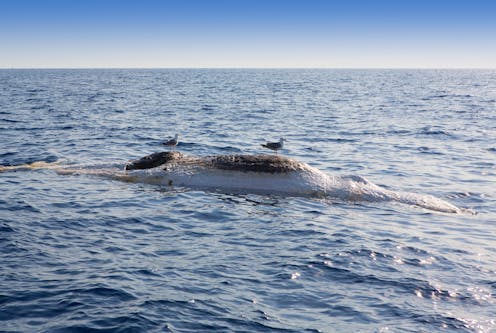
Global whale numbers are increasing for many species. While this is good news for conservation, the higher numbers coupled with dangers such as pollution, boating and climate change have caused an increase in whale deaths and strandings.
Some dead whales reach the shore, where their disposal poses a logistical challenge for authorities. Towing the carcass out to sea is one option, but it poses risks, such as the remains floating back to shore or into shipping channels. So understanding where whale bodies drift at sea is important.
That’s where our new research comes in. Last year, we tracked a whale carcass floating off the Queensland coast. We then compared this real-world data to that produced by computer modelling software typically used to help find boats lost at sea. We found the model accurately predicted where the carcass ended up.
Whale strandings are undoubtedly sad events. But with the help of science, the body can be disposed of in a way that doesn’t harm nature or people.
Big animal, big problem
When a whale dies at sea, it will initially sink but may refloat after a day or two, as gas develops in its intestines. If the carcass washes up on the beach, it must be dealt with.
Disposing of dead whales is complicated. Last century, authorities sought to blow up the carcasses to break them into smaller, more manageable pieces – a method, thankfully, which is no longer pursued.
In most cases these days, whale remains are buried in sand dunes or trucked to landfill.
Burying whale carcasses is not without challenges. They include the potential spread of diseases, groundwater contamination, and the attraction of scavengers which may impact local fauna and trigger public safety concerns.
Landfill disposal is also an imperfect solution. It requires an excavator and a truck to be brought to the beach – not always possible in very remote or inaccessible locations. To be feasible, a landfill should be located within a reasonable distance. And the loading and unloading of the carcass creates the potential for disease to spread.
The disposal of whale remains in landfills is also culturally controversial and raises ethical questions. Often, people have built up a positive connection with whales and want them buried respectfully.
Finally, the decomposition of organic matter in landfills produces climate damaging gases such as methane and carbon dioxide. It also removes important nutrients from the ocean.
Towing the carcass back out to sea may often be the best alternative. But it also comes with challenges – chiefly, preventing the carcass returning to shore or from becoming a hazard to boats. That’s why it can be useful to predict the movement of deceased whales adrift at sea.
The drift of a whale carcass is influenced by several factors such as wind, waves, tides and currents. Decomposition rates also play a role, and this can be affected by sun exposure, water temperature and scavengers.
A high-tech investigation
Our study involved a dead whale floating towards Queensland’s Sunshine Coast in July last year. The remains were identified as a 14-metre long female humpback, likely killed by a ship strike. The remains provided an opportunity to test and develop a prediction method for the whale drift trajectory.
The whale remains were disposed of about 30 kilometres offshore, close to the southward-moving East Australian Current. We then attached a satellite transmitter to the carcass, which provided information about the position of the whale remains every few minutes.
We tracked the whale remains for a week until we lost the signal – presumably because the carcass sank. We found the remains drifted towards the north – which was unexpected, given the prevailing current flowed in the opposite direction. We were also surprised that the remains travelled more than 150 kilometres.
The next step was to compare the real-world results against a computer simulation, to see how accurately the software predicted the path of the whale drift. Using search and rescue software known as SARMAP – designed to find various types of vessels lost at sea – we simulated the movement of the whale remains over the same period we tracked the carcass.
And the results? We found a simulation of a capsized skiff gave the best match for the actual path of the whale. It travelled in the same direction as the whale remains, within a few kilometres. We suspect this is because the objects are similar in terms of size and exposure above the sea surface.
The finding showed the forecasting of where whale remains might end up at sea is possible with surprisingly high accuracy.
Doing disposal well
Simulating the drift of a whale carcass towed to sea would reduce the risk of it being washed back ashore and help determine the best possible release location.
This would allow for more deceased whales to be returned to sea, where their remains play an important role in the marine ecosystem. The deep sea is generally deprived of nutrients, meaning a sunken whale carcass can be the only available food for many marine creatures.
Offshore disposal can be an ethical, cost-effective and safe option if managed well. To achieve this, we need better collaboration between local authorities, scientists and coastguards.
Authors: Olaf Meynecke, Research Fellow in Marine Science and Manager Whales & Climate Program, Griffith University

















