

Rethinking traffic congestion to make our cities more like the places we want them to be
- Written by: Brian Feeney, Adjunct Fellow, School of Earth and Environmental Sciences, The University of Queensland
Soon after becoming prime minister last year, Scott Morrison appointed a minister for “congestion busting”, signalling the importance he attaches to this issue. The large number of Google search results on “traffic congestion in Australian cities 2019” (9.5 million) and “traffic congestion in Australian cities costing the economy 2019” (8.3 million) seems to support his opinion.
But what if this concern for traffic congestion is based more on “groupthink” than a careful look at the relevant data? What if congestion is not such a big social or economic problem? What if congestion costs are overemphasised?
Read more: Stuck in traffic: we need a smarter approach to congestion than building more roads
In thinking about these questions, it should be recognised that there is always an underlying demand for driving, which exceeds the road space available, so building more roads induces more traffic. Congestion soon returns but with more vehicles affected than before. In addition, congestion is likely to increase with rising population and living standards.
Is traffic congestion a problem for the economy?
The Bureau of Infrastructure, Transport and Regional Economics (BITRE) estimated the “avoidable social costs” of traffic congestion for Australia’s eight capital cities at A$16.5 billion in 2015. While the estimate is carefully calculated, there is scope to consider other relevant factors such as:
traffic congestion is usually a problem only for commuters in or near metropolitan CBD areas – for other road users, their average time delay is a relatively minor problem
the BITRE estimate is a small proportion (about 1%) of Australia’s 2015 GDP
more than one-third of the A$16.5 billion estimate is for private time costs that aren’t factored into GDP calculations
except perhaps for congestion charging, avoiding the BITRE cost estimate would require capital expenditure, reducing the net benefit that action to reduce congestion costs could capture
the BITRE estimate gives insufficient attention to changes in travel behaviour and location decisions in response to congestion.
There is evidence that road users, both private and business, adapt to congestion by changing travel route and time of travel, as well as changing location. In addition, the effects of the so-called Marchetti travel time budget (time saved on one route tends to be used for more travel elsewhere rather than for non-travel purposes) does not seem to have been considered in the BITRE calculations.
Read more: Modelling for major road projects is at odds with driver behaviour
Using congestion to guide development
While the avoidable social costs of road congestion are arguably not a big deal, it’s pretty clear congestion plays a significant role in structuring urban areas.
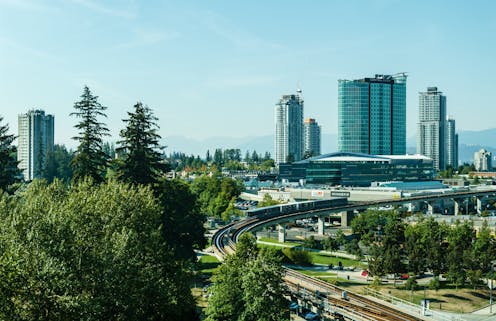
Urban planners in Vancouver recognised this some 40 years ago. Rather than trying to reduce traffic congestion, they consciously used that congestion to limit commuter car access to the city centre. They went so far as to say “congestion is our friend”.
A “carrot and stick” approach was adopted in Vancouver. Traffic congestion was used to discourage commuting by car from the suburbs to the CBD. At the same time, complementary urban planning and design policies were enacted to make the inner city a more attractive place to live for all family types including those with young children. High-quality public transport (particularly the SkyTrain metro system) to the CBD was expanded to cover more of the metropolitan area, providing an attractive alternative to commuting by car.
Of course, congestion management can be used to support other land use planning strategies, such as metropolitan decentralisation. Again this would require a “carrot and stick” approach.
Read more: Brisbane's Cross River Rail will feed the centre at the expense of people in the suburbs
Congestion narrative fuels ‘the infrastructure turn’
Urban researchers have identified what has been called “the infrastructure turn”. This is an excessive focus on building infrastructure, particularly large transport infrastructure, rather than on integrated strategic land use and transport planning.
The infrastructure focus is a simplistic response to growing city populations. Importantly, it fails to manage travel demand towards a more sustainable long-term result, such as metropolitan decentralisation like Sydney’s “three cities” approach.
Emphasising congestion and its estimated costs reinforces a sense that urgent action is needed, and supports the “infrastructure turn”.
Read more: Reimagining Sydney with 3 CBDs: how far off is a Parramatta CBD?
Planning for the city we desire
A best practice approach to metropolitan planning requires that transport planning and land use planning work together to achieve a desired future for the city. And community deliberation determines this desired future. The performance of the transport system should be measured mainly by how well this desired future is being achieved, rather than by the level of traffic congestion.
While traffic congestion is real and annoying to many (and also a worry for politicians like the prime minister), it’s not a big social or economic problem. Instead, the congestion could be managed – rather than just catering to projected demand – so our cities become more like the places we want them to be.
Authors: Brian Feeney, Adjunct Fellow, School of Earth and Environmental Sciences, The University of Queensland

















