

40 years on from its 1984 victory, the Fourth Labour Government still defines NZ
- Written by Richard Shaw, Professor of Politics, Massey University
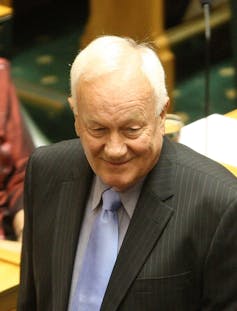
It’s easy to look back at the bad haircuts, beige clothes and brown Beehive carpets and chuckle. But whatever one’s views on its aesthetics, the Fourth Labour Government – elected 40 years ago on July 14 – was no laughing matter.
After nine years of economic nationalism and social conservatism under National prime minister Robert Muldoon, David Lange’s new broom left no corner unswept. In the space of a few short years, fuelled by a high-octane blend of neoliberal theory and neoclassical state minimalism, it reinvented the nation.
The incoming government was helped on its way by Muldoon precipitating a constitutional crisis just days after the election, and by a political system that allowed a government with a parliamentary majority to legislate with relative impunity.
Lange and his finance minister Roger Douglas also relied heavily on the intellectual support of senior Treasury officials who had spent the Muldoon years absorbing the free market philosophies of the Chicago School of Economics.
Labour deployed the political resources of a new, reforming government to full effect. And the list of its reforms says as much about the country we once were as it does about the one we have become.
Drunk with power: National’s Robert Muldoon calls the snap election in 1984.The rise of Rogernomics
During its first term in office, public subsidies in the agriculture and forestry sectors were removed. Foreign exchange and interest rate controls were lifted. The dollar was floated and financial markets substantially deregulated.
The goods and services tax (GST) was introduced, the personal income tax structure simplified, and the top tax rate for individual income earners fell from 66 to 48 cents in the dollar.
Government businesses and departments were corporatised. Many were then privatised, particularly after Labour’s increased support at the 1987 election. One of the most regulated economies in the world rapidly became one of the most open.
It was dubbed “Rogernomics”, but the Lange-Douglas government’s social and foreign policy reforms were almost as significant. Rape within marriage was finally outlawed, homosexuality was decriminalised, and nuclear-free laws passed as part of a newly assertive and independent foreign policy.
Attorney-general Geoffrey Palmer revised parliament’s Standing Orders, transforming our legislature into one of the most open in the parliamentary democratic world. Palmer also shepherded the Constitution Act (1986) through the House, which formally ended the outmoded provision that New Zealand governments could ask the British parliament to legislate on their behalf.
The past shapes the present
The Lange government would drive other, deeper transformations over time. The manner in which both Labour and its National Party successor threw their executive weight about, for instance, goes a long way to explaining the advent of the MMP proportional electoral system in 1993.
Many, perhaps naively, hoped MMP would clip the wings of the political executive. But the more astute architects of reform recognised MMP was the perfect system for locking in the structural changes made in the 1980s and 1990s by Labour and National.
The sort of radical politics that would be required to undo the neoliberal reforms enacted since 1984 are much harder to achieve in a multi-party system than in one dominated by two parties which swap executive power.
Moreover, the DNA of Labour’s Lange-Douglas era can still be found in the party system that has evolved under MMP.
Most obviously, the ACT Party was co-founded by Roger Douglas. It draws its intellectual inspiration less from Ayn Rand’s Atlas Shrugged than from the Treasury’s epochal briefing to the incoming government in 1984, Economic Management. NZ First leader Winston Peters still adheres to aspects of the world Lange and his core cabinet ended.
And Te Pati Māori is the latest in many attempts to wrangle something for tangata whenua out of our Westminster parliamentary arrangements. The political environment in which it operates was shaped by Labour’s expansion of the Waitangi Tribunal’s powers.
A new orthodoxy
Perhaps the Fourth Labour Government’s most enduring legacy, however, is the least visible: it changed the way we talk and think about politics, especially what we now consider either politically possible or beyond the pale.
We have voluntarily chosen to constrain our ability to control fiscal and monetary policy. And these self-imposed limits on state power are now so embedded in legislation that any form of fiscal activism – such as saving jobs and businesses during a pandemic – seems extraordinary.
The notion that the human condition amounts to the rational pursuit of individual self-interest is similarly pervasive. By this reasoning, wealth inequality – of which there is a great deal more than in 1984 – is a moral not a market failure. Not even a global financial crisis or pandemic could really shift the paradigm.
These things are now widely accepted as natural and immutable, rather than the political choices they are. Without anyone really noticing, two equivalent fictions – the “dead hand” of the state and the “invisible hand” of the market – have assumed the status of both lore and law.
In France, one of the crucibles of modern democracy, the fall of the ancien régime during the revolution is commemorated on July 14, Bastille Day. On that same day in 1984, an old New Zealand order also fell. It was replaced by a new orthodoxy that has effectively smothered an alternative political or economic imagination.
We are all still living in the shadow of 1984. That is the real legacy of the Fourth Labour Government.
Authors: Richard Shaw, Professor of Politics, Massey University

















