

Win or lose the next election, it may be time for the Liberals to rethink their economic narrative
- Written by: Carol Johnson, Adjunct Professor, Department of Politics and International Relations, University of Adelaide
This is part of a major series called Advancing Australia, in which leading academics examine the key issues facing Australia in the lead-up to the 2019 federal election and beyond. Read the other pieces in the series here.
In the heady political days of late 2018, former treasurer Peter Costello argued that the Liberals need to unite behind a clear economic narrative. He claimed that this would avoid Liberal politicians defining themselves on the “social issues” that have divided the government.
However, the ideological problems in the Liberal government go beyond the evident, and electorally damaging, differences over social issues. The Liberals’ economic ideology, which often cuts across their internal division between conservatives and moderates, may also be contributing to their electoral and policy difficulties.
Is it now time for the Liberals to reconsider their free market, neoliberal economic policy narrative? It emphasises lower taxes combined with radical deregulation, privatisation, corporatisation, major cuts to government spending on services and the dismantling of Australia’s century-old industrial arbitration system.
But it is a narrative that contributed to the 2014 budget cuts that helped undermine the Abbott government. It gave rise to the proposed tax cuts for big business that contributed to the poor 2016 election and 2018 byelection results. It also made it harder for the Liberals to accept a range of regulatory policy issues, including the need for a banking royal commission.
Read more: Turnbull is right to link the Liberals with the centre – but is the centre where it used to be?
Costello’s critics claim that his own tax cuts significantly reduced government revenue. This made it much more difficult for future governments to return the budget to surplus.
Has neoliberalism’s time passed?
The Liberals have always argued that they would be better economic managers than Labor; that they supported individual rights and free enterprise and opposed Labor’s so-called “socialism”. Nonetheless, their economic narrative has not always been the neoliberal, free market one that Costello and others have espoused from the Howard government on. As we shall see below, the Liberals originally believed in a more substantial role for government.
Labor has been quietly moving away from some neoliberal positions that it embraced during the Hawke and Keating years. For example, it is now more supportive of government regulation and has re-embraced Keynesian perspectives that see a major role for the state in managing capitalist economic cycles.
It has also questioned some neoliberal aspects of past Labor government industrial relations policy, such as an over-reliance on enterprise bargaining, acknowledging that this has contributed to reduced wages and conditions.
The Liberals have introduced some electorally opportunistic economic measures. These include funding for industries in sensitive electorates, energy price measures and backing down on tax cuts to big business that they couldn’t get through the Senate. But they have not undertaken a major reconsideration of their economic ideology despite the related policy problems, from unpopular budget and tax cuts to originally opposing a banking royal commission.
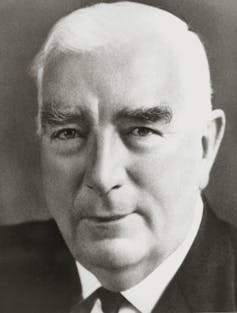 Robert Menzies believed governments should implement more economic controls, not fewer.
AAP/AUSPICS
Robert Menzies believed governments should implement more economic controls, not fewer.
AAP/AUSPICS
Yet Robert Menzies, the founder of the party, decried laissez-faire economics and argued for more controls, not fewer. He boasted of reading Keynes, given that politicians need to know “a great deal about applied economics”.
Menzies also championed the role of Liberal administrations in establishing an industrial relations arbitration and conciliation system that gave “to organised labour the basic wage, the standard working week, the protection of employees and the enforcement of their legally established rights”.
Nonetheless, the Howard government largely abolished such a system in its neoliberal-influenced (and electorally unpopular) WorkChoices legislation.
In short, the Liberals were originally more influenced by social liberalism, rather than neoliberalism, in that they were more willing to endorse state intervention to protect the welfare of citizens and the smooth functioning of markets.
So why might it be important for the Liberals to reconsider some of their economic policy narrative now?
Time for a rethink
Social democrats are fond of claiming that it has been their historical role to save capitalism from its own excesses, including during the Global Financial Crisis. However, social liberals can argue that they have also aimed to do that.
Capitalism now faces some major policy challenges. The very neoliberalism the Liberals have championed since Howard has contributed to a crisis of consumption. In Australia, the weakening of both unions and arbitration protections, particularly industrial awards, has contributed to lower wage outcomes. Reduced consumption then has impacts on private businesses that have trouble selling their goods and services.
Contemporary Liberal governments have tended to respond to cost-of-living pressures by arguing they will cut taxes and energy costs while Labor will increase them. However, negative campaigning against Labor’s tax and energy policies may prove insufficient to allay voters’ concerns about low wages growth.
Meanwhile, voters may be less convinced by arguments for free markets and light-touch regulation in the wake of the disturbing findings of the banking royal commission. This is despite the government’s belated pledges to take action, including on regulatory issues it had previously rejected.
There is also evidence, at both federal and state level, that neoliberal deregulation, privatisation and outsourcing of government functions have contributed to dysfunction in many areas. Examples include high-rise building safety (for example, structural failures and flammable cladding), and the pharmaceutical industry.
Read more: Cladding fire risks have been known for years. Lives depend on acting now, with no more delays
The Royal Commission into Aged Care, initiated by the Morrison government, is likely to reveal further regulatory failures in both design and implementation.
Federal and state governments have repeatedly proved naive in their belief that inadequately regulated industries will put the needs of ordinary Australians before the pursuit of financial gain. Consequently, they risk doing too little, too late.
The case for greater government intervention
A neoliberal belief in free markets has arguably contributed to the Liberals’ inadequate efforts to address serious market failures in areas ranging from climate change to high-speed broadband.
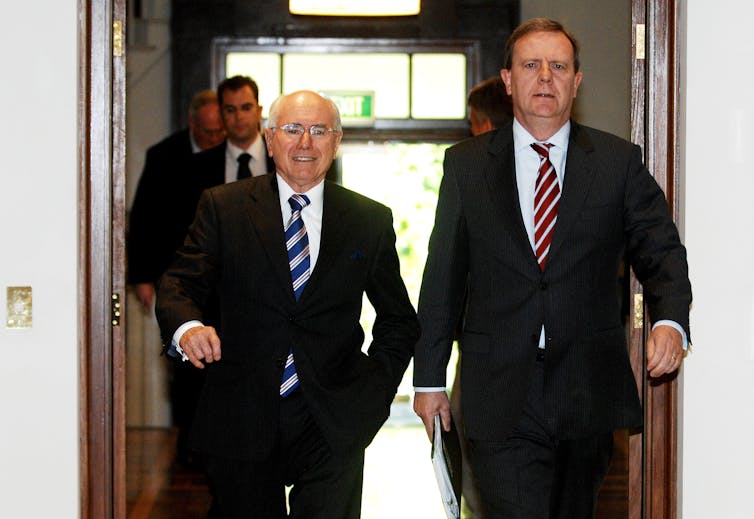 The neoliberalism that the Howard government embraced may no longer be serving the Liberal Party well.
AAP/Paul Miller
The neoliberalism that the Howard government embraced may no longer be serving the Liberal Party well.
AAP/Paul Miller
As well, Howard-era neoliberal beliefs, which saw people primarily as individuals and movements for social change as politically correct “special interests” attempting to rip off taxpayer funds, have contributed to a failure to address real issues of discrimination. The Liberals’ failure to deal with gender equity in their own party is just the latest manifestation. This from a party that a women’s organisation played a major role in establishing in the Menzies era, winning quotas in party governance structures as a result.
Read more: 'Balmain basket weavers' strike again, tearing the Liberal Party apart
Importantly, all of this is happening just as the international economy is entering a period of considerable uncertainty. This calls for careful government management of the economy and its social effects. The trade tensions between China and the US reflect broader geopolitical and economic challenges to the West as Asia rises.
Technological disruption is likely to increase unemployment, including through offshoring jobs. Developments in biotechnology will pose major ethical and regulatory challenges for governments.
For all the above reasons, it is becoming harder to argue that neoliberal market solutions, from tax cuts to deregulation, will necessarily benefit and protect ordinary voters. Public support for government spending on services is rising.
Voters have lost trust in politicians and the ability of governments to look after them. The Liberals’ current economic narrative leaves them particularly vulnerable to Labor’s claims they primarily support the big end of town.
Whether they win the 2019 federal election or find themselves back in opposition, it may be time for the Liberals to reconsider their attitude to the role of government in providing services and regulating markets effectively, while still claiming that they are more supportive of private enterprise and are better economic managers than Labor.
The challenges of 21st-century Australia may require the Liberals to draw on some of their earlier, social liberal, perspectives.
Authors: Carol Johnson, Adjunct Professor, Department of Politics and International Relations, University of Adelaide

















