

Hermit kingdom, nuclear nation ... If the media keep calling North Korea names, it will only prolong conflict
- Written by: Bronwen Dalton, Associate professor, Management Discipline Group UTS Business School, University of Technology Sydney
As US President Donald Trump and North Korean leader Kim Jong-un meet at a summit in Vietnam, we are again seeing the same kind of language used in relation to North Korea. The country is constantly described as the “hermit kingdom” and words like “nuclear threat” enter the headlines.
The US president himself called Kim “Rocket Man”, delegitimising the country and its leader. This kind of language demonises North Korea and closes off possibilities for more constructive engagement.
Past research has identified that the media regularly engage in “conflict-priming” during times of international conflict. An example was the dehumanisation of Arab citizens during the Bush-labelled “war on terror”. The authors noted the language “took the form of animal imagery” that equated human actions with subhuman behaviours.
Our research into Australia’s coverage of North Korea showed the news media often uncritically reproduced metaphors that framed North Korea as dangerous, provocative, irrational, secretive, impoverished and totalitarian.
The wider public picks up cues about the national interest, and how it might influence their own, from the media. A widespread group-think on North Korea’s impulsiveness and aggression could quickly and dramatically escalate tensions.
Read more: When governments go to war, the Fourth Estate goes AWOL
The hermit kingdom and other metaphors
We analysed coverage on North Korea in three major Australian media outlets: The Australian, The Sydney Morning Herald (SMH) and transcripts of the Australian Broadcasting Corporation (ABC) over three years – from January 1 2010 to December 31 2012.
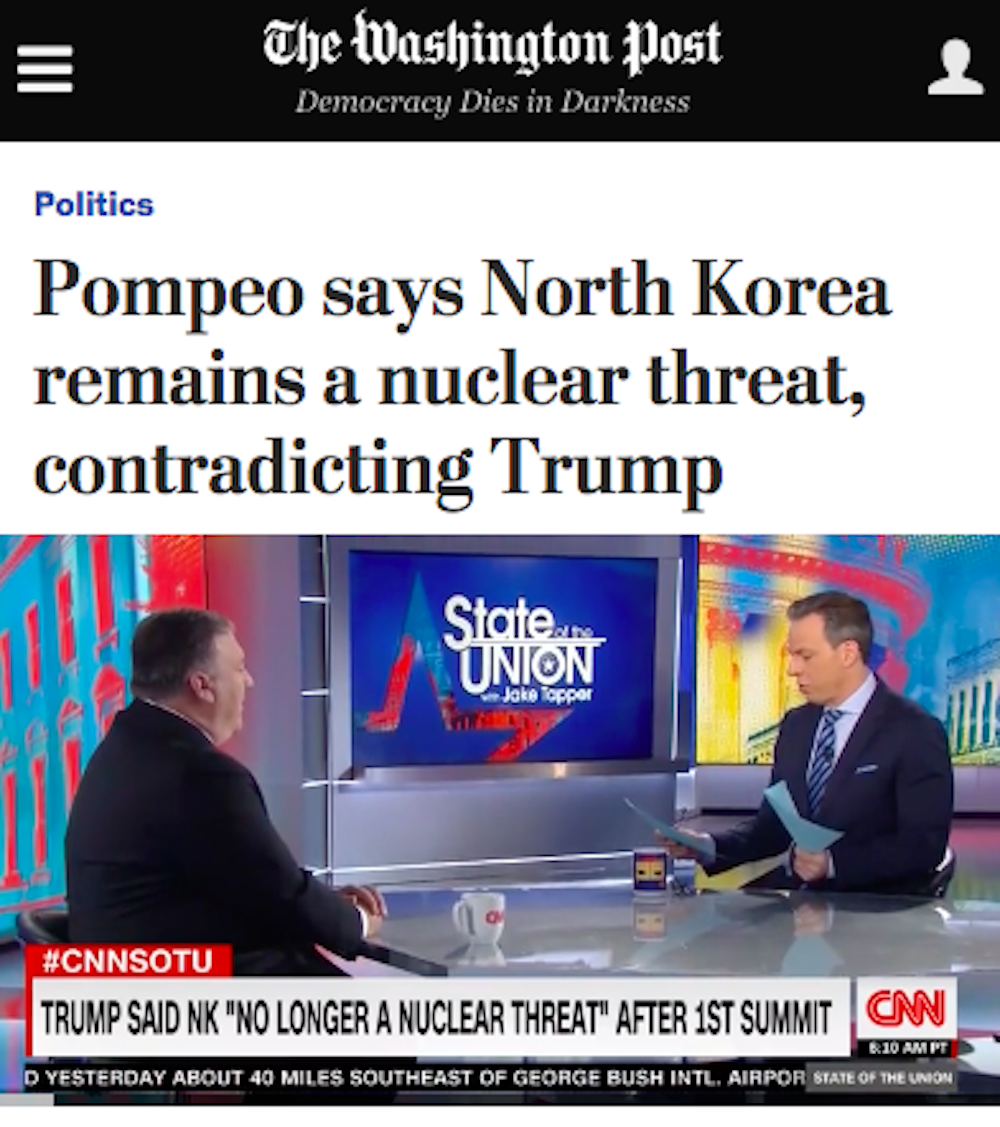 The word ‘nuclear’ often accompanies ‘North Korea’.
Washington Post Screenshot
The word ‘nuclear’ often accompanies ‘North Korea’.
Washington Post Screenshot
We found North Korea was rarely referred to as a country or its rulers as a government. Instead it was described as: an impoverished rogue state; a secretive state; the world’s most isolated state; a totalitarian regime; an evil regime; and Asia’s worst regime. The country’s leader was often referred to a ruthless psychopath or demonic big brother.
Several dominant metaphors appeared in the coverage. These framed North Korea as
- a military threat (conflict metaphor)
- unpredictable, irrational and ruthless (psychopathology metaphor)
- isolated and secretive (pariah metaphor)
- a cruel dystopia (Orwellian metaphor)
- impoverished (basket-case metaphor).
These metaphors help shape public perceptions of North Korea, giving the country a negative, often adversarial orientation. Without a change to the North Korean frame, resourced and evidence-based intervention is more likely to fail due to donor disengagement.
We also run the risk of dehumanising the North Korean people. In the event of conflict, such dehumanising can mean humanitarian imperatives are pushed aside in favour of attack.
North Korea – nuclear and narcissistic
The conflict metaphor was the most frequent across the three news sites, particularly referring to the country’s “nuclear” capabilities. Typing “North Korea” into Google News today elicits much of the same:
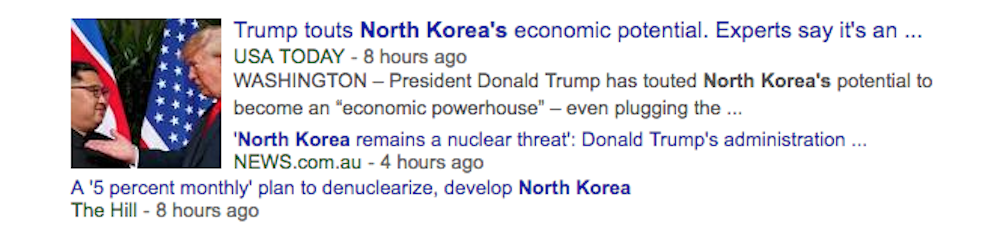 The word ‘nuclear’ appears frequently in coverage on North Korea.
Google News screenshot
The word ‘nuclear’ appears frequently in coverage on North Korea.
Google News screenshot
While the extent of North Korea’s nuclear capability is not categorically known, it is often assumed, with references to a possible “nuclear holocaust” and fears a North Korean rocket carrying a nuclear warhead could reach Australia.
Another common theme in our research was that North Korea was covered as if suffering from a pathological, narcissistic disorder. North Korea was often portrayed as seeking attention or exploiting the threat of nuclear retaliation to extricate more aid.
We can still see this today. An article in The Australian this week noted that Kim Jong-un was a master of “deceptive statecraft” as practised by his father. The author wrote:
Pyongyang is a master at getting something meaningful from the US and giving up something less meaningful or even meaningless in return… In the schoolyard, this is like the bully promising not to punch you in the face tomorrow in return for your pocket money today.
Another piece in Fox News used similar language, talking about the country as if a narcissist stringing along a romantic interest with manipulation and deceit.
Kim’s father and grandfather – who ruled North Korea before him – have a history of stringing along past US presidents of both parties with assurances of cooperative behavior and then breaking their promises.
So, North Korea is depicted as an isolated and backward country run by a tyrant with comically eccentric, excessive tastes. And its leader is perceived as a liar and a cheat.
This unbalanced consideration of North Korean motives makes us virtually oblivious to the country’s point of view. A failure to understand North Korea’s interests has serious implications for how Australia (and its allies) respond to North Korea.
Why it matters
Research shows recognising others’ concerns as valid is key to resolving long-term conflicts. But, by reinforcing a negative, often adversarial stance towards North Korea, the media effectively demonise North Korea’s interests and close off the possibility of engagement.
This locks North Korea and the “civilised” West into a mutually antagonistic relationship that precludes any solution other than the enemy being eliminated through conversion or destruction.
Read more: Beyond the war of words: how might the Australian media's coverage of China affect social cohesion?
The Australian media would be substantially enlivened by more stories illustrating individual and community life. This would give North Koreans a human face and offer the Australian public a less singular, monotonous depiction of a country so often written about with such a limited lexicon.
Access into North Korea can be tricky for journalists. But our analysis found even where human stories of refugees exist, they are often tied to negative metaphors. For the sake of balance, the media should resist common, creative descriptions and let North Korean refugees speak for themselves.
Such journalism would alter the way we view North Korea and soften the tendency to see it as an adversarial, irrational, rogue state populated by brainwashed citizens devoted to the cult of the Kims. It also should seek to better capture some of the complexities and differences of opinion that make the North Korean problem so difficult to resolve.
Authors: Bronwen Dalton, Associate professor, Management Discipline Group UTS Business School, University of Technology Sydney

















