

Most Australian welders are exposed to high levels of dangerous fumes. More than 40,000 may be at risk
- Written by Renee Carey, Senior Research Fellow, School of Population Health, Curtin University
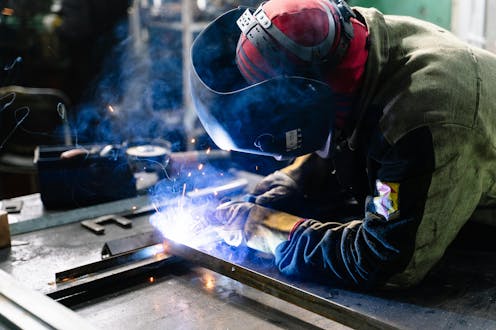
Census data show at least 60,000 people are employed as welders in Australia. Welders work in a variety of industries, including construction, manufacturing and mining.
Welding is a method used to join metals together by heating them to a high temperature and then allowing them to cool, forming a strong join. This process creates fumes.
Welding fumes are a complex mixture of very fine metal dusts, gases and other particles. These fumes have been associated with health harms including cancer, respiratory diseases and neurological disorders.
But little is known about the level of exposure to welding fumes, or the use of control measures to prevent or reduce this exposure, in Australian workplaces.
In our study published today, we surveyed 634 workers involved in welding from around Australia, across a range of ages and industries. We found most Australian welders are being exposed to high levels of dangerous, carcinogenic fumes. And we’re not doing enough to protect them.
The health risks of welding
Welding fumes were classified as a known carcinogen by the International Agency for Research on Cancer in March 2017. This was based on evidence that showed exposure to welding fumes increased the risk of lung and possibly kidney cancer. This risk was apparent regardless of the type of welding or the metals being welded.
There’s also some evidence suggesting exposure to welding fumes can cause respiratory diseases such as chronic obstructive pulmonary disease and asthma, as well as respiratory symptoms such as cough and wheeze.
There is limited evidence that welding fumes containing manganese might be related to neurological disorders such as Parkinson’s disease.
The exposure limit for welding fumes has recently been lowered in Australia, from 5 milligrams of fumes per cubic metre of air (5 mg/m³) to 1 mg/m³. This brings us into line with exposure limits in countries such as the Netherlands and Germany.
Exposure to welding fumes
In our study, we asked the workers about the tasks they did in a regular working week to understand their level of exposure to welding fumes. We also asked about the environment they worked in and the safety measures used in their workplaces. Participants responded via an online survey.
We found most welding workers (91%) were exposed to welding fumes. And worryingly, a large proportion (76%) of those were exposed at a high level, likely above new exposure limits. This is a level known to be associated with serious health harms and indicates many welding workers are not using effective protective measures.
When we apply this to the number of Australians employed as welders, this means more than 40,000 workers could be exposed to high levels of welding fumes at work.
We also know many other people – such as farmers, plumbers and mechanics – may do some welding as part of their jobs. There are also other people who work in the same areas as welders who may be exposed to welding fumes.
One limitation of our research is that we didn’t go out and measure levels of exposure to welding fumes in the workplace. Instead, we used software that assigns exposures based on the participant’s work tasks. This method has been used to assess workplace exposures in other studies in Australia and internationally.
What about protection?
The levels of protection reported were generally low. Less than 20% of participants said their workplace had some form of effective ventilation. Around 60% of those who worked in non-ventilated areas also reported they didn’t use personal respiratory protection in the form of an air-supplied welding helmet. In a recent study, wearing these helmets was found to prevent around 60% of exposure to welding fumes.
We also found the welders were performing their work tasks in ways that could increase their exposure. Many reported welding in confined or restricted spaces, which is associated with higher levels of exposure. Around 86% of welders also reported leaning over the welding area while welding, which can put their breathing zone directly in line of the fumes.
Our findings show more needs to be done to protect our workers. Employers must consider work design and provide effective exhaust systems that can remove the fumes at the source, before the welder can breathe them in.
The United Kingdom has introduced tighter regulations around the control of welding fumes. These regulations mean all indoor welding tasks need to use local exhaust ventilation, which removes the fumes from the workplace air (away from workers). This is to be supplemented by adequate respiratory protection. We would like to see these regulations enforced in Australia.
Under current Australian regulations, businesses need to take all reasonably practicable steps to eliminate or minimise exposure to welding fumes. We have the technology available in the form of effective ventilation and air-supplied welding helmets to prevent or reduce exposure – we just need to make sure we are using these controls consistently. State and territory workplace safety regulators will have a role to play in making sure these regulations, and the exposure limits, are enforced.
We’ve recently seen increased attention being paid to occupational hazards, in particular with the decision to ban engineered stone and tighter regulation of silica exposure. We need to continue this momentum to ensure all of our workers are protected from harm in the workplace.
Authors: Renee Carey, Senior Research Fellow, School of Population Health, Curtin University

















