

Estuaries and coastlines capture most plastic before it gets out to sea, giving us a chance to stop ocean pollution
- Written by Melissa Bowen, Associate Professor in Physical Oceanography, University of Auckland, Waipapa Taumata Rau
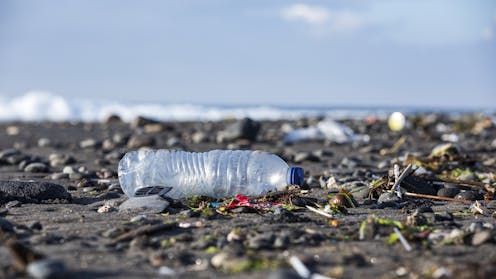
If you ask someone where plastic ends up, they will usually say the ocean. It’s not a surprising answer because we have known since the 1970s that plastic is accumulating in the subtropical oceans, far from land.
Most people have heard of the “great garbage patch”, a region of the North Pacific between Hawaii and California, where plastic is accumulating. Images of remote plastic-covered beaches often appear in the media.
However, the numbers don’t add up. Estimates of all the plastic drifting in the ocean show less than 10% of what enters rivers and coastlines reaches the subtropical accumulation zones.
Most must be ending up elsewhere, and the most likely places are along coastlines – either in estuaries, where rivers meet the sea, or along the open coast, where waves can push floating debris ashore.
We set out to investigate just how much plastic is retained in an estuary. The results of our research astonished us.
Using the main harbour of Auckland, the Waitematā estuary, as our study site, we made floating plastic packets using GPS receivers inside mobile phone pouches and tracked where they went over several tidal cycles.
Most ended up on the shoreline and none were able to move the relatively short distance needed to exit the estuary.

The speed of the drifters varied between tides, as shown in the animations above (spring tide) and below (neap tide).
 The tracks of buoyant plastics drifting during neap tides in the Waitematā estuary, with speed (in metres per second) shown by the colours.
Zheng Chen
The tracks of buoyant plastics drifting during neap tides in the Waitematā estuary, with speed (in metres per second) shown by the colours.
Zheng Chen
Currents in estuaries trap plastic
When we repeated the experiment with computer simulations, trying a wide range of freshwater flows and tides, we found the same thing. Anywhere from 60% to 90% of buoyant material was retained in the estuary over ten tidal cycles.
Surprisingly, when we increased the river flow in the model, the percentage of plastic retained in the estuary was very similar. Although the buoyant material moved towards the ocean, it became trapped before it reached the mouth.
Currents within the estuary trapped the buoyant material by “pumping” it towards land when the tide was coming in and pushing it towards the sides when the tide was going out, leading to more plastic grounded along the shore.
This movement on the incoming tide leads to the long lines of foam and debris you often see along the channel of an estuary, sometimes extending over many kilometres. On the outgoing tides, floating debris is pushed towards the sides of the channel where it accumulates.
We know these types of flows are happening in many estuaries around the world. Studies measuring plastic waste in estuaries in France, Germany and Vietnam also suggest much of plastic entering estuaries is being retained.
These findings show that removing plastic waste from the shorelines of our estuaries and coasts (and the rivers and creeks that flow into them) is a very effective way to prevent it from entering the ocean.
The most recent international study found the numbers do agree if one takes into account that plastic waste is trapped and retained along coasts.
Changing perspectives about plastic
This shift in the way we think about where plastic ends up has many implications.
For most places in the world, much of the plastic waste emitted locally stays close by. Collecting this plastic waste will keep most of it out of the ocean, which means local community clean-ups can make a difference in controlling marine pollution.
It also means, given the long lifetime of plastic, that shorelines have been accumulating this waste for many decades and are acting as plastic “reservoirs”. Much of the plastic pollution may be hidden from view as it degrades to micro- and nanometre-sized particles.
Efforts are underway in communities and within nations to reduce the use of plastic and remove it from the environment. An international treaty to mitigate plastic pollution is expected to be in place by the end of 2024.
The aim of the treaty will be to curb the emission of 53 million metric tonnes per year of new plastics that would otherwise enter the aquatic environment by 2030. But we will need to continue cleaning up plastic for many decades to undo the legacy of our consumption.
Authors: Melissa Bowen, Associate Professor in Physical Oceanography, University of Auckland, Waipapa Taumata Rau

















