

Yes, Australia’s environment is on a depressing path – but $7 billion a year would transform it
- Written by Jamie Pittock, Professor, Fenner School of Environment & Society, Australian National University
The condition of Australia’s environment continues to decline. Many Australians wonder if it’s possible to reverse this depressing trajectory – and our landmark assessment released today shows the answer is yes.
Our report, launched today by the Wentworth Group of Concerned Scientists, demonstrates how repairing Australia’s landscapes is not only achievable and affordable, it’s in the national interest.
Using the best available science and expert advice, we identified 24 actions worth A$7.3 billion each year over 30 years, which could repair much of the past two centuries of degradation.
For context, the investment amounts to about 0.3% of Australia’s gross domestic product. It’s also far less than the estimated $33 billion a year Australians spend on their pets.
This report is the most comprehensive of its kind undertaken in this country. It is a tangible, practical pathway which challenges the notion that repairing our continent is a task too big and expensive to tackle.
The strong case for repair
Australia’s population is projected to grow to 37 million by 2052. Earth’s population will reach ten billion in the same period. Global food demand will increase and competition for land will intensify.
Climate change makes the environmental repair task more pressing. The Australian continent has already warmed almost 1.5°C since records began. We have experienced shifts in rainfall patterns, droughts, bushfires, flooding and more. Extreme weather is predicted to become even more frequent and severe.
About half Australia’s land surface has been significantly modified since European settlement, and at least 19 ecosystems are collapsing due to climate change and other pressures.
And the capacity of agricultural landscapes to maintain productivity has significantly declined, and they are becoming less able to support native species and ecosystems.
Our key findings
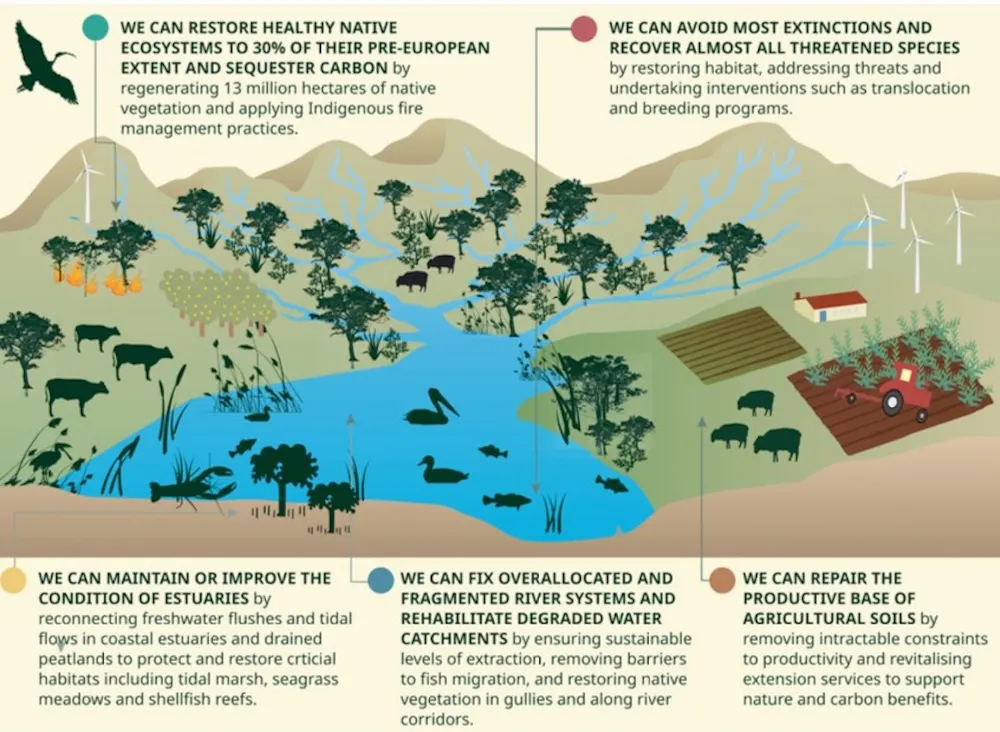
Our assessment focuses on five key landscape components identified as degraded in successive State of the Environment reports: soils, inland water, native vegetation, threatened species and coastal environments.
We defined objectives for each component, and actions to meet them, based on public policy ambitions and expert advice. We then sourced data to identify where in the landscape each action is required, and the spending it would entail. Independent experts reviewed our findings.
Our blueprint identifies 24 practical actions needed now to repair Australia’s degraded landscapes. Click here to see the full details.
The list includes:
applying lime and gypsum to agricultural soils to improve productivity
remediating high-risk gullies
encouraging landholders to restore vegetation along the banks of rivers, streams, lakes and wetlands
restoring 13 million hectares of degraded native vegetation
addressing key threats and restoring habitat for threatened species
maintaining or improving the condition of degraded salt marsh ecosystems.
We estimate investment of $7.3 billion each year (in 2022 dollars) is needed from 2025 to 2054 to deliver these all actions. That includes:
• $580 million to repair the productive base of agricultural soils
• $2.9 billion to fix fragmented, degraded river systems
• $1.7 billion to restore ecosystems to at least 30% of their pre-1750 extent
• $1.2 billion to mitigate imminent extinction risk and ensure medium-term survival of Commonwealth-listed threatened species
• $35 million to maintain and improve estuary health
• $640 million in transaction costs (such as legal fees, data and compliance)
• $250 million a year to maintain the improvements (such as monitoring, and management of pests, weeds and fire).
How will Australia pay for this?
We cannot accurately measure the true cost of environmental degradation to the environment, people and the economy. But evidence suggests these costs far outweigh the cost of nature repair.
Our report proposes measures for Australia that are feasible and fiscally responsible.
And they also address multiple objectives. For example, restoring native vegetation across 13 million hectares would also abate almost one billion tonnes of carbon dioxide-equivalent – equal to 18% of Australia’s net emissions over the next 30 years.
Through carbon markets, private landholders could be paid to regenerate native vegetation. Our analysis shows this could generate 7% to 15% of the investment needed.
The investment we propose would also support employment and jobs in the short- and long-term. This would promote a strong circular flow of income, generating government revenue in the form of income tax, GST and associated revenues.
A broad range of financing mechanisms is needed to enact this plan. As a starting point, we suggest:
significantly increased public investment for stewardship programs, Indigenous land managers and threatened species recovery
revenue-neutral changes to the tax system to encourage conservation and remove subsidies that degrade the environment
public investment in the federal government’s green bond program, which will enable investors to back public projects that contribute to environmental repair
using markets and other emerging private sector solutions to encourage conservation on private land
fundraising via philanthropy.
Indigenous Australians are key
Aboriginal and Torres Strait Islander peoples have been stewards of Country for more than 60,000 years and have continuing cultural connections to land and waters.
We propose four key measures to give Aboriginal and Torres Strait Islander peoples leading roles in managing and repairing landscapes:
increase Indigenous ownership and management of land and water
recognise the value of traditional knowledge in areas such as managing species and using fire to maintain the health of Country
establish and improve programs to employ Aboriginal and Torres Strait Islander peoples to repair and manage Country, such as expanding Indigenous ranger programs and providing resources and long-term funding
ensure Aboriginal and Torres Strait Islander peoples are supported to generate meaningful, commercially sustainable employment and businesses on Country through land and water ownership.
A healthier, more resilient Australia
All Australians are stewards of this unique land and seascape. It is our responsibility to ensure nature is preserved for its own sake, and for current and future generations.
Our plan expands on successful efforts to conserve the environment. It won’t fix everything – for instance, it did not address air quality, urban settlements or marine environments.
But the actions we propose – if done together, at scale, and built into broader public policy reforms – will leave our landscapes healthier and more resilient.
Australians don’t have to choose between a healthy environment and a productive economy – we can have both.
The report underpinning this article was prepared by the Wentworth Group of Concerned Scientists with input from more than 60 experts. See the report for the full list of contributors.
Authors: Jamie Pittock, Professor, Fenner School of Environment & Society, Australian National University

















