

How old, inefficient housing and time-of-use electricity rates are leaving some households worse off
- Written by: Lee White, Senior Lecturer and Horizon Fellow, School of Social and Political Sciences, University of Sydney
Australia was slow to introduce minimum building standards for energy efficiency. The Nationwide House Energy Rating Scheme (NatHERS) only came into force in 2003.
Older homes tend to have very poor energy efficiency. They need more electricity or gas to heat to a comfortable temperature, and more electricity to cool them in summer. This can get expensive.
We now suspect the energy efficiency of a person’s home also shapes how they respond to electricity rates that vary with time of use.
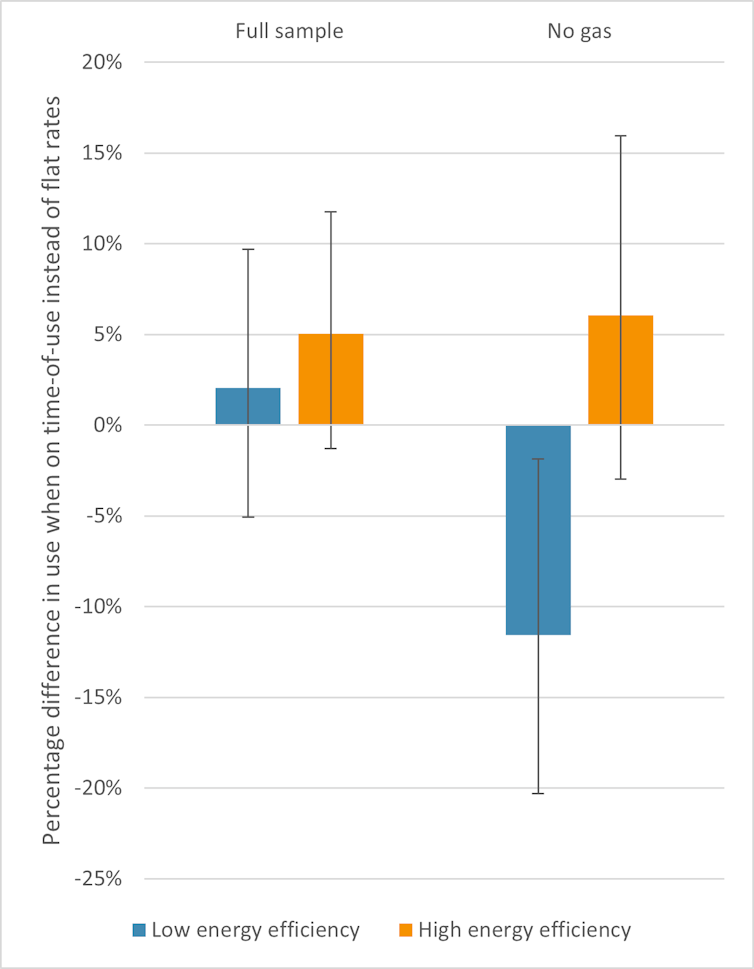
Our research suggests people in homes with low energy efficiency are turning off their heaters more when they’re on time-of-use rates, which likely means colder homes. But those in more efficient homes didn’t reduce their use or save money on time-of-use rates, even though they should be more able to shift demand to cheaper off-peak times without causing themselves discomfort.
What’s the point of time-varying rates?
Time-varying rates are becoming more common. Their purpose is to provide an incentive (lower rates) for people to use more electricity when it’s plentiful, and less electricity when expensive gas peaking plants need to be turned on at times of high demand (when higher “peak” rates apply).
For time-of-use rates (a subset of time-varying rates), peak times usually follow a set schedule. Costs are higher in the early morning and in the evening, matching when people leave for work and return home.
By nudging demand to better match supply, these rates might allow us to defer expensive upgrades to the power grid and investments in batteries (or, worse, more gas-fired generation with its carbon dioxide emissions).
However, these time-varying rates rely on the assumption that people can shift their electricity use to times when it’s cheaper. That’s not always the case.
People might not be home during the day to do laundry or dishes at off-peak times. They might have to organise meals, entertainment and cleaning around work and school schedules. They might not know which appliances are most energy-hungry and end up shifting minor uses while keeping major uses during peak times. Or they might simply not be able to shift their electricity use without their home getting too cold or too hot.
How inefficient homes have knock-on effects
Heating and cooling account for up to 50% of energy use in Australian homes, varying by climate zone and heating technology. A simple fan heater or bar heater uses three to six times as much electricity as a reverse-cycle air conditioner to produce the same amount of heat.
If your old home with old technology loses heat almost as fast as you add it, you don’t have many options. You can turn the heater off and avoid the on-peak charges in a chilly house, or leave the heater on and bear the cost.
To understand which option people were choosing, we analysed changes in electricity use and estimated bills for households in the ACT that had moved between time-of-use rates and flat rates. Utility company ActewAGL Retail provided the data.
It looks like people in homes with low energy efficiency are going with the option of turning off their heaters when on time-of-use rates. This saves money – bills for low-efficiency homes were cheaper for those on time-of-use rates than on flat rates.
Because we only have quarterly electricity bills to analyse, we don’t know for certain these people actually felt colder or were turning off the heating as opposed to other electricity uses. But households that relied on electricity for heating reduced their use on time-of-use rates – and it’s pretty hard to be warm in a Canberra winter if your heater is off.
In energy-efficient homes, you should be able to “pre-heat” or “pre-cool” your home during an off-peak time. You can then turn off the heating to avoid higher on-peak costs and your home should stay reasonably comfortable for a while.
But, interestingly, people in high-efficiency homes didn’t reduce their electricity use when on time-of-use rates. Their bills didn’t decrease either.
Where we did see a change for high-efficiency homes, bills and energy use tended to be slightly higher – the opposite of what we expected. We can only speculate on the reasons, but it’s clear time-of-use rates weren’t having the intended effect.

Building efficiency isn’t the only complication
Time-varying rates can disadvantage vulnerable households in other ways. A study in a US state with a hot climate found electricity bills rose for the elderly and those with disabilities after switching to time-of-use rates.
Both groups are likely to need more electricity to keep their homes warm or to run equipment essential for their health. This means they have less flexibility about when they need to use electricity.
That same study found ethnic minorities had more heat-related health problems after switching to time-of-use rates, although they had lower bills. Households where someone had a disability had both higher costs and worse health outcomes.
What does this mean for Australian homes?
These differences in response to time-varying rates could further widen the gap in home comfort between those who can secure an energy-efficient home and those who can’t. These rates could pinch households even further in a cost-of-living crisis.
If they are on a quarterly billing cycle, this adds to their problems. People can better understand and shift their electricity use when they receive immediate feedback such as through in-home displays.
If households can’t shift their electricity use, time-varying rates won’t achieve the goal of better matching supply and demand. As Australia rolls out these rates, we need to remember not everyone is able to respond to these price signals.
Our housing stock is shaping the way people respond. The divide in energy efficiency will continue to shape a divided response to interlinked energy costs and comfort.
Time-varying rates should be accompanied by more immediate feedback on energy use, more support to upgrade energy efficiency, and ways for people to opt out if these rates aren’t working for them financially. These simple measures have been recommended before, but still aren’t universally in place.
Authors: Lee White, Senior Lecturer and Horizon Fellow, School of Social and Political Sciences, University of Sydney


















