

still the world’s biggest emitter, but also an emerging force in climate diplomacy
- Written by: Xu Yi-chong, Professor of Governance and Public Policy, Griffith University
Seven years seems a lifetime in politics. In 2017, President Donald Trump announced the United States would withdraw from the Paris Agreement. It prompted Canada, China and the European Union to convene an urgent meeting to reaffirm political commitment to global climate action.
The successful meeting became an annual event which, this week, took place in Wuhan, China – just as the prospect of another Trump presidency looms large.
Australia’s Climate Change and Energy Minister Chris Bowen represented Australia at the invitation-only meeting of climate ministers and senior officials from nearly 30 countries.
The group gathered to progress global climate negotiations in the lead-up to the next United Nations climate conference (COP29) in Baku, Azerbaijan. Setting stronger emissions reduction targets should send clear signals for investment, which has been lagging in Australia – but not China.
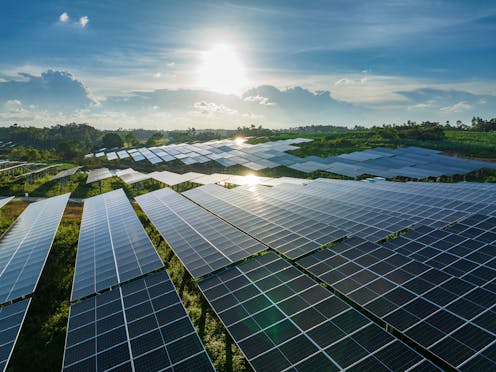
China is making remarkable progress in the transition from fossil fuels to renewable energy. Analysts have observed record growth in solar and wind – reducing coal’s share in electricity generation – alongside a boom in manufacturing of low-carbon technologies, including batteries and electric vehicles.
All of this means China’s greenhouse gas emissions may have peaked, which would be great news for the planet. It also means Australia must get a move on if it wants to become a renewable energy superpower.
China’s quiet approach to climate diplomacy
China clearly wants to play more of a global leadership role in the energy transition, but also put pressure on its own industries and firms to take climate action. China’s decision to host this week’s meeting, and others, reflects this aspiration.
Earlier this month, China hosted a five-day meeting of “like-minded developing countries” in Shandong. Then there was a “BASIC” ministerial meeting on climate action with Brazil, India and South Africa last weekend.
The big meeting this week was formally known as the 8th Ministerial on Climate Action. It involved in-depth discussions on issues surrounding COP29 and COP30, strengthening international cooperation and promoting energy transition.
At the meeting, UN Climate Change Executive Secretary Simon Stiell called for bolder climate action from all nations, especially the rich G20. Under the Paris Agreement, every nation must submit new national climate plans and targets by February next year. As Stiell says:
Done well, these plans are the key to stronger economic growth, more jobs and prosperity, much less pollution and better health.
The transition to a low-carbon economy requires structural changes that are both politically difficult and time-consuming. But China’s efforts to develop the technology for renewable energy revolution are starting to bear fruit, as I outline below.
Electricity
About 40% of China’s CO₂ emissions come from electricity generation, mainly coal, but the share of renewable energy is growing .
Wind capacity expanded from 61 gigawatts (GW) in 2012 to 441GW in 2023, while solar capacity rose from 3.4GW in 2013 to 610GW.
Coal-fired power plants are being built too, though at a much slower rate. Hydropower experienced several successive years of drought.
New storage technologies are being developed to manage the rapid expansion of solar and wind. These include water-pump storage, chemical storage, compressed-air storage, and virtual power plants. Long-distance transmission grids will enable better use of renewables.
China is also experimenting with climate policy including emissions trading and offsetting through carbon markets. A dual system that managed both energy consumption and intensity for nearly 30 years is being redesigned, because the government wants to target fossil fuel consumption instead.
The plan is to replace direct coal burning with electricity, coal with natural gas, and combustion engines with electric vehicles.
Transport
In 2023, global electric vehicle sales exceeded 13 million. China has the largest domestic electric vehicle market with more than 7 million units sold, representing a third of car sales.
In addition, China exported 1.2 million electric vehicles in 2023. This was 80% more than the previous year.
Electric vehicles are already cheaper than cars with internal combustion engines in China, because they have such a high market share. Local carmakers already offer nearly 50 different small, affordable electric models.
Steel
In April, China announced it was preparing to extend emissions trading to the steel industry. This sector is the country’s second largest CO₂ emitter, behind power.
Emissions trading is a market-based approach to controlling pollution. The government allocates permits that allow release of a certain amount of CO₂ over a set period of time. These permits can be bought and sold, or traded.
China accounts for more than half of the world’s steel production. But the industry also supports the energy transition, because steel is used in renewables and electric vehicles manufacturing. Nearly 70% of the world’s key components of wind turbines and 80% of solar panel components are made in China.
The government is encouraging industry to work with universities and research institutes to reduce emissions. It will not be easy, and it will be costly.
China is the world’s largest hydrogen producer, but 80% comes from fossil fuels. Investment in green hydrogen research and development is increasing, with some firms determined to take the lead. If steel-making could be powered by green hydrogen, it would be a major breakthrough.
A glimpse of the future
Given the uncertainty surrounding the US election in November, China’s steady hand in climate diplomacy is welcome.
China is also showing Australia and other nations what’s possible if the energy transition is turned into an opportunity for innovation. The scale of the renewable energy rollout in China is staggering, but so too is the pace of technology development to support renewables – to efficiently store wind and solar power to supply electricity on demand.
As the International Energy Agency said in 2020, more than two-thirds of global greenhouse gas reduction will be supported by the technologies that are still in development. China wants to get there first and corner the market. And there’s every indication it will succeed.
Authors: Xu Yi-chong, Professor of Governance and Public Policy, Griffith University


















