

Modern Australian
The Times

what makes the Olympic surf break at Teahupo'o unique – and so challenging

  • Written by Tom Shand, Honorary Senior Lecturer, Department of Civil and Environmental Engineering, University of Auckland, Waipapa Taumata Rau
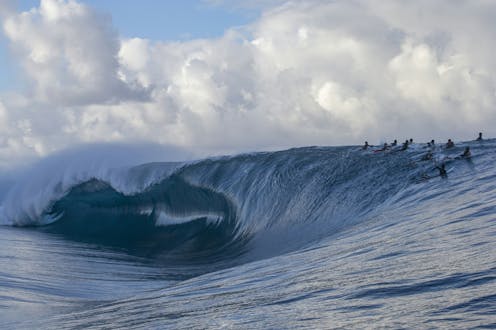
what makes the Olympic surf break at Teahupo'o unique – and so challenging

As the Olympics get going in earnest this week, not everyone’s attention is focused on host city Paris. Surf fans are heading to Tahiti, half a world away in French Polynesia.

Why? Well, apart from the French coast resembling a lake at this time of year, on the south-west coast of Tahiti Iti is a wave unlike any other on the planet: Teahupo'o, which translates somewhat ominously as “place of skulls”.

The wave is unique in the way it breaks. The lower part of the wave appears to drop away below sea level, with the top half folding over dramatically to create an almost cartoonishly perfect form.

It is both the weight of water in the plunging lip and the risk of injury or death for a surfer in the wrong position that make this one of the world’s heaviest waves (in both senses of the word).

To understand why the wave breaks like this, we need to start with bathymetry: the shape of the seabed that influences waves as they approach the shore. At Teahupo'o, a combination of factors comes into play.

Tahiti Iti coast viewed from above and out to sea showing mountain peaks, water craft and surfers
Olympic views: the surf break at Teahupo'o with Tahiti Iti in the background. Ryan Pierse/Getty Images

A one-of-a-kind wave

Waves arriving at Teahupo’o generally originate from intense “roaring forties” storm systems south of New Zealand. By the time the waves reach Tahiti they have become ordered swell, with wave heights of two to five metres and periods of 14 to 20 seconds between successive waves.

These types of long-period waves normally start interacting with the seabed at depths of around 200 metres. On most coasts, this depth would occur up to several kilometres offshore. But at Teahupo’o, it is much closer, just a couple of hundred metres.

This rapid change in depth forces the wave to “shoal” very quickly – the wave speed slows, the distance between waves compresses and the wave height increases.

The change is so abrupt that the wave is still very linear – it hasn’t had time to develop the peaked crest and flat trough (the lowest part of the wave) typical of waves in shallow water.

Clockwise from top left: location of the Teahupo'o surf break, form of the reef and mountains behind, bathymetry of the surf break, and notable reef features (elevation data from SHOM, satellite imagery from Airbus). Tom Shand, CC BY-NC-SA

Waves breaking on this type of steep slope would typically collapse, breaking from the middle of the wave and creating an unsurfable mess. But this doesn’t happen.

At around ten metres’ depth, a flatter shelf in the reef allows the wave to stabilise and “stand up” with a steep front face, before finally breaking as the reef rises again.

And break it does. Owing to the linearity, there is far more water in the crest (the part above water) then most waves, and a deeper trough in front.

This makes for the characteristic below-sea-level break at Teahupo'o, with the overturning lip being half the wave height, and a jet of compressed air forced out of the wave’s barrel after breaking.

The larger the wave, the closer to the steep offshore ramp it breaks, and the more extreme the plunging.

Big wave breaking with surfer visible within its barrel
A typical breaking wave at Teahupo'o: the thick lip and deep trough make it so powerful. Tim McKenna/Getty Images

A pro surfers’ paradise

A range of other unique features contribute to the way the wave breaks at Teahupo’o – and what makes it so challenging as a surfing wave.

A deep channel runs alongside the shallow reef shelf. The wave doesn’t break in this deeper area, allowing it to peel – to break in one direction (in this case towards the left looking towards the shore) – and enabling surfers to ride the wave before it finally closes out onto shallow reef.

A part of the shallow reef platform extends offshore, into the reef pass. This shallow area bends and focuses wave energy from the wider, deeper part of the wave back into the breaking wave. This happens particularly on more westerly orientated swells, increasing the intensity of breaking.

As well as this, the Teahupo'o wave breaks in a direction nearly opposite to the prevailing trade winds, keeping the wave face smooth.

A low tidal range also limits the times the reef is too deep or too shallow to surf. And the wave is near the Passa Hava'e reef pass, which helps the wave’s focusing and breaking. But because it isn’t right in the pass, the wave isn’t affected by high tidal or wave-induced currents.

New-generation wave models that simulate individual waves, rather than just average energy density, provide insight into what creates a surf break such as Teahupo'o (see figure below). These models provide insight into what happens as waves shoal and refract (bend and focus) over the seabed as they approach break point.

They also significantly improve our understanding of what makes a particular surf break unique. This can help in assessing the potential impact of human or natural modifications to the environment.

An example of the Celeris wave model simulating typical surfing conditions at Teahupo’o. The break point, peel angle and speed are able to be verified against satellite and drone imagery. (Elevation data from SHOM, satellite imagery from Airbus.) Tom Shand, CC BY-NC-SA

Authors: Tom Shand, Honorary Senior Lecturer, Department of Civil and Environmental Engineering, University of Auckland, Waipapa Taumata Rau


Read more https://theconversation.com/anatomy-of-a-wave-what-makes-the-olympic-surf-break-at-teahupoo-unique-and-so-challenging-235301

The Growing Popularity of Lab Grown Diamonds in Sydney and Hong Kong

The diamond industry has changed significantly in recent years as more buyers seek ethical, affordable, and sustainable alternatives to mined diamon...

Modern AI SEO Agency vs Traditional SEO: What’s the Difference

Search engine optimisation has changed dramatically over the past few years. Search engines have become smarter, user behaviour has evolved, and bus...

Caravan Travel for Modern Australian Getaways: Plan a Comfortable Holiday

A family road trip is one of the best ways to explore Australia together. And, travelling by caravan gives you the freedom to take your time, stop a...

Mini Excavator and Trailer Package for Sale: What I Buy as One Deal in 2026

The first client who asked me for a mini excavator and trailer package for sale wasn’t trying to save a few hundred dollars on shipping. They we...

Make Dad a Guest in His Own Home This Father’s Day

Father’s Day can accidentally turn Dad into the unpaid event manager of his own celebration. He lights the barbecue, finds extra chairs, checks wh...

Where to Enjoy Your Off-Road Caravan on the Gold Coast

With a caravan, you can travel anywhere and everywhere without battling the rush of the peak holiday season or last-minute reservations. While the r...

How Osteopathy Supports Recovery from Sciatica and Nerve Pain

Sciatica isn't just annoying. It's genuinely painful. It sits deep in your glute and shoots straight down the back of your leg. It turns something as...

The Winter Jewellery Edit: Five Pieces You'll Wear All Season

As wardrobes shift to cosy knits, tailored coats and rich seasonal textures, jewellery becomes the finishing touch that pulls every winter outfit to...

7 Signs It's Time to Upgrade Your Piston Air Compressor

If you run a workshop, panel shop, or fabrication business anywhere around Perth, you already know what heat and dust do to equipment over a few sum...

How Long Do Bathroom Renovations Melbourne Take? Step-by-Step Process Explained

Planning a bathroom renovation is exciting, but one of the biggest questions homeowners ask is, "How long will it take?" While every project is uniq...

Why Your Skin Breaks Out: The Science of Acne Explained

Acne is the most common skin condition in the world. An estimated 85% of people experience it at some point between the ages of 12 and 24, and a gro...

10 Swimwear Trends Australian Women Are Wearing This Summer

Every Australian summer brings a fresh wave of swimwear trends, but some styles have much greater staying power than others. While fashion constantly ...

Why Regular Skills Updates Are Essential for Licensed Security Officers

A guard at a Brisbane shopping centre gets a call about a shoplifter who's turned aggressive.  They’ve done the job for six years. But their de-...

10 Benefits of Choosing Professional Tutoring Penrith Services

Every student has unique learning strengths, challenges, and academic goals. While classroom teaching provides essential knowledge and structure, so...

Sunshine Coast Baby Classes Prove Big Hit Among First-Time Mums

There's a movement gaining traction on the Sunshine Coast, providing a village of support, socialisation and relief for first-time mothers and babie...

Father's Day Gift Ideas for Men Who Are Hard to Buy For

Some dads are easy to buy for. Others do not want anything, already have everything, or give you the classic "don't worry about me" answer every yea...

Top 5 Mistakes That Wear Out Your Brakes Faster

Brakes don't need frequent replacements like oil changes do.   But a lot of the wear happens quietly, over months, because of habits most drivers...

Plantation Shutters vs Curtains: Which Is Better for Your New Home?

Moving into a new home is an exciting opportunity to personalise your space and make it your own. While many homeowners focus on furniture, flooring...















