

Modern Australian
The Times

here’s why the Southern Ocean is a global engine room

  • Written by Luke Bennetts, Lecturer in applied mathematics, University of Adelaide
here’s why the Southern Ocean is a global engine room

The Southern Ocean is wild and dynamic. It experiences Earth’s strongest winds and largest waves. It is home to city-sized icebergs and the biggest ocean current on the globe, as well as tiny turbulent flows that fit inside a teacup.

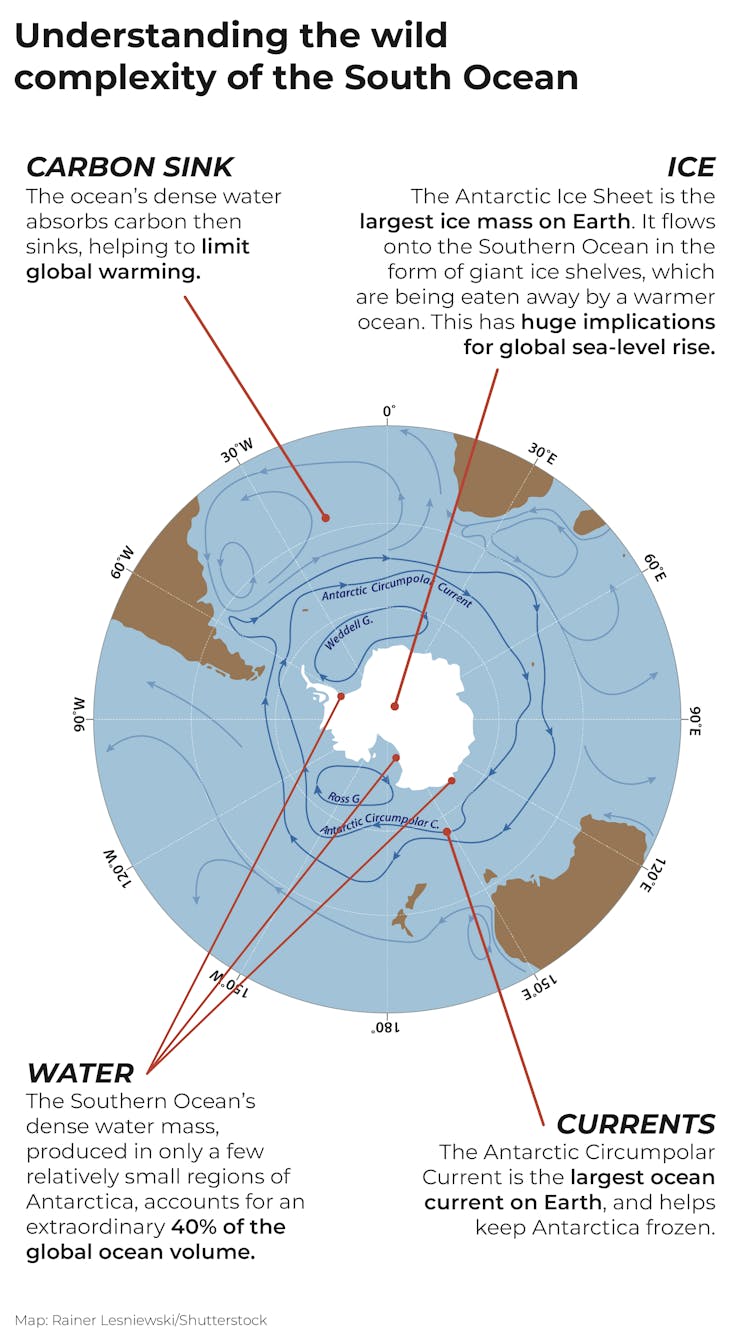
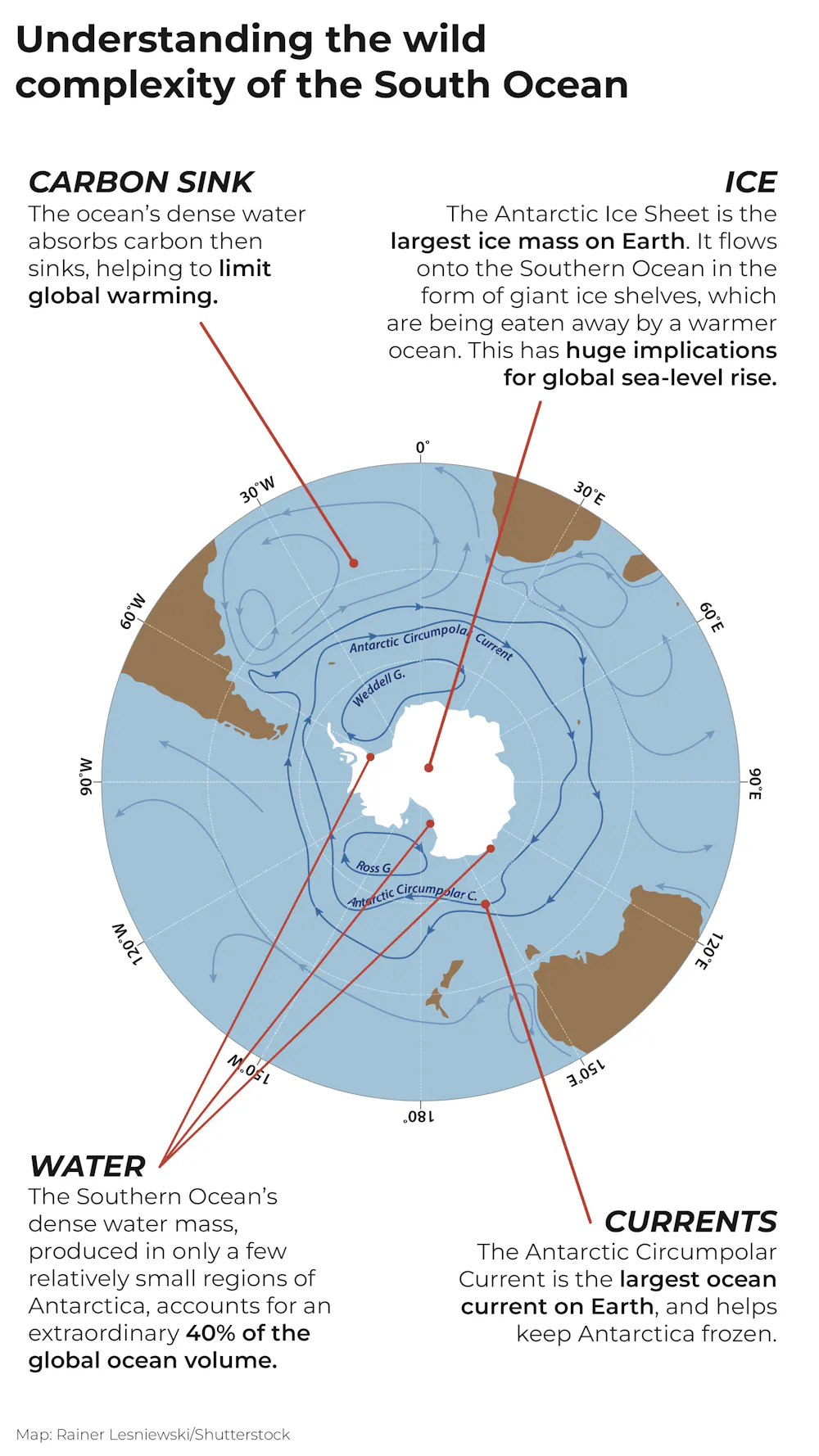
The Southern Ocean is also crucial to Earth’s natural systems. It forms the dense water that fills the world’s deep oceans. It stores heat and carbon resulting from human-caused global warming, and controls the flux of heat to the huge ice sheet of Antarctica – the greatest threat to runaway global sea-level rise.

The scale and complexity of the Southern Ocean can be hard to comprehend. But our new paper may help. It summarises the present state of understanding of the Southern Ocean, how it is changing, and where the knowledge gaps lie.

Scientists and others regularly voyage to the Southern Ocean’s furthermost icy reaches – but more research is needed. The scientific and broader community must join together to advance Southern Ocean science and protect this vital natural asset.

research equipment on boat near Antarctica
Scientists regularly voyage to the Southern Ocean’s furthermost icy reaches – but more research is needed. Louise Biddle

Masses of ice at risk

The Antarctic Ice Sheet is the largest ice mass on Earth, equivalent to 58 metres of the global sea level.

The ice sheet flows onto the Southern Ocean surface in the form of giant ice shelves. Many of these ice shelves are being eaten away from below by a warmer ocean, or crumbling and becoming icebergs at a faster rate than before.

Beyond the ice shelves, millions of square kilometres of the Southern Ocean surface is frozen into a layer of sea ice. This acts as a giant solar reflector and shields ice shelves from powerful Southern Ocean waves.

After decades of seemingly defying warming temperatures, the Southern Ocean’s sea ice has dramatically declined in recent years. This puts ice shelves and the ice sheet under even greater stress.

penguins jump off iceberg
Most ice shelves in the Southern Ocean are losing mass. David Keyton/AP

Filling Earth’s oceans

Much of the sea ice is produced in small regions of open water, called “polynyas”, formed by strong and cold winds blowing off Antarctica. These winds cool the ocean surface below the freezing point, causing ice to form.

As the ice forms it ejects salt into the ocean surface. This extra salt, in addition to cooling effects from the atmosphere, makes the surface seawater heavier, or more “dense”.

The dense water sinks in turbulent plumes (imagine an upside-down volcano) and cascades through underwater canyons into the deep ocean, while mixing with overlying waters.

The resulting dense water mass, produced in only a few relatively small regions of Antarctica, accounts for an extraordinary 40% of the global ocean volume. It is ultimately lifted back to the ocean surface by centimetre-scale turbulent eddies – of the type you see when mixing milk into your tea.

In the deep ocean, this mixing is largely driven by ocean tides that slosh over the rough seafloor and produce internal waves.

Climate system at risk It takes many hundreds of years for the ocean water to cycle from the surface Southern Ocean to the deep and back. Water returning to the surface today is like a time capsule, reflecting the cooler, pre-industrial climate when it first sank to the ocean depths. The water that sinks today has absorbed more carbon to store in the deep ocean, helping to limit global warming. However, models and observations suggest reductions in sea ice and ice shelves are weakening this crucial climate system. They are making the water warmer, less salty and more buoyant, so less prone to sinking. This means less carbon storage and a warmer atmosphere in the years ahead. An oceanographic instrument being deployed. Steve Rintoul/Australian Centre For Excellence in Antarctic Science So much we don’t know Making measurements in the Southern Ocean is immensely challenging due to its remote location and hostile conditions. This means in many cases data is sparse, and so scientists don’t know exactly how quickly changes are occurring. Our review identified several areas as a key priority for future Southern Ocean research. They include observations of ocean temperatures and melting beneath ice shelves, as well as long term measurements of dense water formation. More data is needed to monitor changes and provide early warning of significant climate events, such as ice sheet collapse. Crucially, more data is also needed to inform and assess the computer models on which government, industry and society rely to predict future climate. Unfortunately, ocean observations are expensive. For example, Australia’s premier research vessel, the RV Investigator, costs more than A$100,000 a day to run. And the new SWOT satellite – a joint project of the European Union and United States to measure the ocean surface at unprecedented resolution – cost more than US$1 billion. two women examining cylinders Scientists Sylvie King and Treden Tranchant taking samples on board the research vessel Investigator, in a bid to understand more about Southern Ocean currents. More such work is needed. Amelia Pearson/Australian Antarctic Division These costs also highlight the need for enhanced national and international collaboration. This would make the best use of available resources, and promote technological innovation to develop more cost-effective observing systems such as drones and drifting robotic instruments. The federal government’s scientific priorities and funding decisions should reflect the crucial importance of Southern Ocean science. We are currently in the UN Decade of Ocean Science, which aims to improve predictions of ocean and climate change. Improved understanding of the Southern Ocean is vital to this effort. Authors: Luke Bennetts, Lecturer in applied mathematics, University of Adelaide

Read more https://theconversation.com/giant-waves-monster-winds-and-earths-strongest-current-heres-why-the-southern-ocean-is-a-global-engine-room-233669

The Growing Popularity of Lab Grown Diamonds in Sydney and Hong Kong

The diamond industry has changed significantly in recent years as more buyers seek ethical, affordable, and sustainable alternatives to mined diamon...

Modern AI SEO Agency vs Traditional SEO: What’s the Difference

Search engine optimisation has changed dramatically over the past few years. Search engines have become smarter, user behaviour has evolved, and bus...

Caravan Travel for Modern Australian Getaways: Plan a Comfortable Holiday

A family road trip is one of the best ways to explore Australia together. And, travelling by caravan gives you the freedom to take your time, stop a...

Mini Excavator and Trailer Package for Sale: What I Buy as One Deal in 2026

The first client who asked me for a mini excavator and trailer package for sale wasn’t trying to save a few hundred dollars on shipping. They we...

Make Dad a Guest in His Own Home This Father’s Day

Father’s Day can accidentally turn Dad into the unpaid event manager of his own celebration. He lights the barbecue, finds extra chairs, checks wh...

Where to Enjoy Your Off-Road Caravan on the Gold Coast

With a caravan, you can travel anywhere and everywhere without battling the rush of the peak holiday season or last-minute reservations. While the r...

How Osteopathy Supports Recovery from Sciatica and Nerve Pain

Sciatica isn't just annoying. It's genuinely painful. It sits deep in your glute and shoots straight down the back of your leg. It turns something as...

The Winter Jewellery Edit: Five Pieces You'll Wear All Season

As wardrobes shift to cosy knits, tailored coats and rich seasonal textures, jewellery becomes the finishing touch that pulls every winter outfit to...

7 Signs It's Time to Upgrade Your Piston Air Compressor

If you run a workshop, panel shop, or fabrication business anywhere around Perth, you already know what heat and dust do to equipment over a few sum...

How Long Do Bathroom Renovations Melbourne Take? Step-by-Step Process Explained

Planning a bathroom renovation is exciting, but one of the biggest questions homeowners ask is, "How long will it take?" While every project is uniq...

Why Your Skin Breaks Out: The Science of Acne Explained

Acne is the most common skin condition in the world. An estimated 85% of people experience it at some point between the ages of 12 and 24, and a gro...

10 Swimwear Trends Australian Women Are Wearing This Summer

Every Australian summer brings a fresh wave of swimwear trends, but some styles have much greater staying power than others. While fashion constantly ...

Why Regular Skills Updates Are Essential for Licensed Security Officers

A guard at a Brisbane shopping centre gets a call about a shoplifter who's turned aggressive.  They’ve done the job for six years. But their de-...

10 Benefits of Choosing Professional Tutoring Penrith Services

Every student has unique learning strengths, challenges, and academic goals. While classroom teaching provides essential knowledge and structure, so...

Sunshine Coast Baby Classes Prove Big Hit Among First-Time Mums

There's a movement gaining traction on the Sunshine Coast, providing a village of support, socialisation and relief for first-time mothers and babie...

Father's Day Gift Ideas for Men Who Are Hard to Buy For

Some dads are easy to buy for. Others do not want anything, already have everything, or give you the classic "don't worry about me" answer every yea...

Top 5 Mistakes That Wear Out Your Brakes Faster

Brakes don't need frequent replacements like oil changes do.   But a lot of the wear happens quietly, over months, because of habits most drivers...

Plantation Shutters vs Curtains: Which Is Better for Your New Home?

Moving into a new home is an exciting opportunity to personalise your space and make it your own. While many homeowners focus on furniture, flooring...
















