Smartphones allow us to capture nature like never before – but are they also distorting our view?
- Written by Gemma Blackwood, Lecturer, Media, University of Tasmania
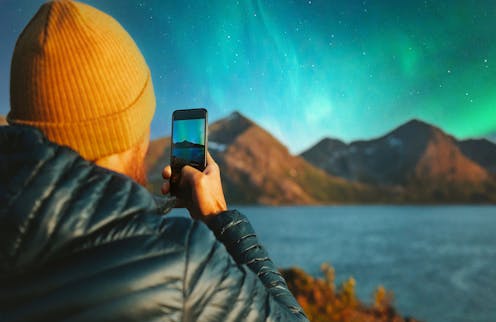
Even if you weren’t lucky enough to spot the aurora light shows visible across southern Australia this week (and which may potentially reappear in coming days), you probably did encounter the onslaught of online news articles and photos that followed.
Just 35 years ago, however, this wouldn’t have been the case. Even digital cameras weren’t easily available until the mid-1990s, which means any dazzling aurora sightings would have been a privileged view for a select few.
Read more: Our obsession with taking photos is changing how we remember the past
According to Photutorial founder Matic Broz, about 1.94 trillion photographs will be taken globally over 2024 – with more than 90% of these taken by smartphones.
Taking photos is also increasingly becoming a part of our experience of the natural world. What was once just stargazing has branched off into the massive field of astrophotography. Our cameras enable a new way of experiencing nature that’s far-removed from how earlier generations would do so.
New technology brings new opportunities
In the case of auroras and other forms of astrophotography, night-friendly photo settings have allowed us to see the world after dark.
Improvements in “night mode” technologies have been in development since smartphones were invented. That said, Google could be considered the first company to have released technology that enables simple astrophotography, with its introduction of “night sight” for Pixel phones in 2018.
Then, in 2019, Apple released a similar “night mode” setting for the iPhone 11 – and for many smartphone users, the need to manually apply exposure settings on a camera suddenly disappeared.
In one of Apple’s night mode ads released in 2020, we see a montage of “before and after” images highlighting the difference in quality when the mode is applied. The montage is set against the Smashing Pumpkins song We Only Come Out At Night, as an aurora photo appears in the set.
Today, there are numerous official and unofficial guides (and even entire books) to help people harness their smartphone camera’s capabilities.
In her book The Aurora Chaser’s Handbook: In Search of Tasmania’s Southern Lights, author Margaret Sonnemann provides a how-to for “photographing the aurora on a mobile phone”. She suggests using apps to enhance the visual settings and switching to “night” or “astro” mode.
Is nature enhanced through the artificial lens?
There are several reasons why you might want to capture the beauty of nature through your smartphone.
For one thing, doing so helps “democratise” our collective experience of the natural world. Sharing photos of nature gives many more people the ability to come across incredible natural sights. This is especially valuable for those who may be financially or physically unable to travel to the distant lands where these sights are found.
Then there’s the fact that photos and video allow us to watch and rewatch natural phenomena. Apart from being a cool thing to do, this provides opportunities for education and analysis of the natural world. Indeed, sharing photos to increase public interest in nature could even be considered a form of environmental communication.
Technology also helps “enhance” our view of the natural world. Aurora photos, for instance, use prolonged exposure times to greatly enhance colours and lights in a way that can’t be seen by the naked eye. This provides an additional incentive to whip out your phone if you do come across one.
Similarly, prolonged exposure times allow us to take “flowing” photographs of waterfalls and surf waves. And time-lapse settings let us create stop-motion videos of slow-moving nature, such as cloud movements or flower buds opening.
Is nature tainted through the artificial lens?
As aurora photography and similar forms become increasingly common, we should also ask the following question: how is this new way of interacting with nature impacting our relationship with it?
Digitally enhanced images literally change what we would otherwise see with the naked eye. Might this distort our ideas of nature?

Many widely shared photos of auroras may not even be real. Post-editing techniques are often used to further enhance aurora shots, or to add an aurora to a shot that never even had one. Some striking images that circulated earlier this year were deliberately faked.
The increasing sophistication of artificial intelligence will only make it harder to distinguish between the truly phenomenal and the phony. As such, the large set of photographs that appear on social media carry with them a whole new set of representational concerns.
Visual culture professor Nicolas Mirzeoff suggests we are compelled to take photos as a “key part of our effort to understand the changing world around us and our place within it”. But photos risk becoming visual commodities when they are extraneously edited (or faked) and plastered online in the millions.
And then there is the concern that a cultural obsession with photographing nature might divert our focus from what’s truly in front of us, taking us out of the magical moment. So, as these new photo technologies enable new ways of connecting with nature, so too do we need to consider how they might be distracting or removing us from it.
Authors: Gemma Blackwood, Lecturer, Media, University of Tasmania