Indigenous Australians want a seat at the table when it comes to conservation. Here’s how we might get there
- Written by Teagan Goolmeer, PhD Candidate, The University of Melbourne
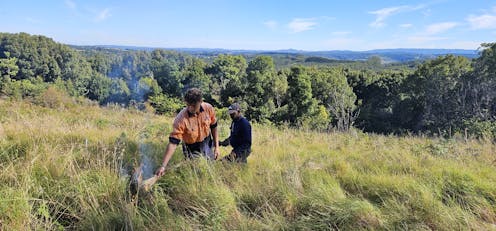
Globally, many Indigenous people want to help protect their traditional lands and waters, drawing on knowledge stretching back millenia. Indigenous people have an obligation to look after species and habitats that are culturally important to them.
But how can Indigenous voices be supported to make land management decisions? And how do we ensure the process is Indigenous-led and culturally safe? New research by myself and colleagues can help.
We engaged Indigenous people from Bundjalung Country on Australia’s east coast. In a process they led, the Bundjalung people identified which culturally significant species they considered priorities for “collaborative management” – that is, management built on mutual respect for both Western science and Indigenous knowledge systems.
We hope this process might be used elsewhere, to give Indigenous people a genuine say in decisions about managing Country.
‘They hold the stories’
Bundjalung Country stretches from Grafton in northern New South Wales to the Logan River in Queensland and inland to Warwick.
The term Country describes the lands, water and seas to which Indigenous people are connected. Country contains complex ideas about lore, custom, language, spiritual belief, culture, material sustenance, family and identity.
For Indigenous Australians, some plants, animals and habitats hold special cultural significance. This may be, for example, because they are used in ceremonies, they feature in Creation stories or are used as a traditional food source.
The importance of this concept was was summed up during our project by Bundjalung man Oliver Costello, who said:
[Culturally significant entities] are the teachers of Country, they hold the stories and are the indicators for the health of Country. If you look after Country, it will look after you.
Our study set out to establish a process by which Indigenous people can come together to identify culturally significant species. The list of priority species would then be used to inform collaborative land and sea management with governments, conservation groups and others.
The process should be led by Indigenous people themselves, and aligned with their obligations and values.
We partnered with the Bundjalung-owned Jagun Alliance. This was crucial to ensuring the project was conducted in a culturally safe manner and developed with an Indigenous lens.
Our project adhered to cultural protocols and protected Indigenous cultural and intellectual property at all times.
What we did
First, we convened a meeting of five non-Bundjalung Indigenous experts with extensive experience in Indigenous-led work biodiversity work.
They identified six objectives for decision-making around culturally significant species. The objectives involved not just environmental values, but also social, spiritual, economic and cultural values.
We hosted several on-Country workshops with Bundjalung people and distributed an online survey, to determine which species might be prioritised for collaborative management. Of the responses we received, 32 yielded usable data.
The culturally significant plant and animal species identified as the top priority by Bundjalung respondents were:
- koalas
- goannas
- platypuses
- echidnas
- wedge-tailed eagles
- coastal emus
- pipis
- long-necked turtles.
Participants were also asked which habitats were most important for collaborative management. Some 70% identified wetlands, followed by grasslands and big scrub (a mosaic of lowland rainforest, swamp forest and wet eucalypt forest extensively cleared by colonists).
Once the results were in, Bundjalung knowledge-holders identified threats to these species, as follows:
- the lack of Bundjalung decision-making in land management actions
- lack of cultural burns
- impacts on Country such as dams, roads, housing and farming
- invasive species
- climate change.
The Bundjalung also identified management actions which should be integrated into Western management under a collaborative approach:
- community gathering on Country, such as holding ceremonies and harvesting traditional resources
- regular cultural burns
- releasing water into catchments to support cultural objectives
- active management of cultural sites and pathways.
Unlike the current threatened species approach, which largely manages only parts of the problem, the actions identified by Bundjalung people were holistic and landscape-wide. This means these actions can benefit many species and habitats.
Bundjalung people were then invited to a meeting to share findings from the work. This provided an opportunity to heal from past trauma over a shared vision for Country.
Spotlight on the koala
In Bundjalung language, the koala is known as the boorabee.
The boorabee is the only culturally significant species identified by Bundjalung people with an active “national recovery plan”. This plan guides and coordinates conservation efforts by governments and others.
The koala recovery plan calls for Indigenous-led action, which offers Bundjalung people an avenue for collaborative management. Likewise, many management actions proposed by the Bundjalung are clearly aligned with the plan.
The koala and coastal emu are listed as threatened species under various pieces of state and federal legislation. However, a species need not be imperilled to be central to Indigenous-led management.
Where to now?
Our process helped a group of Bundjalung people agree on their conservation priorities, and how to act on them.
It’s important to note, however, that the Bundjalung community consists of ten clans – it is not a homogeneous group. As such, our findings may not be supported by all Bundjalung people.
We hope our findings help policymakers understand what Indigenous-led action could look like, if integrated into biodiversity management. The structured process we undertook may benefit other groups – although applied elsewhere, it may involve different objectives, modes of engagement and results.
Indigenous Australians are ready to sit at decision-making tables to improve the management of Country. They intimately understand our precious environment – and their contribution could be transformative.
Authors: Teagan Goolmeer, PhD Candidate, The University of Melbourne