What is ‘slot hoarding’ – and is it locking out regional airlines like Rex?
- Written by Doug Drury, Professor/Head of Aviation, CQUniversity Australia
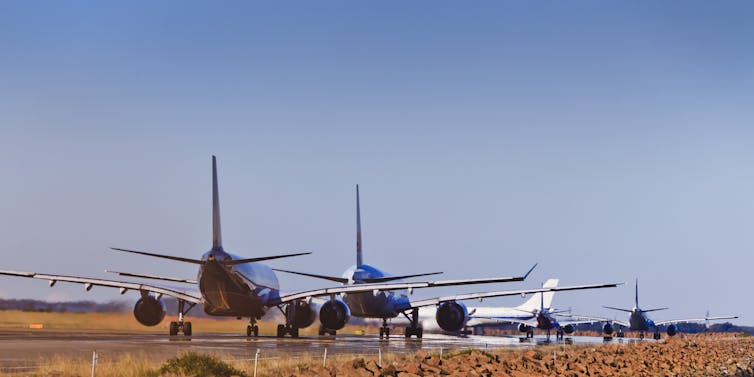
It’s been a depressing year for regional aviation. Rex Airlines has just become the second Australian airline to go into voluntary administration this year, after Bonza’s collapse in April.
Is Qantas’ chief executive Vanessa Hudson right – that there simply aren’t enough passengers in Australia to support more than three airlines?
That’s certainly a convenient narrative for the members of our domestic airline duopoly, Qantas and Virgin Australia, who now face even less competition.
Or did Rex fall victim to other airlines’ strategic management to limit the number of airport slots available to them to successfully fly between the capital cities? This practice is known as “slot hoarding”.
On Thursday, the former chair of the the Australian Competition and Consumer Commission (ACCC), Rod Sims, seemed to think so, telling ABC radio:
The government outsources the management of the slots at Sydney airport to a company that’s majority-owned by Qantas and Virgin, it is just unbelievable.
It’s certainly not a new allegation. Rex, Bonza, and the ACCC have all previously raised concerns.
So how exactly do airline slots work, and does the system need reform?
Read more: Rex Airlines' future up in the air amid questions about viability of small airlines in Australia
What are slots?
Back in the 1970s, the International Air Transport Association (IATA) developed the airline slot system to reduce airport congestion. The aim was to improve the traffic flow during peak travel times at “level 3” high traffic density airports – a category that includes Sydney and Melbourne.
Under the system, airlines are allocated a daily number of slots they can use. Importantly, there is a set amount of slots available, as they represent specific time windows for aircraft to take off or land.
Airlines schedule their slots ahead of time as part of a yield management program. This plan looks across the whole calendar year, taking into account projected peak and off-peak travel times for business and leisure travellers.
An airline owns the time slot it is designated by the airport infrastructure capacity, whether it gets used or not.
The IATA system relies on what’s called the “80/20 rule”, which states an airline must use 80% of its allocated slots or it will loose its unused slots. The 20% is a buffer. But it has been criticised as overly generous.
Airlines can also buy sell or lease, slots they are not using due to slow demand or the need for financial gain. These can sell for huge sums.
Can slots be hoarded?
Broadly speaking, slot hoarding is the practice of booking slots for use only to cancel them in bad faith, preventing other airlines from getting access to premium travel times.
In June last year, Rex’s then-deputy-chairman John Sharp accused Qantas of engaging in the practice:
It’s as plain as the nose on your face that Qantas is hoarding slots by cancelling sufficient flights to remain within the 80/20 rule.
Slot availability is a particular issue for Sydney Airport, because takeoffs and landings are capped at 80 per hour.
Sydney Airport Corporation’s executive general manager of aviation, Robert Wood, as well as the airport’s then-chief-executive Geoff Culbert also both expressed serious concerns about slot use last year.
In February this year, the federal government unveiled a range of reforms for Sydney airport’s slot system. These included requirements for increased transparency on how slots are used, and new independent audits.
Notably though, the government made no change to the 80/20 rule.
What needs to change?
A number of further reforms could help make the airport system friendlier to new entrants and more equitable.
One possibility is to sell a predefined number of slots to the major participating airlines. Airlines would have to make a business case outlining their proposed needs over the next calendar year.
Currently, airlines request slots from the airport slot management team at no cost to the airline, a system which favours established airlines that have met the 80/20 rule.
But a key criticism of this proposal is that the cost of purchasing slots would be passed down to the flying public, likely resulting in higher airfares. Bidding for slots would also add new cost barriers to entry for would-be startup challengers.
Another possibility is to look at slot allocation based on fairness, measuring an airline’s needs against airport infrastructure.
Airlines that had historically used 80% of their allocated slots would be given priority bidding on up to 50% of the following year’s total airport slot allocation.
The remaining 50% of slots could be prioritised for new airlines without an established history, with the goal of awarding them take off and landing times that aren’t necessarily premium, but close enough.
Airlines that didn’t achieve this 80% target or were found to be abusing the slot hoarding rules would be removed from the top-tier fairness status and placed in a slot allocation “sin bin” until their performance measures were brought up to standards.
Australia has challenges ahead for domestic flights that are already at capacity. Government reforms that provide better oversight of airport usage of the 80/20 rule could help mitigate the risk of anti-competitive behaviour.
Australian airlines have the right to compete without feeling unfairly held back, and we as consumers have the right to reasonable airfares.
Read more: What just happened to Bonza? Why new budget airlines always struggle in Australia
Authors: Doug Drury, Professor/Head of Aviation, CQUniversity Australia