

Transnational deceit and a cast of narcissists propel Jessie Tu’s new novel The Honeyeater
- Written by Jessica Gildersleeve, Professor of English Literature, University of Southern Queensland
The Honeyeater is Jessie Tu’s second novel, following A Lonely Girl is a Dangerous Thing (2020). It moves between Paris, Sydney and Taipei, unravelling a story of deceit and confusion, as its protagonist, Miss Fay C, struggles to establish her identity among a cast of narcissists. Its transnational scope and powerful intimacy justify the accolades Tu has received and her growing success on the literary scene.
Review: The Honeyeater – Jessie Tu (Allen & Unwin)
Fay works as a translator and an academic at a well-regarded university in Sydney. Her life appears to be largely limited to her work, which makes her feel stifled and exhausted, and her similarly suffocating home life with her mother. She has recently had an affair with a man who remains unidentified until some way into the novel. But this relationship has also left her feeling unheard and unappreciated. These themes of restriction, subservience and self-effacement take a range of forms in the novel, as Fay struggles to assert herself and move out of these various imposing shadows.
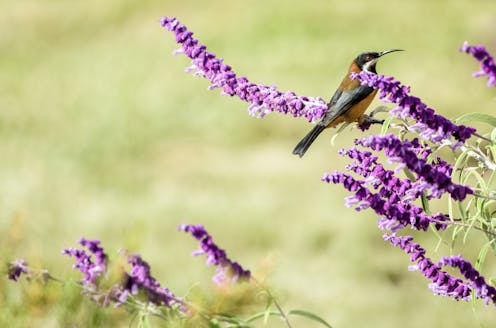
This is evident in the ironic title of the novel. “My honeyeater” is the affectionate nickname Fay’s married lover bestows on her. The name implies Fay possesses Dionysian qualities, but this is not the impression given at any other point in the book. Fay only gratefully sips at the honey offered to her by others, never seeking her own pleasure.
That her lover settles on “honeyeater” after Fay protests at being termed “blackbird” should not be overlooked. He had cast her as his “blackbird” after reciting Wallace Stevens’ Thirteen Ways of Looking at a Blackbird, a poem which exhibits shifts in meaning made by subtle alterations of perspective and the capacity of language to conjure – indeed, to pin down – its object.
In this sense, Fay belongs to her lover. But perhaps more significantly, “honeyeater” is not an epithet Fay’s lover uses only for her. He adopts it for at least one other lover as well, implying that Fay’s qualities are generic, replaceable. The honeyeater is not even a specific bird, but rather a family of birds, a detail that underscores his lack of interest in her as an individual. Fay’s lover calls all of his lovers the same name, gives them the same gifts, meets them in the same place (his office) – there is no intimacy or specificity about their relationship at all.

 Jessie Tu.
Sarah Wilson/Allen & Unwin
The invisible double
Fay’s view on translation is one of fidelity to the parent text: the “translator should become the author’s double”. There is no emphasis on the translator, who becomes “invisible”:
You are the bridge between two cultures. What I didn’t know was that I’d always remain on the bridge – never settling on either side of the bank.
In this sense, she and her mother are similar. Fay’s mother
is a cleaner, after all. Cleaners slip in and out of offices and homes, silent, operating under the optics of everyday life.
Her lover, on the other hand, prioritises his own interpretation over the original work – one of the things that prompts Fay’s eventual realisation that he is
a narcissist. Everything began and ended with him at the centre – he was the sun in every solar system.
Fay has not just been the “author’s double”. She has also been the double of those around her, perhaps most significantly the Professor. Fay’s insistence on referring to the Professor by her title rather than her name signifies the older woman’s power and authority. Fay is her student in every sense; she has been shaped entirely by the Professor’s wishes:
I think of the ways I have given into her suggestions over the years like a dutiful protegee: “Read this”, “Taste this”, “Watch this”, “Listen to this”. I was her experiment, an animated reflection of her own tastes and styles. And I complied […] Perhaps by being so agreeable, I have somehow rubbed out my own identity.
Despite Fay’s codependent relationship with her mother, there is a distinction between her respective relationships with the two women. She and the Professor argue about meaning and word choice, indicating that they do not really speak the same language. Fay and her mother “speak Mandarin when we are in public, a secret code between us”. Fay’s mother prays for her daughter and tries to protect her; the Professor only lies, uses and prevaricates.
Fay eventually returns to Sydney after attending a major international translation conference in Taipei, where the conflict between Fay and the Professor reaches its climax. But does she “escape” or does she “run away”? This is a distinction Fay struggles with in her translation of Beef on Naan. Fay’s mother has named her after the Taiwanese word for “fly”, but what does it mean for this honeyeater to fly? The magnolia Fay gifts her mother at the novel’s end suggests that she returns the desire for protection, ultimately choosing a parental relationship of care and understanding over romance tinged with power.
If Beef on Naan is, as Fay’s mother observes, a novel about growing up, the same is true of The Honeyeater. It is a bildungsroman condensed into the space of three months. Fay has been sheltered and fearful, but (as Fay herself meditates) the events of the novel “thrust or shove” her into adulthood. Much has ended, but this ending looks more like freedom.
Authors: Jessica Gildersleeve, Professor of English Literature, University of Southern Queensland
Jessie Tu.
Sarah Wilson/Allen & Unwin
The invisible double
Fay’s view on translation is one of fidelity to the parent text: the “translator should become the author’s double”. There is no emphasis on the translator, who becomes “invisible”:
You are the bridge between two cultures. What I didn’t know was that I’d always remain on the bridge – never settling on either side of the bank.
In this sense, she and her mother are similar. Fay’s mother
is a cleaner, after all. Cleaners slip in and out of offices and homes, silent, operating under the optics of everyday life.
Her lover, on the other hand, prioritises his own interpretation over the original work – one of the things that prompts Fay’s eventual realisation that he is
a narcissist. Everything began and ended with him at the centre – he was the sun in every solar system.
Fay has not just been the “author’s double”. She has also been the double of those around her, perhaps most significantly the Professor. Fay’s insistence on referring to the Professor by her title rather than her name signifies the older woman’s power and authority. Fay is her student in every sense; she has been shaped entirely by the Professor’s wishes:
I think of the ways I have given into her suggestions over the years like a dutiful protegee: “Read this”, “Taste this”, “Watch this”, “Listen to this”. I was her experiment, an animated reflection of her own tastes and styles. And I complied […] Perhaps by being so agreeable, I have somehow rubbed out my own identity.
Despite Fay’s codependent relationship with her mother, there is a distinction between her respective relationships with the two women. She and the Professor argue about meaning and word choice, indicating that they do not really speak the same language. Fay and her mother “speak Mandarin when we are in public, a secret code between us”. Fay’s mother prays for her daughter and tries to protect her; the Professor only lies, uses and prevaricates.
Fay eventually returns to Sydney after attending a major international translation conference in Taipei, where the conflict between Fay and the Professor reaches its climax. But does she “escape” or does she “run away”? This is a distinction Fay struggles with in her translation of Beef on Naan. Fay’s mother has named her after the Taiwanese word for “fly”, but what does it mean for this honeyeater to fly? The magnolia Fay gifts her mother at the novel’s end suggests that she returns the desire for protection, ultimately choosing a parental relationship of care and understanding over romance tinged with power.
If Beef on Naan is, as Fay’s mother observes, a novel about growing up, the same is true of The Honeyeater. It is a bildungsroman condensed into the space of three months. Fay has been sheltered and fearful, but (as Fay herself meditates) the events of the novel “thrust or shove” her into adulthood. Much has ended, but this ending looks more like freedom.
Authors: Jessica Gildersleeve, Professor of English Literature, University of Southern Queensland 
















