We reviewed 100 studies about little kids and screens. Here are 4 ways to help your child use them well
- Written by Sumudu Mallawaarachchi, Research Fellow, ARC Centre of Excellence for the Digital Child, University of Wollongong
Screen time is one of the top worries for Australian parents. In a national February 2021 poll by the Royal Children’s Hospital Melbourne, parents rated it as the number-one health issue facing their children.
Our previous research also shows parents feel guilty about screens, even though they are all around us.
At the same time, guidance on what parents should be doing is confusing. According to the World Health Organization and the Australian government, young children’s screen time should be limited to no more than one hour per day for two- to five-year-olds, while children under two shouldn’t be exposed to screens at all.
But the UK Royal College of Paediatrics and Child Health has said it is “impossible to give comprehensive national guidance or limits” because the effect of screens depends so much on context and the evidence is uncertain.
This made us wonder what else matters for children’s healthy development beyond “screen time”. So we gathered all available evidence on the context in which children use screens.
Our research
In our new research, published in JAMA Pediatrics, we reviewed 100 studies on the influence of screen use contexts on the cognitive (brain), social and emotional development in children from birth to five years. The screens included TV, computer games, smartphones and tablets.
These studies, published between 1978 and 2023, involved more than 176,000 children and their families from 30 countries. This included the United States, United Kingdom, China, Canada, Japan and Australia.
From this, we distilled four research-based ways parents can help their children use screens in healthy ways.
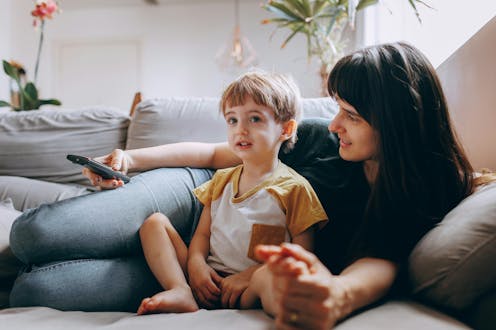
1. Make screen time together time
The studies we analysed show that if children and caregivers use screens together (also called co-viewing or co-use), it is beneficial for children’s thinking and reasoning skills. It is especially beneficial for their language development, including the number of words children know, their social communication skills, language understanding and processing.
When you watch together you can have conversations about what children are seeing or doing, help them understand the content (for example, “Why did Bluey hide that from Chilli?”) and draw connections to the real world (“How do you think Bingo is feeling right now?”). This can help their language development and learning.
2. Choose age-appropriate content that encourages play
Not all screen time is “bad” but we should consider the content and how it might influence a child’s development and behaviour.
Our research found a link between children watching age-inappropriate content and poor social skills and behaviour.
This highlights the importance of purposeful and high-quality screen experiences for children. Parents might ask themselves, what age or developmental stage is the content designed for and does it promote learning and development (for example, Sesame Street)?
Does it stimulate imaginative play and creativity in the real world (such as Playschool)? Does the content have positive social messages (Bluey)? Does it encourage movement like dancing to music (Ready, Steady, Wiggle)?
Avoiding violent content and content for mature audiences is key, and parents can use trustworthy guides like those from Common Sense Media if they have any doubts.
3. Don’t let screens get in the way of parent-child interactions
Mobile technologies mean children can use screens almost anywhere and anytime. The same is also true for parents.
Sometimes parents’ screens can interfere with conversations and connections between them and their child. In our study, children had better social skills, behaviour and ability to regulate their emotions when parents avoided screen use during interactions and routines like family meals.
When parents are distracted, it can affect the quality and quantity of interactions with their child.
4. Don’t have the TV on in the background
Children learn from their environments and background TV may divert a child’s attention from play and learning. Our research found children had better thinking, reasoning and language abilities when there was less background TV in the home.
This can also be because of less conversations between parents and children when there is a TV on in the background.
So, when the TV is not actively being watched, consider turning it off so children can play, listen and learn.
Jade Burley co-led the research described in this article.
Authors: Sumudu Mallawaarachchi, Research Fellow, ARC Centre of Excellence for the Digital Child, University of Wollongong