Romans were terrified by war elephants at first – but eventually found a way to defeat them in battle
- Written by Michael B. Charles, Associate Professor, Management Discipline, Faculty of Business, Arts and Law, Southern Cross University
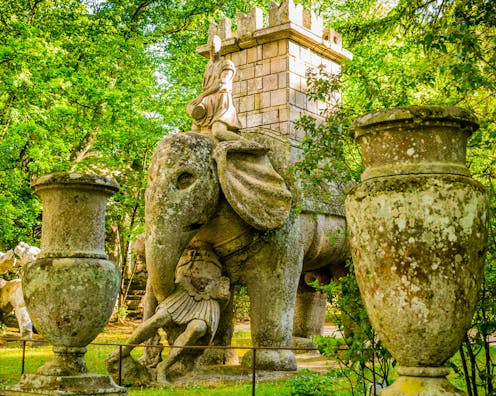
Imagine, for a moment, you are a Roman soldier at war. In the midst of battle, you are confronted with an enormous and loudly trumpeting creature you’ve never seen before.
It appears to have sharp spears protruding from either side of its mouth and a bizarre, powerful limb extending from its face. Armed men ride atop this towering beast, which, running toward you at speed, is crushing your comrades underfoot.
Roman soldiers were reportedly terrified the first time they faced war elephants on the battlefield. It’s hard not to feel bad for the elephants too, as using animals this way in war is undoubtedly cruel.
But Rome’s enemies, particularly various Hellenistic kingdoms and the Carthaginians, did indeed use war elephants. So, how did they acquire and deploy them in battle – and how did the Romans respond?
Alexander encountered war elephants in India
Alexander the Great brought elephants back to the Mediterranean world after campaigning in northern India, where elephants had been used for centuries in warfare – and would be used for centuries to come.
Alexander had fought against an elephant-equipped army at the Battle of the Hydaspes (in modern-day Pakistan) in 326 BCE and had obviously been impressed by the animals. So began the ancient Mediterranean world’s (rather misguided) fascination with war elephants.
Many of the so-called Successor kingdoms that arose in the Hellenistic world in the wake of Alexander’s death in 323 BCE – such as the Seleucids of Syria, the Ptolemies of Egypt and the Antigonids of Macedonia – enthusiastically incorporated the Asian elephant (Elephas maximus) into their ranks. So equipped, they often went to war with each other.
Most of these elephants had to be imported from friendly Indian kingdoms, although the Ptolemies of Egypt eventually secured African elephants from beyond the southern borders of their kingdom after their rivals, the Seleucids, cut them off from Asian supplies.
One Greek leader who equipped his army with war elephants was King Pyrrhus of Epirus, who eventually went to war with the then-emerging power of Rome – and reportedly introduced them to war elephants.
Romans meet elephants
Pyrrhus – from whose name we get the phrase “Pyrrhic victory”, meaning to win the battle but at great cost – met the Romans several times in combat.
His army beat the Romans at Heraclea in southern Italy not far from Tarentum in 280 BCE, where Pyrrhus’ elephants supposedly terrified the Roman cavalry. He defeated the Romans again in Asculum 279 BCE (this was the battle that gave us the phrase “Pyrrhic victory”).
Pyrrhus later met the Romans at Beneventum (southern Italy) in 275 BCE. This time, the Romans were better prepared. Though initially successful in forcing back the Roman forces, the elephants – eventually tormented by the missile weapons of the Romans – ran back and stampeded Pyrrhus’ own men.
This revealed perhaps the biggest weakness of using elephants in battle: they could be as much danger to their own side as to the enemy.
Hannibal, the Carthaginians and war elephants
The Romans next faced off against the growing Carthaginian threat coming from north Africa in the Punic Wars.
The Carthaginians had no ready access to Asian elephants, so they procured their elephants more locally, such as in the Atlas Mountains, spanning Morocco, Algeria and Tunisia.
This population of elephants is now gone. They were once assumed to be African forest elephants (Loxodonta cyclotis), smaller than both the Asian elephant and the very large African bush or savanna elephant (Loxodonta africana). After looking at a variety of evidence in my research, I believe these north African elephants were either bush elephants or a subspecies that closely resembled them.
The Carthaginians made some use of elephants during the First Punic War, such as in the battle at Bagradas River (255 BCE) in modern Tunisia. Here, around 100 elephants helped to crush a Roman expeditionary force. But at a later battle at Panormus (250 BCE) in Sicily, the Carthaginians’ elephants characteristically turned on their own troops.

During the Second Punic War, the famed Carthaginian general Hannibal Barca famously took 37 elephants across the Rhône and the Alps into northern Italy.
Hannibal’s elephants were posted towards the wings of his formation at the Battle of the Trebbia River against the Romans in 218 BCE. The degree to which the elephants contributed to Hannibal’s victory here is uncertain, but they almost all died during the subsequent harsh winter.
Hannibal seems to have received more elephants to continue the fight in the Italian peninsula after his rout of the Roman legions at the Battle of Cannae in 216 BCE.
But Rome had an ace up her sleeve: the young Roman general Scipio.
Scipio was born Publius Cornelius Scipio but later, after his African campaign, became known as Scipio Africanus. He had been successful against the Carthaginian forces in Spain, where Rome’s enemy had used elephants (albeit in small numbers).
Rome’s plan was to send Scipio to Africa with a large expeditionary force, and draw Hannibal out of Italy to defend his home turf.
Hannibal took the bait and rebuilt his armies in readiness for the ultimate showdown. Among his recruits were at least 80 elephants, likely captured only recently, and thus unlikely to be as well trained as his earlier ones.
Scipio and Hannibal’s forces met at Zama (in what is now Tunisia) in 202 BCE. Hannibal drew up his 80 or so elephants in front of his battle line.
But Scipio was prepared. He had arranged for passages or pathways to be set up between the heavy infantry of the legions.
These passages were filled with highly mobile missile-armed light infantry. When the elephants charged, the light infantry ran to the rear or clung to the sides of the legionary formations to reveal the passages.
The elephants were ushered through these passages while being assailed with the light infantry’s missile weapons.
Some of the maddened beasts supposedly fell back on the two wings of Hannibal’s force, causing considerable confusion and damage to their own cavalry.
Elephants are a double-edged sword
Overall, war elephants in the ancient Mediterranean world could be useful against infantry – and especially horses – that had not experienced them before.
But once that initial fear was mastered, elephants often proved to be a double-edged sword, trampling their own side’s men.
Elephants also require prodigious amounts of water and feed, and slowed down the armies that travelled with them.
This is likely why the Romans, who relied heavily on the mobility of their troops, decided against incorporating elephants into their own ranks.
Authors: Michael B. Charles, Associate Professor, Management Discipline, Faculty of Business, Arts and Law, Southern Cross University