

Tiny fossil arm bone sheds light on evolution of ancient Indonesian ‘hobbits’
- Written by Adam Brumm, Professor of Archaeology, Griffith University
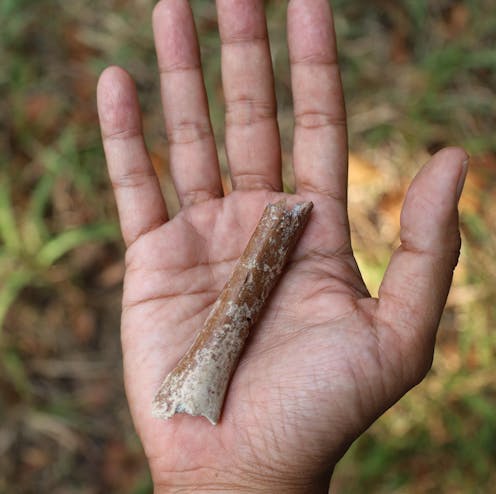
We have discovered rare and very old human fossils on the Indonesian island of Flores, including an astonishingly small adult limb bone. Our finds are reported in a new paper out today in Nature Communications.
Dated to around 700,000 years old, these findings throw new light on the evolutionary history of Homo floresiensis, the so-called “hobbits” of Flores who inhabited this small island east of Bali as recently as 50,000 years ago.
A strange new human
In 2003, an archaeological dig co-led by the late Australian–New Zealand archaeologist Mike Morwood unearthed the fossils of a previously unknown species of early human at Liang Bua cave on Flores. Named Homo floresiensis, these humans were extremely short, with tiny brains and a host of unusual features.
Nothing like this had ever been found before, so the origins of the creature were disputed. Scientists argued over whether the remains belonged to a new human species or a modern person with a pathological condition. One professor even claimed the “hobbit” had a recent dental filling.
More sober-minded assessments suggested Homo floresiensis was a dwarfed descendent of Asian Homo erectus from nearby Java. Other palaeoanthropologists argued Homo floresiensis had evolved from an earlier and more primitive African hominin, perhaps Homo habilis or Australopithecus afarensis (or “Lucy”).
Digging for pre-“hobbit” ancestors
In an attempt to resolve this puzzle, we searched for fossils of “hobbit” ancestors in the So’a Basin. This is an area of tropical grasslands east of Liang Bua where stone artefacts dating to at least a million years ago have been found.
In 2016, after years of digging at a site named Mata Menge, we reported the first early human fossils from outside Liang Bua: several isolated teeth and a jaw fragment found in a layer of sandstone around 700,000 years old.

Pre-dating the Liang Bua hominins by 650,000 years, the Mata Menge fossils belonged to at least three individuals with even slightly smaller jaws and teeth than Homo floresiensis, implying small body size evolved very early on Flores.
 The dig at Mata Menge, where fossils of extinct animals occur alongside stone artefacts in hard sedimentary layers deposited by small streams. The fossil deposits date to between around 700,000 years ago to as early as 773,000 years ago. In the foreground are tusks and limb bones of stegodonts, an extinct relative of elephants.
A. Brumm
The dig at Mata Menge, where fossils of extinct animals occur alongside stone artefacts in hard sedimentary layers deposited by small streams. The fossil deposits date to between around 700,000 years ago to as early as 773,000 years ago. In the foreground are tusks and limb bones of stegodonts, an extinct relative of elephants.
A. Brumm
But as we had not found any bones from below the head, we could not confirm our inference that these So’a Basin hominins were at least as diminutive as Homo floresiensis, if not even slightly smaller.
It was also unclear what species the fossils belonged to, owing to the limited skeletal elements at hand. However, some of the Mata Menge teeth seemed to be intermediate in form between early Asian Homo erectus and Homo floresiensis.
The new fossils
In 2013, before the teeth and jaw fragment, we had found a tiny limb bone fragment broken into several pieces in the 700,000-year-old fossil layer at Mata Menge.
We initially thought it was from a reptile, until in 2015 the curator of fossils at the Geology Museum in Bandung, Indra Sutisna, restored the bone fragment and recognised it as the shaft of a human upper arm bone. This was later confirmed by one of us (Kaifu), although initially it was thought to belong to a child because of its extremely small size.
 The 700,000-year old adult humerus fragment from Mata Menge.
Y. Kaifu
The 700,000-year old adult humerus fragment from Mata Menge.
Y. Kaifu
After years of analysis and a long hiatus in research caused by the pandemic, we can now report that this fossil is the distal shaft of an adult humerus (or, in everyday terms, the lower half of an upper arm bone).
The fossil limb bone provides a wealth of evidence about the body size evolution of Homo floresiensis.
The microscopic structure of this tiny bone indicates it came from an adult. Based on the estimated length of the bone (206–226mm), we were able to calculate this hominin was about 100cm tall.
A skeleton of 60,000-year-old Homo floresiensis, the type specimen found at Liang Bua, was estimated to be around 106cm tall, based on the length of its thigh bone. (Based on its arm bones, its height would be estimated at around 111.5cm.)
 The Mata Menge humerus fragment (left) shown at the same scale as the humerus of Homo floresiensis from Liang Bua.
Y. Kaifu
The Mata Menge humerus fragment (left) shown at the same scale as the humerus of Homo floresiensis from Liang Bua.
Y. Kaifu
This confirms our hypothesis that an early form of Homo floresiensis was already extremely small in stature. In fact, the Mata Menge humerus is not just shorter than that of the type specimen of Homo floresiensis, it is the smallest upper arm bone known from the hominin fossil record worldwide. It is now apparent that the early progenitors of the “hobbit” were even smaller than we had thought.
Two additional hominin teeth from Mata Menge are also small in size and one bears shape characteristics most consistent with early Homo erectus of Java. This does not support the hypothesis that Homo floresiensis evolved from a pre-erectus hominin, the likes of which have never been found in Southeast Asia.
The beginnings of Homo floresiensis
The Mata Menge human remains, which now total ten fossil specimens, are from at least four individuals (including two children). The teeth are rather similar anatomically to those of the Liang Bua Homo floresiensis, as is the arm bone fragment. Hence the Mata Menge hominin should probably be thought of as an older variant of this hominin – though its teeth do not have some of the changes found in the latter Liang Bua Homo floresiensis.
It is certainly evident that extreme body size reduction occurred very early in the history of the Flores hominins – by at least 700,000 years ago.
We should note that the Mata Menge arm bone is not necessarily Homo erectus-like. It more resembles small-bodied Homo such as Homo floresiensis and Homo naledi.
But the Liang Bua hominins were very odd quirks of evolution. They display a mixture of archaic and modern traits, some that hint at their descent from Homo erectus and others that imply they evolved unique characters over long isolation.
The latter include not only small body and brain sizes but also apparently primitive limb proportions (a combination of longer arms and shorter legs) as well as advanced or “hyper-modern” molar morphology.
In our view, the new fossils from Mata Menge confirm the hypothesis that a group of early Asian Homo erectus somehow became isolated on Flores and underwent a remarkable process of evolutionary change, giving rise to Homo floresiensis.
But the fossils are few and fragmentary and hence the history of the Flores hominins is not known with certainty. The picture may change dramatically if we are lucky enough to find a partial skeleton or even a more substantial portion of a skull at Mata Menge or elsewhere in the So'a Basin.
Authors: Adam Brumm, Professor of Archaeology, Griffith University

















