How the US election turned ‘weird’ – and why it’s working for the Democrats
- Written by Kate Burridge, Professor of Linguistics, Monash University
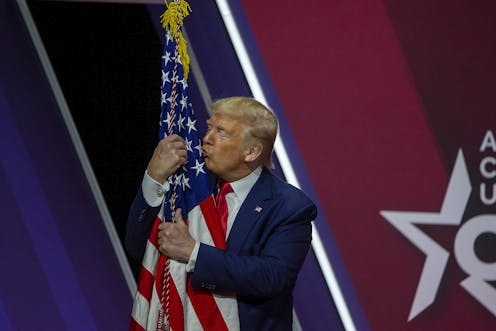
The Democrats have discovered a secret sauce in their campaign against Donald Trump and the MAGA mob — suddenly media headlines are splashed with references to “weird”. For example:
The label "weird” – while established in this campaign by newly minted Democratic vice-presidential candidate Tim Walz – had already made a few earlier memorable appearances.
Notably, in 2017, at the end of Trump’s inauguration speech, George W. Bush was famously reported as describing the new GOP reality as “weird shit”. This new reality coincided with Merriam-Webster’s choice of “surreal” as the Word of the Year (defined as “marked by the intense irrational reality of a dream”). These editors base their Word of the Year selections on what sends people to the dictionary — and “surreal” had major spikes in look-ups following the election result.
Words are reality-describing-and-creating tools. Whether you think Trump and the modern GOP have created a “weird” reality will depend on your politics. But the Democrats have scored a linguistic rare win by describing them as “weird”.
Why does it work? We show here that “weird” is a spicy cocktail of emotional framing, destiny and red meat politics.
Political protein versus empty calories
The choice of one word can have a significant impact on your audience. Fifty-one percent of Americans approve of “personalising” social security, whereas only 34% approve of “privatising” it — even though these words point to the same thing.
To these ends, right-leaning politicians and their supporters have dominated the language game.
Whether it’s Mitt Romney’s “makers” and “takers”, Joe Hockey’s “lifters” and “leaners” or David Cameron’s “shirkers” or “workers”, it’s clear who is carrying whom in this world of “glittering generalities”.
For their part, the political left blame “neoliberals” — a much vaguer bogeyman in a sea of jargon and white-jamming (“the flooding of the information space with conflicting and confusing information”).
The left (and the right) warn of “fascists” and “fascism”, but again we run into a problem of a vague concept with non-shared meaning.
This isn’t a new problem. In his 1938 book The Tyranny of Words, economist and social theorist Stuart Chase argued that when we talk about “democracy”, “freedom”, “socialism” or “fascism”, we don’t all mean the same thing.
Chase interviewed 100 people about “fascism” in the 1930s and found little agreement. He cautioned: “Multiply the sample by ten million and picture if you can the aggregate mental chaos.”
Herein lies the trouble with language for the Democrats — and perhaps why “weird” works so well. Anthropologist Ted Carpenter wrote
Language is the storage system for the collective experience of the tribe […] This involves [a speaker] in the reality of the whole tribe […] in an echo chamber.
Whether we are right-wing people, left-wing people or the so-called exhausted majority, we have our own languages and dwell in our own echo chambers. But we all feel like things are “weird” right now. Unlike “neoliberalism” or “fascism”, we don’t have to think about it or imagine it. In a world of aggregate political chaos, we all have “weird” as a collective experience.
It goes without saying that both the GOP and Democrats have contributed to “weirdness” this year. However, with President Joe Biden dropping out of the race, the Democrats can — at least for the time being — assert a claim to not being the “weird” ones.
“Don’t think of an elephant” – an elephant
Linguist George Lakoff has famously pointed out that if you tell a voter not to think of an “elephant”, that’s exactly what they’ll do. He argues it is important, if not critical, to avoid using the language of your opponent.
The American right have excelled at getting the left to use their language and framing. Whether it’s “tax relief” or shifting the discussion from “global warming” to “climate change” (which focus groups suggest is less scary), the right have dominated the language landscape and consequently how an issue is framed.
However, with “weird”, the Trump campaign is falling into the exact trap the Republicans has been setting for the left for years. Donald Trump junior, in pushing back against this narrative, tweeted:
As David Karpf, strategic communications professor at George Washington University, points out, responses like these show how “weird” has frustrated opponents, “leading them to further amplify it through off-balance responses”. In short, they are responding by telling voters, “don’t think of an elephant”.
“Weird”: an odd destiny
So how did “weird” become the meaty main course of current political discourse? Clues lie in its early history.
In Anglo-Saxon times, the word (originally “wyrd”) was “fate or destiny” — and it was a big deal at the time. The following line from the epic poem Beowulf describes how the hero is about to take on the hideous monster Grendel. We are left asking, will “weird” take him down, or will Beowulf triumph?
Gæð a wyrd swa hio scel (literally, “weird (=fate) goes always as she must”)
It was the unknowable and random nature of fate that drove the shift to our modern understanding of the adjective: “deviating from the normal, strange, odd”. But with its lingering overtones of the unpredictable and the creepy, Germanic “weird” is also unsettling in ways that French-inspired “bizarre” and “strange” are not. And its Germanic ordinariness also makes it less sniffy and less smug.
The flourishing of entries in the crowd-sourced online Urban Dictionary certainly suggests “weird” connects with a large segment of the population. It has more impact than “strange” and “bizarre” – and in the political arena, it packs a stronger protein punch than labels such as “felon”, “rapist”, “Nazi”, “liar” and “fascist”.
Yet “weird” is no cry of alarm — more a gesture of scorn and disregard, and this is its strength. Small wonder the Democrats in their interviews and online presence are turning up the volume on the “weird” dial.
Dialling for red meat
Of course, this “weird” discourse will not resonate with everyone. And herein lies the final stroke of genius with this narrative. As Anand Giridharadas has pointed out, political polling often focuses on whether a message increases or decreases support among base, opposition and moderate voters.
Anat Shenker-Osorio, a political consultant for the left, notes that Democrats have historically gone with messaging that increased support among all three groups. This contrasts with the approach taken by the right, which is to find a message that animates the base, persuades the middle and reduces support among your opposition.
Political communications consultant Frank Luntz, largely responsible for this right-wing polling and approach, has reputedly said of his polling approach, “I dial for the red meat.”
Authors: Kate Burridge, Professor of Linguistics, Monash University