Liked to death? The social media race for nature photos can trash ecosystems – or trigger rapid extinction
- Written by Robert Davis, Senior Lecturer in Wildlife Ecology, Edith Cowan University
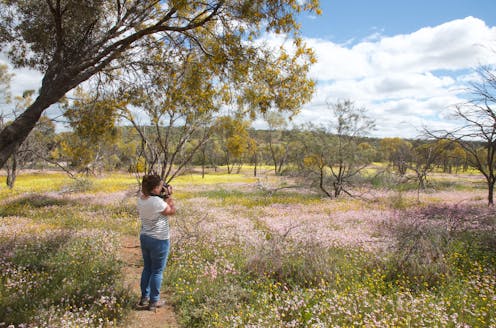
Have you ever liked or shared a social media post about nature? It could have been a photo of a rare orchid or an unusual bird. Or you might share a stunning photo of an “undiscovered” natural place.
It feels good to do so. You’re sharing something beautiful, an antidote to negativity. But not even this simple act is problem-free.
Social media have become a huge force. It’s come with many positives for nature, such as greater visibility and interest in citizen science and public knowledge about the species we share the planet with. Australia’s largest citizen science project, the Aussie Bird Count, collected reports of 3.6 million birds in backyards in one week, for example, making good use of social media.
There is, unfortunately, a dark side to this effortless sharing of information. It is possible to love species to death, as our new research has found.
How? Viral photos of undisturbed natural beauty can lead thousands of people to head there. As more people arrive, they begin destroying what they loved seeing on screen.
And then there’s the competitiveness among photographers and content-makers hoping to gain influence or visibility by posting natural content. Unethical techniques are common, such as playing the calls of rare bird species to lure them out for a photo.
Social media do not directly cause damage, of course. But the desire for positive feedback, visibility or income can be very strong incentives to act badly.
Can social media really damage species?
The critically endangered blue-crowned laughingthrush now lives in only one province in China. Its wild population is now around 300.
So many people went to find and photograph this rare bird that the laughingthrush was forced to change how it nested to avoid flashlights and the sound of camera shutters.
Or consider bird call playback. For scientists, playing a bird’s calls is a vital tool. You can use calls to entice seabird colonies back to former nesting grounds or to monitor threatened or hard-to-spot species.
It’s very easy for birdwatchers and photographers to misuse this power by using bird ID apps and a speaker to draw out rare species. It might seem harmless, but drawing shy woodland birds out into the open risks predation, or can entice a mother off her nest. Playing calls can also make birds aggressive, change important behaviours, or disrupt their breeding.

Baiting, drones, poaching and trampling
The list of bad behaviours goes on and on.
Wildlife photographers are known to use baiting to get their photo – putting out food sources (natural or artificial), scent lures and decoys to boost their chances. But when baiting is done routinely, it changes animal behaviour. Baiting by tourist operators who offering swimming with sharks has led to reduced gene flow, changed shark metabolism and increased aggression.
Drone photography, too, comes with problems. Drones terrify many species of wildlife, causing them to break cover, try to escape or to become aggressive. In Western Australia, for instance, an osprey suffered injuries after a photographer flew their drone into it.
Then there are the world’s rare or fragile plants. Social media give us beautiful images of wildflower meadows and rainforests. But when we collectively go and see these places, we risk trampling them. Unlike animals, plants can’t run away.
Take orchids, a family of flowering plants with many human admirers. During the 18th century, “orchidelerium” gripped Europe. Rich people paid orchid hunters to roam the globe and collect rare species.
In our time, orchids face a different threat – social-media-driven visitors. Orchids are very particular – they rely on specific fungal partners. But this makes them highly vulnerable if their habitat changes. One study found that of 442 vulnerable orchid species, 40% were at risk from tourism and recreation.
Sharing locations is a big part of the problem. Even if you deliberately don’t make reference to where you took the photo, the GPS co-ordinates are often embedded in a photo’s metadata.
In 2010, a new species of slipper orchid (Paphiopedilum canhii) was discovered in Vietnam. Photos with location information were posted online. Just six months after discovery, more than 99% of all known individuals had been collected. The orchid is now extinct in the wild.
What should be done?
Broadly, we need to talk about the need to make ethical choices in how we present nature on social media.
But there is a specific group who can help – the admins of large social media groups devoted to, say, wild orchids, birdwatching or scuba diving. Admins have significant influence over what can be posted in their groups. Better moderation can go a long way.
Site admins can make expectations clear in their codes of conduct. They could, for instance, ban photos of rare orchids until after the flowering season, or put a blanket ban on posts with locations, as well as explain how photos can have embedded location data.
Park and land managers have other tools, such as banning drones from specific areas and making it harder to access environmentally sensitive areas. There’s a very good reason, for instance, why the location of wild populations of Wollemi pines is a secret.
Many of us won’t have given much thought about how social media can damage the natural world. But it is a real problem – and it won’t go away by itself.
Dr Belinda Davis from Western Australia’s Department of Biodiversity, Conservation and Attractions contributed to this article.
Authors: Robert Davis, Senior Lecturer in Wildlife Ecology, Edith Cowan University